Category Archives: HOME

Does OFAC Really Know What They’re Doing? A War On Crypto And Privacy

Does OFAC Really Know What They’re Doing? A War On Crypto And Privacy

This month, we witnessed one of the most significant attacks on crypto privacy in the form of the US Treasury’s Office of Foreign Assets Control (OFAC) sanctioning Tornado Cash. This led to protocols blocking addresses, funds being seized, and one of the Tornado Cash developers being arrested. The action was unprecedented, given that it was the first time we have effectively had sanctions placed on a piece of open-source software – essentially, restrictions on lines of code. 

For those unfamiliar with Tornado Cash, it has long been one of the most well-known mixing protocols on Ethereum. What it would essentially do is obfuscate or camouflage transaction history. This means it would anonymize transactions and remove all traces of where funds originated. Thousands of people used this privacy tool in the Defi space.

Unfortunately, it was also used for laundering the proceeds of cybercrime, which is the use case the Treasury focused on, stating that Tornado was a favorite tool of North Korean hackers and had been used to launder more than $7 billion. 

The moment Tornado was sanctioned, its website was taken down, and the code disappeared from GitHub. Not only that, but one of the contributors had his GitHub account banned. Circle blacklisted any USDC in the affected wallets, and RPC providers such as Infuror and Alchemy started blocking requests to Tornado Cash Smart contracts. 

Additionally, some decentralized applications also began to restrict access to their front ends for wallets that had interacted with the Tornado Cash Smart contract. For example, both Aave and dYdx reported blocking access from wallets that had interacted with Tornado Cash and even those that had received funds from it. Regarding dYdx, users who had insignificant amounts but were associated with Tornado Cash in the past were also blocked.

Dusting Celebrity Wallets Gag

Things were further complicated because someone in the community started dusting several public ETH addresses of celebrities in the space. In other words, they sent many small transactions to hundreds of known wallets associated with ETH addresses and their .ens official addresses. 

The likes of Brian Armstrong, Jimmy Fallon, and Steve Aoki were potentially committing sanctions violations by appearing to be doing business with a sanctioned protocol. What's even crazier than that is that some of those users who were subjected to the dusting found that they could not interact with Aave’s front end. These included the likes of Anthony Cesano and Justin Sun. 

The gag effectively points out the absurdity of such sanctions for users receiving funds from blacklisted addresses that they have no power to decline. The open nature of crypto is designed to cut out intermediaries, unlike the traditional financial sector that would use banks and other financial institutions to act as gatekeepers against such transactions.

Image source: eff.org

Is Code Fundamentally Free Speech? 

Perhaps the most chilling development, at least so far, was the arrest by Dutch police of one of Tornado Cash’s developers. Alexey Pertsev was picked up by the Dutch Fiscal Information and Investigation Service (FIOD) two days after Tornado Cash was sanctioned. The Dutch police have yet to clarify which exact rules Pertsev broke, but if it's just because he wrote some code, this is a dangerous precedent for several reasons. Furthermore, he is still detained and forbidden from communicating with his wife.  

The first thing we need to ask ourselves, however, is whether these actions by the treasury were legal. It is the first time that the treasury has effectively sanctioned a tool, a piece of Open Source Code that exists on the Ethereum Blockchain and which can be used by anyone for any purpose, albeit good or bad. Given that it is open source, that means it is akin to the likes of a public good. 

So that could be comparable to a road or a park; it would be as if OFAC were to sanction the use of an interstate highway because drug dealers drive on it. Or a more relevant example would be the treasury sanctioning the TCP IP protocol because hackers use the internet for hacking: It's impractical.

Moreover, just because a tool is sanctioned does not mean that the criminals will not use it. That's because criminals, by definition, have zero consideration for the law; they're likely to continue using the Smart contract as they see fit. Then there is the fundamental question of whether sanctioning a piece of code violates the First Amendment. 

To put it in perspective, thanks to a 1996 case Bernstein versus the DOJ, it's been established that code should be considered as speech, and if it is indeed speech, then it should be protected by the First Amendment. By sanctioning this tool, the treasury effectively says that speech itself is illegal. 

Now there is a real possibility that should someone want to challenge these sanctions, they could have a strong case in court. The Coin Center lobbying group is doing just that and believes the Treasury has overstepped its legal authority. The group wants to engage with OFAC to share their thoughts and will be exploring with counsel a court challenge. Additionally, they have had inquiries from members of Congress about the situation and are keeping the interested parties briefed on the matter. 

Furthermore, if, indeed, the only thing the developer did was write code, then that could also be seen as a violation of free speech. But if any legal challenges are mounted, they will take a long time to settle. Until then, the sanctions will have to be enforced, which means that specific Defi projects and protocols will continue blacklisting the Smart contract for fear of arrest. 
 

What Are The Practical Issues? 

Apart from the legal aspect, there is a practical consideration for how this will be enforced.  Remember, criminals will be criminals, and they will continue to use it. The code is open source and free to fork. Should that happen, the treasury will ultimately be playing whack-a-mole with a bunch of newly deployed Smart contracts. 

Not only that but those other crypto projects and protocols will also have to monitor not only the funds coming from the original Tornado Cash Smart contract but also from all the forked ones. This could quickly become a logistical impossibility, and projects will always have to worry whether any ETH they handle has gone through a forked version of the original Tornado Cash.

And speaking of which, there's also the broader question around who could technically find themselves violating OFAC rules due to these sanctions. 

If someone sends ETH from the Tornado contract to you, does that mean you are in violation? I mean, it's not like you can refuse to receive it. As we saw with those dusting attacks, protocols themselves have started blocking some of these dusted addresses. Could the Feds start going after any of those wallets that have received Tornado-tainted ETH? Could we soon see Jimmy Fallon dragged away in handcuffs? 

It's not even about addresses that have received funds. What about liquidity providers on a DEX? What happens if they unknowingly convert ETH that has been through Tornado Cash into some other cryptocurrency? Are they thus engaging with sanctioned entities? 

What about Ethereum miners? What liability did they have if they were to propagate a block that included a Tornado Cash transaction? Does that mean that they could also be flirting with illegality? Or how about that ETH that is sent to the ETH2.0 staking contract? What would that mean for Ethereum’s Proof-of-Stake? 

What happens once the transition to proof of stake is complete? Will validators have to decide to censor certain transactions that their jurisdiction deems illegal? Could they get censored? So you can see how quickly this grows out of control. The crypto space has just seen a massive can of worms open up right in front of it. 

Now, of course, there will be some who claim that these actions are justified. Swiped funds from some of the most high-profile crypto hacks of the past two years have gone through Tornado. This was seen in the wake of the $100 million Harmony hack a few weeks ago. 

Why Do We Want Privacy?

Many people have been asking whether there are any legitimate use cases for Tornado Cash, a tool designed specifically for privacy. Essentially this all comes down to the broader question of why someone would want to have financial privacy in the first place. As the old saying goes, “why do you worry if you have nothing to hide?” 

Well, for plenty of reasons; firstly, because blockchains are public and transparent, everyone can see exactly what your wallets are doing and what you could be buying or investing. This is not the case with traditional finance, where your bank account balances and spending habits aren't public. The moment they are public, and someone can attach them to your IRL identity, it opens you up to potential physical harm if criminals ever want access to your crypto. 

Or perhaps you wanted to donate crypto to a cause that may get you into serious trouble in your country. For example, what happens if you were a citizen of Iran or Venezuela who wanted to donate to a journalist or newspaper that the government didn't like? Blockchain is immutable; you’d live in constant fear of being placed on a list of some kind. 

Or how about if you were a Russian who wanted to donate to Ukraine, not something you would like the FSB to know about? On the flip side, you could be a Ukrainian refugee wishing to hide where you are getting your donations from. This is something that Vitalik Buterin himself highlighted earlier this year when he donated to the country. 

Beyond such high stakes implications, it could also just be a situation where you don't want people you interact with on-chain to know what you do with your money. For example, let's assume that you get paid in crypto. That means your employer can see exactly what you do with that money and what you're buying. 

Or perhaps you're buying something from an online Merchant, and you don't want them to know what else you've been spending the money on or how much you have; just imagine the targeted advertising coming your way. Ironically this would be much easier to achieve when paying with a wholly open and permissionless form of money. 

These are reasons why someone would want to anonymize their transaction history. Some might say you could just use a centralized exchange; however, the whole point of the decentralized and censorship-resistant currency is that you don't have to rely on a centralized gatekeeper. Moreover, some people are just not comfortable having others holding their private keys, and can you blame them? 

OFAC’s False Press Release

In its press release, it was also pretty disingenuous for the Treasury to claim that $7 billion was laundered through Tornado Cash. That was the total volume of transactions, many of which would have been for such perfectly legitimate reasons. 

In fact, according to stats from Chain Analysis, only about 17% of the funds that flow through the protocol were tied to sanctioned activity. The vast majority, 50%, was related to DefI activities. That means that these users were thrown into the laundering bucket by the Treasury when all they were really doing was trying to anonymize their funds. 
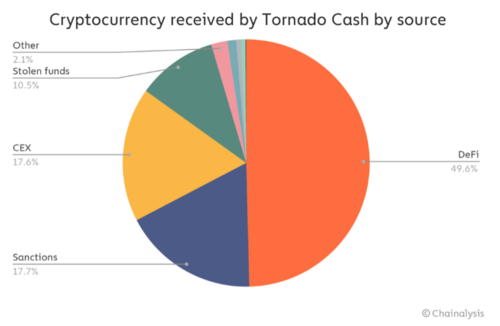

Image Source: Chain Analysis

First Crypto War Had Net Positive Result

So this raises the question of what all this means for crypto privacy and also privacy in general. It's pretty clear that privacy is under attack, albeit this move by the treasury was prompted by concerns around the North Korean hacking. Still, this radical approach by the Treasury is so nonspecific for what it's trying to achieve that you have to wonder whether the folks at OFAC gave any thought to collateral damage. 

Many have drawn parallels with the early Crypto Wars, for example. For unfamiliar people, this was when the US government arrested Phil Zimmerman, a developer who distributed PGP cryptography online. They accused him of “munitions export, without a license.” 

They contended that his PGP encryption system was a weapon that adversaries could use. Really? It would seem they don’t consider that any citizen wants and has a right to privacy. Only criminals and enemy governments would want to encrypt their communications. 

Well, it turned out that there were many practical uses for encryption online, and various encryption standards have helped power the multibillion-dollar e-commerce revolution we've experienced over the last 20 years. What was initially considered a way to hide state secrets has allowed legal commerce to thrive. 

Many have also wondered why Tornado Cash got hit and not other well-known crypto projects, like Monero. Virtual mixers seem to be viewed with much more suspicion than privacy-by-default currencies. People could see on-chain how the Lazarus group was laundering its funds through the tool. This isn't something that you can easily observe with Monero. 

Moreover, the sheer volume of funds running through Tornado Cash made it a prime target, but this doesn't mean Monero isn't being studied and tracked. There may well be a robust state-backed effort to crack the ring signature technology for which Monero is famous. This is perhaps one of the reasons why the Monero developers pushed through some new upgrades to the protocol only recently. 

Crypto And Congress Take A Stand

There has been a genuine outcry from the crypto industry arguing that the Treasury Department’s actions to shut the Tornado Cash could be “unconstitutional” as people have a right to privacy. 

Abraham Piha, co-founder, and CEO of Web3-focused firm Tomi, told Cointelegraph

“Tornado existed only because most blockchains were not private enough. If successive updates of Ethereum or Bitcoin include protocol integrations like Mimblewimble, will the next step be to block them as well? This act is yet another reason to push for Web3, a free web, controlled by users and not by some big brother governments.”

Kenny Li, co-founder and core developer for Manta Network, a privacy-preservation protocol, said that the Treasury’s decision to sanction Tornado Cash is far-fetched and extreme, even though, in the past, specific individual crypto wallet addresses have been subject to the same treatment. But in most cases, he said, there was a clear case of fraud, hacks, or a Ponzi scheme:

“In this case, smart contract addresses are being blacklisted. Smart contracts aren’t people. Not only that, but people forget that Tornado Cash is a protocol, not a person or an entity, which means it will continue to run regardless of the sanctions. It is time that we realize privacy and anonymity aren’t the same, and Web3 is all about privacy.”

Additionally, some Congress members are standing up, demanding an explanation from OFAC. Specifically, United States Congressman Tom Emmer sent a four-page letter to Treasury Secretary Janet Yellen regarding the unprecedented sanctioning of Tornado Cash. 

He posed a series of questions that sought to clarify the position of the Treasury Department’s OFAC. They were practical questions noting that Tornado Cash is a collection of several Ethereum Smart contract addresses that are not controlled by an individual or entity. 

Emmer asked what persons could be associated with those addresses and:

“Given that the Tornado Cash back-end will operate unchanged […] as long as the Ethereum network continues to operate, who or what entity did OFAC believe was reasonably responsible for imposing controls on the Tornado Cash blockchain contracts?”

Emmer posted the full letter on Twitter, stating that the growing adoption of decentralized technology would certainly raise new challenges for OFAC. Nonetheless, technology is neutral, and the expectation of privacy is normal.

Closing Thoughts

Firstly, I dare say we can all agree that those who engage in criminality should be brought down. The laundering of ill-gotten gains, be it through a bank account or a Defi protocol, should be prosecuted to the full extent of the law. 

Those wallets linked to criminal activity should also be sanctioned and flagged. This is precisely what the treasury did before the Tornado Cash sanctions were imposed. And it's not as though this approach wasn't enjoying some success. Thanks to some pretty advanced tools and tracking services, law enforcement can catch such miscreants more effectively than they could in the past. 

They also have the power of subpoenas and search warrants. They simply didn't need to take this action against Tornado Cash. The collateral damage resulted in a loss of privacy for some and a massive disruption for all in the Defi space. 

As for those North Korean hackers, they'll switch to one of the other 100 or so laundering techniques they were using long before Tornado started operating. Moreover, given that tornado cash is nothing but code, it'll be hard to outlaw permanently; it'll be a game of whack-a-mole. It won't have the desired effect. And the collateral damage is already permeating the crypto industry. 

These actions also raise legal questions. Is this a breach of the First Amendment, and what happens to any citizens who have used it in the past? Or anyone that interacts with it? It's a legal quandary, to say the least. 

With legal challenges brewing, this could turn into a new crypto war. One, with a positive long-term impact, as we saw with the first crypto war. Or maybe the large centralized institutions will conform, and we’ll have a more amenable but less free crypto space. It does demonstrate how some developers will continue to embrace decentralization, and many of us as individuals will fight for our right to freedom and privacy. 

Reference:
Coin Bureau
Cointelegraph


Editor and Chief Markethive: Deb Williams. (Australia) I thrive on progress and champion freedom of speech. I embrace "Change" with a passion, and my purpose in life is to enlighten people to accept and move forward with enthusiasm. Find me at my Markethive Profile Page | My Twitter Account | and my LinkedIn Profile.


Also published @ BeforeIt’sNews.com; Steemit.com


Tim Moseley

What Are the Benefits to Joining the Webtalk Referral Program?

What Are the Benefits of Joining the Webtalk Referral Program?

What are the benefits to join Webtalkco

As a member of Webtalk, you will have access to several benefits such as free contact management, social syndication, and rewards app. You can also earn points that can be redeemed for cash each month. These points can be earned by sharing popular content and engaging with users. The best part is that this program is 100% free and available to users from all over the world. Additionally, if you're on the go, you can download the Webtalk mobile app to enjoy faster and more convenient messaging. These mobile apps feature contact uploading, contact syncing, real-time push notifications, and more.

Free-contact management

If you're not already a member of Webtalk, you can sign up for a free trial and start organizing your contacts. The service combines Facebook and LinkedIn features and lets you organize your contacts in categories such as professional and personal. You can further refine your professional contacts by adding searchable tags, timestamped notes, and common interests. You can choose to share your contacts or keep them private.

A Webtalk membership comes with many advantages. For example, you can create unlimited contact lists and send unlimited emails. You can even syndicate your news. All of these features make it easy to manage your contacts. Webtalk offers both free and premium levels of membership. If you join as a free member, you have limited access to all features. However, if you want to have access to advanced features, you can pay up to $30 per month.

While Webtalk is free to join, you can pay a monthly fee for more features. Free membership includes the ability to send and receive messages to up to 50 people. Paid membership allows you to send unlimited messages and add unlimited contacts.

Free social syndication

Webtalk.co is a social networking site that allows users to share their invitation links with others. They can do this by sending an email, text message, or social media post. Webtalk also offers a banner-advertising option. Users who sign up for Webtalk through the banner advertisement will automatically receive an invitation.

Webtalk offers personal and professional networking services as well as social content syndication, allowing users to share content across various networks. Social content can be syndicated to LinkedIn, Facebook, Twitter, and Slack, among others. Webtalk also offers rewards, where users can earn cash for sharing content and referring other users.

webtalk

Free referral program

If you'd like to join the free Webtalk referral program, you'll need to know how to get started. To start, you'll need to sign up with the Webtalk website. Once you're a member, you can invite other users to join the network. This will allow you to build your network and earn bonus 5-level commission plans.

You'll earn commissions when your referrals buy products and services on Webtalk and earn cash rewards for referring others. You'll also be rewarded when your referrals cross-post to Facebook, LinkedIn, and other social networks. If you get a high volume of referrals from your referrals, you'll earn additional cash rewards.

The free-referral program allows you to earn 10% of the referral revenue generated by people you refer to Webtalk.com. This referral program is valid for both Pro and Free accounts. It also has a Bonus 5-level commission plan for life, meaning you'll continue to earn as long as your referrals upgrade. In addition to the referral program, Webtalk has a free tier for new members.

Free rewards app

The Webtalk.co rewards app is one of the first of its kind and has been tested extensively. It forms the backbone of Webtalk's new Groups, Clubs, and Eventwave platforms. If you are not a member yet, you can easily sign up and begin earning points.

This social media app is revolutionizing the way people network and share web content. It offers personalized experiences and rewards for sharing great content and engaging with others. Users can redeem points to earn cash or other rewards each month. Webtalk pays out the cash directly into their bank accounts. It also has a referral program for business and entertainment.

The Webtalk rewards app gives its users the chance to earn cash, which they can redeem every month. They can also earn influencer points and engagement points for engaging in other users' conversations. This program is totally free and available worldwide. Users can also use the Webtalk mobile app, which offers a more convenient and faster experience. The app also helps users upload their contacts and find friends. It also allows users to share content with their friends and has real-time push notifications.

Tim Moseley

The highly anticipated Jackson Hole Economic Symposium commences today

The highly anticipated Jackson Hole Economic Symposium commences today

Each year the Kansas City Federal Reserve hosts one of the most important economic symposiums in Jackson Hole, Wyoming. This major event is attended by the top central bankers in the United States and globally. This year’s event, the 2022 Economic Policy Symposium, "Reassessing Constraints on the Economy and Policy," will be held August 25-27.

While the Federal Reserve Bank of Kansas City is attended by dozens of central bankers, policymakers, academics, and economists from around the world, it will be Friday’s keynote speech by Chairman Jerome Powell that will garner the most attention.

This year’s symposium occurs at a critical time as the Federal Reserve began an aggressive tightening of its monetary policy. Beginning in March of this year the Federal Reserve raised its Fed funds rate for the first time since 2018. More so, they have raised rates at each of the last four FOMC meetings. They raised rates by 25 basis points in March, 50 basis points in May, and 75 basis points at both the June and July FOMC meetings.

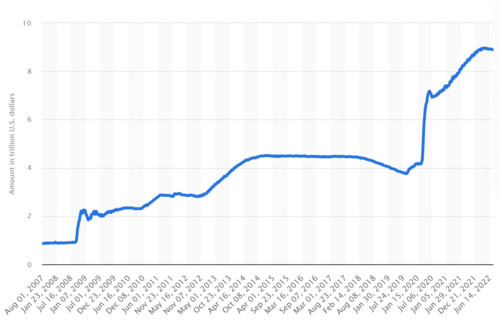
The Federal Reserve also announced that it would begin to taper or reduce its asset balance sheet. However, based on information from the Statista Research Department as of July 26, 2022, the Federal Reserve had $8.89 trillion in assets. Considering that in 2007 their assets were roughly at $0.9 trillion the Federal Reserve has been extremely challenged in reducing its assets. The only noticeable reduction occurred in September 2019 when the Federal Reserve reduced its $4.5 trillion balance sheet to $3.77 trillion.

Economists and analysts are divided as to the content of Friday’s keynote speech by Chairman Powell. Some analysts suggest that market participants are bracing themselves for an extremely hawkish speech by Powell, while others are anticipating that Powell might have a more dovish demeanor suggesting that the Federal Reserve will begin to lessen its aggressive rate hikes based on recent economic reports indicating an economic contraction in multiple sectors such as new-home sales and a disappointing U.S. manufacturing sector index report.

My current assessment is that Powell will first offer assurances to the American public that they are doing everything within their power to reduce inflation. Then chairman Powell will likely use his go-to playbook and state that all decisions are data-dependent and thereby deflect any specific timelines when they will begin to reduce the amount and frequency of each rate hike.

The Federal Reserve will hold its next FOMC meeting on September 20 – 21, a week after the release of the CPI inflation index for August.

Although there is much debate and uncertainty as to the tone and demeanor of Powell’s keynote speech, Chairman Powell will continue to walk an extremely thin tightrope between the current economic contraction and the current level of inflation. The likelihood that the Federal Reserve can pull off a “soft landing” will be difficult at best and impossible at worst.

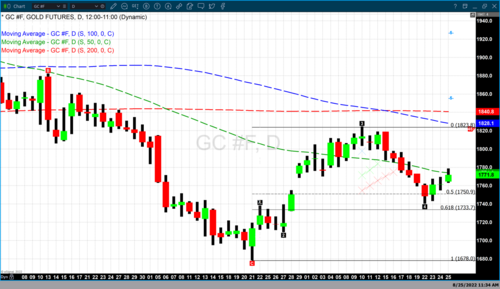
These facts have been highly supportive of gold prices over the last few weeks. Gold has risen from its low of $1678 on July 21 to its current value of $1771.80 today. Today’s gains were a combination of a softer dollar, fractional declines in U.S. Treasuries yields, and market participants actively buying the precious yellow metal.

By Gary Wagner

Contributing to kitco.com

Time to buy Gold and Silver on the dips


Tim Moseley

Is Gold A Sleeping Giant? The Basel Accord

Is Gold A Sleeping Giant? The Basel Accord

In the light of much focus on cryptocurrency this article examines whether gold will make a comeback and establish its true value and status in our economy.

History is Prelude

From time immemorial precious metals have been recognised for their stored value as tangible assets, including silver and gold. A key reason for paper notes becoming used commercially was because it was cumbersome to carry gold and precious metals around in any major quantity for purposes of trade.

Paper notes would be denominated with an inscription pointing to the value of that note in terms of gold and silver. In simple terms they were a bit like coupons. Two particular landmarks in history changed the nature of money. Firstly, things fundamentally changed with the confiscation of gold from the people in the 1930’s by executive order of President Roosevelt.

Then in 1971 gold and silver was removed as backing altogether, courtesy of President Nixon. From that moment the populace had the form of money but not the substance of money, which I referenced in another articleHere in the UK the gold standard was suspended during the Napoleonic War, and brought back for a while from 1821 to 1914.

Image Source: Gold

Inflation

Gold’s restorative impact on the economy and hedge against inflation was well known. In 1914,  £0.95 could buy what £1 pound could buy in 1821, meaning that Britain’s economy strengthened with gold as the key factor. Also Elizabeth I used it to counter inflation during her reign between 1558 and1603.

So, gold has shown itself to be real money and has been the consistent answer to inflation. Based on its track record in history this is one indicator that gold will make a comeback. In the meantime the value of money has been in significant decline for approximately 100 years due to money existing in form alone. Right now as I write this article the UK has now surpassed 10% inflation though I suspect the number is higher. Why?

Mario Innecco is a financial markets and macro economics analyst who recently discovered and reported that the Bank of England had been manipulating data on inflation, to make inflation look better than it really is. The bottom line to curbing inflation is to restore money of substance, in other words to bring back the likes of gold and silver.

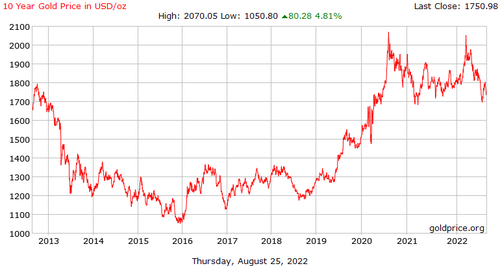
The second reason that gold could become resurgent picks up on the theme of manipulation of data. The only reason to manipulate data is when you want it to fit a certain narrative, and to control perception. The conflated numbers cited during the so-called pandemic, show this is a common strategy used by the establishment. If you take a look at the summary gold chart, you will notice that since 2012, when gold was near 1800 per ounce, it declined thereafter to an all time low in 2016.

Image source: Gold Chart

It was not until 2020 during the so-called pandemic that it broke the 2012 record. Again it correlates to rising inflation and yet, the graph resembles a picture of suppression, rather than reflecting its true value according to many commentators. Gold has a history of being stolen, suppressed, and manipulated as far as its data is concerned. This tells its own story of how precious and valuable it is, otherwise you would not see so much energy going into destroying its true worth to the public.

What Happened to All That Gold?

I have always wondered what happened to the abundant supply of gold that used to be? Is it going extinct like the dinosaurs?  Gold has not disappeared but it has transferred from the many to the few through asset stripping and theft.

Recall in history when gold was confiscated with such extreme measures and touted as being in the interests of the economy, only to be sold at a higher price by the American government. It revealed the truth and betrayal of the people by the government. It was a form of asset stripping by theft, designed to enrich the few and enslave the many.

You may also recall Karen Hudes, former World Bank employee who blew the whistle and expanded on the fraud, and the theft of gold which was taking place at the higher echelons of the bank. These thefts mean that gold simply got transferred by force to a few global oligarchs. 

As it stands today, the World Gold Council reports that the Central Banks hold one fifth of all the existing , with the USA leading the way, although China and Russia are the two biggest producers of gold. While you can buy gold today,  the asset stripping strategy is showing up in more subtle forms, as the following case underlines.

Insider Trading

According to the dictionary, insider trading is defined as ‘the illegal practice of trading on the stock exchange to one's own advantage through having access to confidential information’. This has been shown to be going on in the stock market in general, and among those implicated are high ranking officials such as Nancy Pelosi, USA speaker of the house, and Federal Reserve chief Jerome Powell. The following case highlights the connections at the highest level.

The Court Hearing of JP Morgan

Recently In Chicago the trial of certain officials of JP Morgan took place. The court discovery revealed what many suspected – insider trading of gold, which involved spoofing and market manipulation. What’s more the court discovery was able to ascertain that JP Morgan were effectively agents for the BIS, and also the Federal Reserve. At one point the label ‘criminal enterprise’ was used to describe the organized theft.

Certain individuals were charged with fraud. It’s interesting that the trial took place in Chicago. COMEX is a division of the Chicago Mercantile Exchange, and is the primary futures and options market for trading metals such as gold, silver, copper, and aluminum. 

One of the other fraudulent activities that takes place within these exchanges by insiders is fooling people into thinking they own real physical gold [allocated gold] when in fact they only hold the form of it.  ETF stands for exchange traded fund, and is an example of such a paper asset.

The challenge with fraud charges is that so much money is made in fraudulent activities, that many banks think they can simply buy their way out of the consequences. However, that may be stopped in its tracks sooner rather than later.

The Basel Accord 

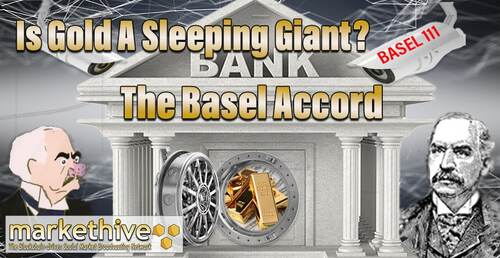
The Basel Accord, sometimes referred to as Basel IV, comprises Basel III with its three pillars, Basel I, II and III. This is a series of international banking reforms designed to strengthen banking through different economic challenges. It can be summed up in this diagram. 

Image Source: Basel III

This series of regulatory changes are designed to introduce highly disciplined practices to increase safety and to minimize risk in the banking sector. Basel started back in 1974 as a collaborative committee comprising 10 countries including the United Kingdom and USA. Its focus was on quality, safety and efficiency in banking. In 2009 the first version of Basel III came out in response to the financial crisis. Common themes of the accord is the requirement for banks to have greater capital reserves and show liquidity.

Within this comes the monitoring and reporting of key data demonstrating that the bank balance sheets add up. This potentially puts the banks in the headlights where paper versus physical allocated gold is concerned. Now they have to show proper reconciliation. The minimum requirements of Basel III took effect from Jan 2022, and must be fully in play by 2027. The big banks appear to be panicking because they have to report and  submit the relevant documents. It seems that they are using this transition to buy up physical gold in huge quantities in order to plug the gaps they created.  

Alongside this you have Russia who are now charging in gold for its energy, This has resulted in the G7 banning imports of gold from Russia. This has not stopped Russia. Russia is one of the BRIC countries [including Brazil, India and China], and it is being muted that they may come out with their own gold standard, which would threaten the dominance of the USD further.

Elsewhere, Zimbabwe is now offering gold coins as legal tender to curb inflation, and Lithuania is going down a similar path. Many financial commentators such as Robert Kiyosaki and Jim Rickards are predicting a surge in both gold and silver as a result of the pressure of inflation, Basel III, and the activity around the purchase and use of gold.

Gold With Greater Functionality

If you are wondering if gold is still for the long term as simply a store of value, the good news is that its functionality now goes beyond that. You can buy, trade, save and own gold more easily.

For example the Glint App allows you to buy gold through their app using EUR, USD and GBP. The gold you purchase is physical allocated gold, and is stored in a non government brinks vault in Switzerland. You own it. Furthermore you can digitize what you own through their debit mastercard, meaning you can then spend it on everyday things. I have found the purchase of gold through the app to be seamless, and am looking forward to buying something effectively with gold. Check if GLINT is in use in your country.

Another company that has done something similar is Kinesis. The problem they solve is explained in Gresham’s Law, which is where good money is saved and bad money spent historically. They are creating a banking ecosystem around this concept which allows you to buy gold and silver on their exchange, using fiat or select cryptocurrencies, and then you can store it in your own wallet, as well as to be able to send and receive to other participants in the ecosystem.

They are coming out with a VISA debit card too, both virtual and offline. With their own built in exchange, you can trade gold and silver, and you get yields on different activities such as minting, buying, holding and referring. Off course if you are new to this concept, and simply want to buy physical gold you may wish to look up Mike Maloney on YouTube for educational input and recommendation. If gold backed cryptocurrency appeals to you here is a guide as a starting point for exploration.

I have developed a mini ecosystem within my portfolio which allows me to accept payment for my businesses in gold, as well as to save and make purchases. I also have some gold backed cryptocurrency and related company shares based around gold. It certainly feels more empowering to be working with real money, which surpasses what my traditional bank can do.

Much attention has been focussed on cryptocurrencies as the emerging new ‘money’ especially since bitcoin came into being around 2009. In fact many commentaries refer to bitcoin as the new digital gold, since one of the assertions is that it cannot be confiscated. Confiscation is one consideration but anything that deters access to your money is another, as we saw in a previous article which looked at regulation. The volatility of cryptocurrency does not help with the immediate threat of inflation.

With rampant inflation, the intense suppression of gold through market manipulation, and the imminent full implementation of Basel III, these trends suggest that gold will make a comeback and find its true value. Gold may well be the sleeping giant, as it has an inherent and powerful ability to restore an economy that has gone out of control.

Whatever else you do, consider adding this to your resources to stave off the decline in purchasing power of your local currency. Now you know the game that is being played by the establishment, it is up to we the people, the majority, to protect our assets, in order to create and pass on generational wealth to bless ‘we the people’ ad infinitum.


About: Anita Narayan. (United Kingdom) My life's work is about helping individuals to greater freedom through joy and purpose without self-sabotage, so that inspirational legacy can serve generations to come. Find me at my Markethive Profile Page | My Twitter Account | and my LinkedIn Profile.


Tim Moseley

Gold sees modest short covering bargain buying

Gold sees modest short covering, bargain buying

Gold prices are firmer in midday U.S. trading Wednesday, on a routine upside price correction from recent selling pressure. Short covering in the futures market and some perceived bargain buying in the cash market are featured. The U.S. dollar index is trading slightly down and near its daily low, which also gave the metals market bulls a bit of encouragement. However, rising U.S. Treasury bond yields at mid-week has limited buying interest in the metals. October gold futures were last up $4.90 at $1,756.30. September Comex silver futures were last down $0.021 at $19.005 an ounce.

U.S. stock indexes are higher at midday. The marketplace is awaiting the late-week Jackson Hole, Wyoming Federal Reserve annual symposium that begins Thursday and includes a speech from Fed Chairman Jerome Powell Friday morning. Past Jackson Hole Fed meetings have significantly moved markets. Markets are expecting Powell to lean hawkish on U.S. monetary policy and on the Fed’s fight against inflation.

Gareth Soloway's Trading Tips: A Guide from a Master Trader

The key outside markets today see Nymex crude oil prices lower and trading around $93.00 a barrel. The U.S. dollar index is slightly lower at midday, after hitting a 20-year high on Tuesday. Meantime, the yield on the 10-year U.S. Treasury note is fetching 3.109%. Bond yields have been on the rise recently.

Technically, October gold futures bears still have the firm overall near-term technical advantage. Bulls’ next upside price objective is to produce a close above solid resistance at $1,800.00. Bears' next near-term downside price objective is pushing futures prices below solid technical support at the July low of $1,686.30. First resistance is seen at today’s high of $1,759.70 and then at 1,775.00. First support is seen at today’s low of $1,745.50 and then at this week’s low of $1,730.40. Wyckoff's Market Rating: 2.5.

September silver futures bears have the solid overall near-term technical advantage. Silver bulls' next upside price objective is closing prices above solid technical resistance at the August high of $20.87. The next downside price objective for the bears is closing prices below solid support at the July low of $18.01. First resistance is seen at this week’s high of $19.155 and then at $19.50. Next support is seen at this week’s low of $18.605 and then at $18.35. Wyckoff's Market Rating: 2.0.

September N.Y. copper closed down 460 points at 364.95 cents today. Prices closed nearer the session low today. The copper bulls have the overall near-term technical advantage. Prices are in a five-week-old uptrend on the daily bar chart. Copper bulls' next upside price objective is pushing and closing prices above solid technical resistance at 400.00 cents. The next downside price objective for the bears is closing prices below solid technical support at 335.00 cents. First resistance is seen at this week’s high of 373.15 cents and then at 380.00 cents. First support is seen at this week’s low of 360.40 cents and then at last week’s low of 354.20 cents. Wyckoff's Market Rating: 6.0.

By Jim Wyckoff

For Kitco News

Time to buy Gold and Silver on the dips

Tim Moseley

StuffMyInbox Review – How Does StuffMyInbox Work?

StuffMyInbox Review – How Does StuffMyInbox Work?

stuffmyinbox

You've probably heard about StuffMyInbox, the website that gives away XBOX game systems. You may be interested in finding out how the system works. It generates autopilot leads and integrates John Thornhill's "Ambassador Program" into its sales funnel. But, how does it work for affiliate marketers? How do you earn commissions and leads from StuffMyInbox? Read on to learn more about this site and how to start generating leads with it.

StuffMyInbox is a website that gives away XBOX game systems

If you are looking for a website that generates leads and commissions on autopilot, you may want to check out StuffMyInbox. This website is 100% automated, meaning that you never have to work on it. You can generate thousands of free leads and generate unlimited commissions with this program. As an added bonus, you will receive free traffic, leads, and sales. What's even better, you can start earning commissions on your first offer!

It generates autopilot leads

If you have ever wondered how to generate unlimited traffic and autopilot leads, you've probably come across StuffMyInbox. This cloud-based software can help you create unlimited lists, increase your sales, and earn autopilot commissions. The best part is, it is FREE to use, so you can even get it for free if you sign up for their PRO membership. What's more, you can use it to get free XBOX game systems.

The StuffMyInbox system sends autopilot leads to OTO users by referring visitors to your offers. Every time someone visits your website, you receive an email from them with a link to an OTO. This will automatically send them visitors, leads, and purchases. That means you can expect insane conversions. And you can start getting free traffic right away. If you want to maximize your income on autopilot, you should start using StuffMyInbox.

It integrates John Thornhill's "Ambassador Program"

If you've ever wondered how to make money online with minimum effort, you've probably heard about the John Thornhill's Ambassador Program. It's a complete system that includes a high-converting webinar and back-end products. In fact, John has earned more than $1 million using the Clickbank affiliate marketplace. You can join his program and start making money today by promoting his products and services.

The StuffMyInbox integration works great for promoting John Thornhill's Ambassador Program. All you have to do is drive targeted traffic to the program's landing page, sign up for the webinar, and then you'll be rewarded with commissions from sales made through your affiliate link. This is a great opportunity for those interested in affiliate marketing, and because John Thornhill has an 85% success rate with affiliate marketing, you'll be able to sell his product to a larger audience.

It offers a money-back guarantee

While most digital products come with a 30-day money-back guarantee, StuffMyInbox offers a ninety-day money-back guarantee. That's not too shabby, considering the fact that the author wants to get more clients and traffic. That's pretty good news for anyone considering buying the product. Regardless of whether you choose to use it or not, you can rest assured that it will help you succeed.

The creator of StuffMyInbox is Bryan Winters, who has been in the online marketing industry for 15 years and has built a solid reputation by consistently producing innovative and quality products. His most recent product, the MonsterMode 700K System, has been making people millions of dollars and has earned his considerable trust. The StuffMyInbox formula automatically generates traffic for affiliates and offers up to $312 per click! In addition, the system also gives away brand new XBOX game systems every ninety days.


Tim Moseley

Gold silver rebound as USDX backs off crude oil rallies

Gold, silver rebound as USDX backs off, crude oil rallies

Gold and silver prices are higher in midday U.S. trading Tuesday, on short covering in the futures markets and bargain hunting in the cash markets, following recent selling pressure. The key "outside markets" are also in a bullish daily posture for the metals today, as the U.S. dollar index backed off a bit and crude oil prices were solidly higher. October gold futures were last up $13.80 at $1,752.40. September Comex silver were last up $0.147 at $19.03 an ounce.

U.S. stock indexes are weaker at midday. Traders and investors early this week are concerned about a still-aggressive Federal Reserve that is fighting problematic price inflation by raising U.S. interest rates at a rapid pace–even if it causes a U.S. economic recession. A Wall Street Journal news headline read: "Wall Street swings from greed to fear as the Fed's message sinks in." The marketplace is awaiting the late-week Jackson Hole, Wyoming Federal Reserve annual symposium, including a speech from Fed Chairman Jerome Powell Friday morning. Past Jackson Hole Fed meetings have significantly moved markets.

The Ethereum Merge will be the biggest crypto event since the first Bitcoin was mined – Ran Neuner and Steven Sidley

The key outside markets today see Nymex crude oil prices solidly higher and trading around $93.25 a barrel. The U.S. dollar index is weaker on a corrective pullback after hitting a nearly 20-year high in early U.S. trading. The surging greenback is denting bullish enthusiasm in many raw commodity markets, as they are priced in U.S. dollars on the world market. The appreciating greenback is making those commodities more expensive to purchase in non-U.S. currency. Meantime, the yield on the 10-year U.S. Treasury note is fetching 3.0%.

Technically, October gold futures bears still have the firm overall near-term technical advantage. Bulls' next upside price objective is to produce a close above solid resistance at $1,800.00. Bears' next near-term downside price objective is pushing futures prices below solid technical support at the July low of $1,686.30. First resistance is seen at today's high of $1,757.60 and then at 1,775.00. First support is seen at today's low of $1,733.80 and then at this week's low of $1,730.40. Wyckoff's Market Rating: 2.5.

September silver futures bears have the solid overall near-term technical advantage. Silver bulls' next upside price objective is closing prices above solid technical resistance at the August high of $20.87. The next downside price objective for the bears is closing prices below solid support at the July low of $18.01. First resistance is seen at last Friday's high of $19.48 and then at $20.00. Next support is seen at this week's low of $18.605 and then at $18.35. Wyckoff's Market Rating: 2.0.

September N.Y. copper closed up 380 points at 368.95 cents today. Prices closed nearer the session high and hit a seven-week high today. The copper bulls have the overall near-term technical advantage. Prices are in a five-week-old uptrend on the daily bar chart. Copper bulls' next upside price objective is pushing and closing prices above solid technical resistance at 400.00 cents. The next downside price objective for the bears is closing prices below solid technical support at 335.00 cents. First resistance is seen at today's high of 373.15 cents and then at 380.00 cents. First support is seen at this week's low of 360.40 cents and then at last week's low of 354.20 cents. Wyckoff's Market Rating: 6.0.

By Jim Wyckoff

For Kitco News

Time to buy Gold and Silver on the dips


Tim Moseley

Commerzbank lowers gold price target to 1800 and sees potential for higher prices by 2023

Commerzbank lowers gold price target to $1,800 and sees potential for higher prices by 2023

The third quarter has been disappointing for many gold investors as the precious metal has been in a sharp downtrend and recently has been unable to hold any gains above $1,800 an ounce.

Although gold has struggled in the face of rising interest rates and surging momentum in the U.S. dollar, Carsten Fritsch, precious metals analyst at Commerzbank, said in a report Monday that the price action is doing a lot better than one would expect given the current environment.

Although gold prices have dropped, prices have held initial support at around $1,700 an ounce as the Federal Reserve embarked on an extraordinary tightening cycle. So far this year, the U.S. central bank has raised interest rates by 2.25%, driving real yields higher and boosting the U.S. dollar to a 20-year high.

"Despite all the complaining about the disappointing gold price development in recent months from an investor's point of view, it should not be forgotten that gold is still the best performer this year compared to other asset classes," Fritsch said in the report.

"Gold is currently trading 4.5% below the level at the beginning of the year. In the case of U.S. bonds, the corresponding loss amounts to 9.5% due to the sharp rise in yields, if the T-Note future is used as a reference. The equity markets have lost around 14% since the beginning of the year as measured by the MSCI World, the bitcoin price even more than 50%," Fritsch added.

While the German bank sees some resilient strength in the gold market, they are still downgrading their gold price forecast for the rest of the year. In the report, Commerzbank said that it sees gold prices ending the year at around $1,800 an ounce, down from the previous forecast of $2,000.

"In the short term, gold could come under pressure again because the U.S. Federal Reserve is likely to raise interest rates further until the end of the year," Fritsch said.

However, Commerzbank isn't completely giving up on gold. The bank said that it is a little too early to look for a recovery, but they see the potential for higher prices by the start of 2023.

"As soon as it becomes apparent that the rate hike cycle is coming to an end, the gold price should start to rise. This is likely to be the case in the fourth quarter," Fritsch said. "Like the market, we expect the Fed to cut rates again next year as the U.S. economy slides into recession."

Commerzbank sees gold prices ending 2023 at $1,900 an ounce, down from the previous estimate at $2,000 an ounce.

The German bank is also lowering its silver price target to $20.50 an ounce, down from the previous forecast of $24 an ounce. For 2023, Fritsch said that prices could rise to $25 an ounce, down from the prior estimate of $27 an ounce.

Fritsch noted that the silver market has been hit with significant bearish sentiment as investors flee the market.

"Since the beginning of the year, the holdings of silver ETFs tracked by Bloomberg have fallen by more than 3,000 tons. This corresponds to 1.5 months of global mine production that is additionally available as supply. Since the beginning of July, the outflows amount to more than 1,900 tons," he said.

However, Fritsch added that by 2023 silver should see more demand due to the global push for green alternative energy.

Finally, Commerzbank is also lowering its year-end price target for platinum to $1,000 an ounce, down from $1,050 an ounce.

"Since the beginning of the year, these have now totalled more than 400 thousand ounces. The platinum market could therefore be more oversupplied this year than previously expected," Fritsch said.

Credit Suisse downgrades its average gold price forecast to $1,725
By Neils Christensen

For Kitco News

Time to buy Gold and Silver on the dips


Tim Moseley

Hidden in Plain View

Hidden In Plain View

by Jeff Thomas, editor, International Man Communique

Hidden In Plain View

In 1796, the US issued its first quarter dollar.

On the obverse, it displayed the image of Lady Liberty, and above the image (in case there was any doubt about the message), the word "LIBERTY" was prominently displayed. The coin was minted from silver (90%) and copper (10%).

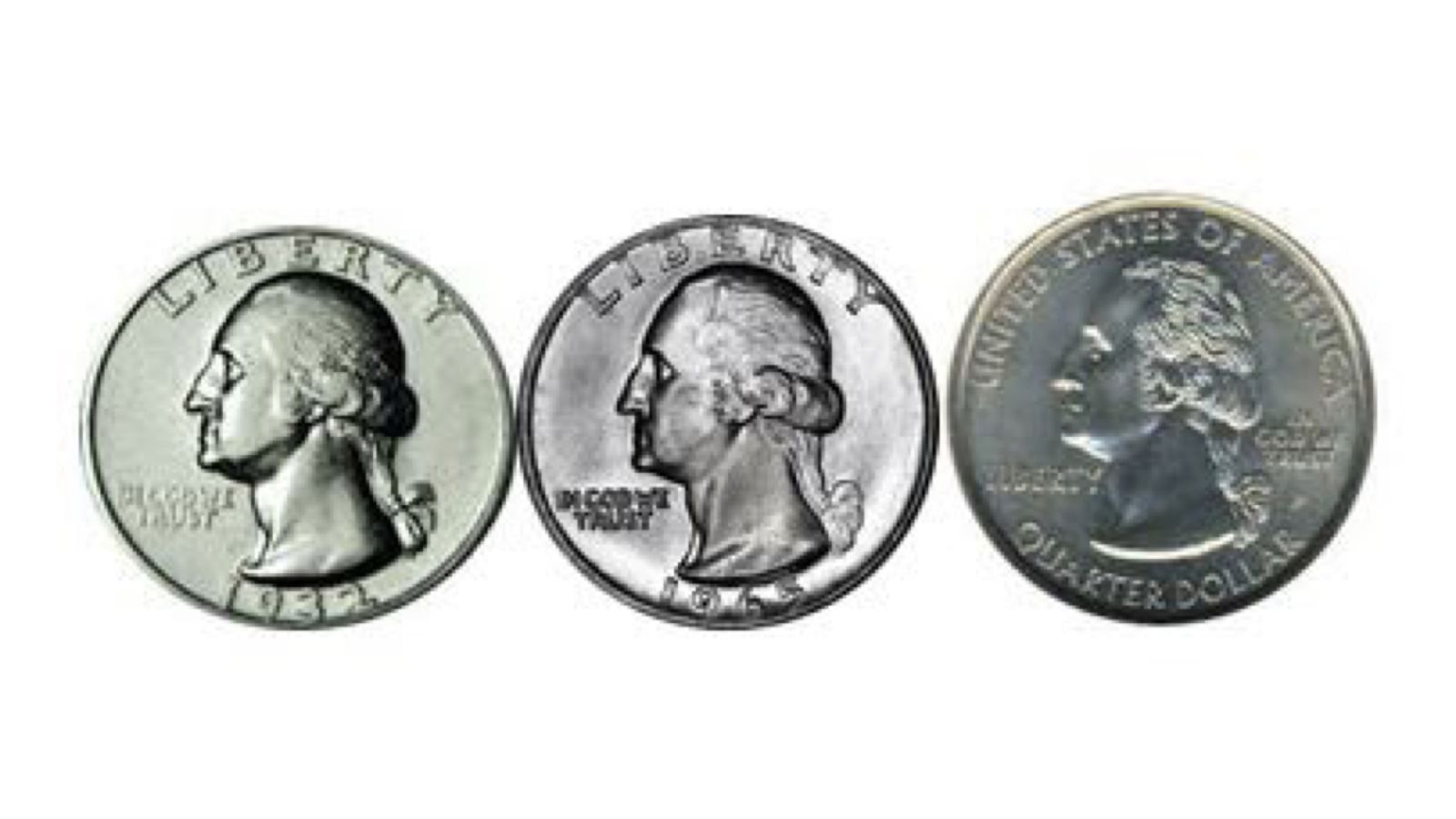
Over the years, the design of the US quarter changed repeatedly. Then, in 1932, a new quarter (image #1, above) was issued that featured the image of American Founding Father George Washington. As before, the word "LIBERTY" appeared above his image—a continuing reminder of the primary principle upon which the US was founded. And as before, the coin was minted from silver (90%) and copper (10%).

So far, so good.

The quarter remained unchanged until 1965. The new quarter (image #2) was the same in every way, except that it contained no silver whatsoever. It now contained only copper and nickel. (At today’s metals prices, the intrinsic value of the quarter dropped suddenly to 1% of its previous value.)

Conceptually, the American people should have been outraged, as they had effectively lost the ability to hold real, redeemable wealth. The coin they would hold in the future would not have the value of silver; it would be a mere token. The new coin represented no more than a "promise of value" on the part of the US government.

However, there was almost no outcry. The reason? Because the new quarter still retained the same purchasing power it had when it was made of silver. As long as the quarter was perceived by all and sundry as having value for the purpose of payment, most Americans were content to accept the switch.

In 1999, the quarter’s design did change (image #3). The word "LIBERTY" was removed from above the head of Washington and in its place were the words, "UNITED STATES OF AMERICA." It might have been argued at the time that those words needed to be on the quarter to remind holders of the coin what nation had issued it. However, those words had always appeared on the reverse of the Washington quarter, and I recently saw a 1999 quarter that had those words on both sides—a very odd redundancy for a coin, which, by its very size, has little space to spare, even for essential information.

The word "LIBERTY" was still in evidence on the new coin, but it had been moved lower down, beneath Washington’s chin, and was now much smaller.

It would seem one reason for the change in design had been to diminish the importance of Liberty as an American concept. (Later, when the "states" quarters were issued, the Mint dropped the "UNITED STATES OF AMERICA" on the reverse and retained it on the obverse.)

In any case, as in 1965, there was no outcry from the American people—again, for the same reason as before. The coin retained the same purchasing power, so the change in design was simply not an issue.

Some citizens may have a different slant on the subject. It may be argued that the two changes in the American quarter reflect the changes in the US as a nation. There can be no doubt that the value of US currency, in general, has been dramatically reduced in purchasing value since 1932. It is also true that none of the US currencies (whether paper notes or metal coins) have any true, redeemable value. They have only perceived value, which is subject to dramatic change, depending on economic conditions. (In the last century, the un-backed currencies of some twenty nations have been rendered valueless, as a result of hyperinflations.)

In 1796, when the quarter was first minted, the quarter was in itself wealth. The paper banknotes that came later (beginning in 1861) were initially fiat (during the war) but were quickly replaced by notes backed by, and redeemable for, silver. The redemption of US banknotes for silver bullion ended in 1968.

Today, if a US citizen seeks to build up his wealth, he cannot do so by holding the currency of his country. All US currency, whether paper or metal, only represents his faith in the currency to retain its value, which it is unquestionably losing. Therefore, merely by dealing every day in US currency, the holder is paying a hidden tax, and his wealth is diminished accordingly.

As to US Liberty, many would agree that that, too, has been devalued, particularly after 1999. Laws such as the Patriot Act of 2001, its expansion in 2011, and the National Defense Authorization Act of 2011 have stripped Americans of their constitutional rights on a wholesale basis.

There is an old saying that, "The best place to hide something is in plain view." If true, a reminder of what the US citizen has lost may be found in plain view, merely by reaching into his pocket and examining his change.

Unfortunately, there's little any individual can practically do to change the trajectory of these trends in motion.

The best you can and should do is to stay informed so that you can protect yourself in the best way possible, and even profit from the situation. We think everyone should own some physical gold.

Gold is the ultimate form of wealth insurance. It has preserved wealth through every kind of crisis imaginable. It will preserve wealth during the next crisis, too.


New Opportunities Are Emerging For Citizens of The World.

Freedom and democracy may appear to be struggling to stay alive in America, but there may be a knock-out punch ready to be released. The evolution of the blockchain-enabled metaverse is going to enable the 'Citizens of the World' to gain their own Freedom by democratizing power and creating a new world with new rules, new players, and new opportunities. For 99.99% of us, the metaverse will improve our real-world lives by democratizing power and opportunity.

Along with the major long-term trend of society towards decentralization and smaller-scale organizations, there are new opportunities developing to help 'Preparers' in the cryptocurrency sector. Businesses are beginning to issue their own Crypto Coins that can be traded on Cryptocoin Exchanges.

Markethive.com will release its HiveCoin (HIV) in the coming weeks. It has tremendous upside potential that is outlined in a Video by Founder Tom Prendergast, "Entrepreneur Advantage…".

Not only that, if you go to their website and register as a FREE Member, you will be given 500 HiveCoins for "FREE" along with access to several Earning Opportunities and online tools to increase your HiveCoin balance.

Be sure to check it out today – Markethive.com

Markethive

Tim Moseley