How to Set a Time Budget for Online Casino Play

Determining how many minutes or hours to spend on virtual wagering sites requires careful evaluation of both personal habits and the design patterns inherent in modern software. Because these web applications load instantly and feature continuous loops of visual and auditory stimuli, hours can pass unnoticed without a predefined structure. Recognizing these intrinsic design strategies is the first step toward establishing realistic boundaries for recreational activities.

When deciding on an appropriate duration, individuals must compare various structural elements rather than relying solely on willpower. For instance, fast-paced virtual table titles and automated reel mechanics generate outcomes at a much higher frequency than traditional leisure pursuits, which accelerates the consumption of attention. Prioritizing structured intervals over open-ended access allows participants to notice fatigue before it impairs judgment or leads to extended play.

A frequent error involves treating temporal limits as flexible guidelines rather than strict operational thresholds. To avoid this common pitfall, observers should look at tools provided by operators, such as automatic logouts or session reminders. For additional context, Elonbet can be considered alongside this overview. Reviewing these features helps clarify which platforms genuinely support user control versus those that encourage prolonged engagement through persistent notifications and reward structures. A comprehensive resource on platform transparency can be found via this for further study.

Evaluating personal vulnerabilities is equally critical when formulating a schedule. People often overlook how stress, boredom, or late-night hours alter decision-making capacity, making them more susceptible to chasing losses or extending a session past its intended end. Avoiding late-night sessions or periods of emotional distress helps maintain the clarity needed to honor a predetermined time limit effectively.

Ultimately, keeping leisure activities properly proportioned requires a proactive mindset that weighs the benefits of virtual entertainment against other daily priorities. By replacing vague intentions with concrete temporal boundaries, participants preserve complete authority over their attention. This disciplined approach ensures that online wagering remains a controlled, occasional diversion rather than an unstructured routine that consumes valuable personal hours.

Bitcoin Price Outlook and Its Impact on Altcoins: What Does This Mean for Hivecoin?

Bitcoin Price Outlook and Its Impact on Altcoins: What Does This Mean for Hivecoin? 

The past 18 months have been historic for Bitcoin and the crypto industry, marked by several significant developments. From the approval of Bitcoin ETFs to discussions about a national Bitcoin reserve, the cryptocurrency has seen remarkable activity. One of the key moments for Bitcoin was the approval of spot Bitcoin ETFs by the Securities and Exchange Commission. (SEC) This move added more liquidity to Bitcoin and helped establish it as a legitimate investment asset, showing its potential to become a mainstream financial instrument. 

Bitcoin (BTC) has experienced significant growth over the past year, with its value increasing by 50%, surpassing the $100,000 mark for the first time. It has attracted the attention of institutional investors, governments, and retail traders. The cryptocurrency community anticipates continued expansion, attributing this optimistic outlook to President Donald Trump's leadership and pro-crypto sentiment, and forecasting further record highs for Bitcoin in the coming years.

It’s Official – Cryptos Are Not Securities

A seismic shift is occurring in cryptocurrency regulation, affecting investors and the finance sector. The SEC now states that most crypto assets are not securities, a stark departure from Gensler's previous anti-crypto stance, where he often viewed digital assets as securities. This crucial decision marks a significant change for crypto, bringing greater clarity and reducing regulatory uncertainty. Recently, the newly appointed SEC Chair, Paul Atkins, announced plans to incorporate cryptocurrencies into mainstream finance. These initiatives represent a shift from skepticism and enforcement to support and integration.

Moreover, on August 7, President Trump issued an executive order allowing cryptocurrencies in 401(k) plans, marking a significant step for retail investors. This creates a new opportunity for everyday savers to include digital assets in their retirement portfolios. While institutional investors have been increasing their crypto holdings, retail investors have faced restrictions due to fiduciary risks, regulatory uncertainties, and volatility concerns. 

This executive order represents a substantial advancement for the crypto industry, which has long sought greater retail participation and increased legitimacy within the financial system. The order signals strong support for cryptocurrencies as legitimate investments, potentially unlocking trillions of dollars in new capital.

The regulatory shifts – SEC's crypto reclassification, Chair Atkins' agenda, and Trump's executive order on 401(k) inclusion – signal a positive change in how digital assets are viewed and regulated in the U.S. This clarity and support are expected to boost institutional adoption, attract mainstream investors, and help the global cryptocurrency ecosystem grow. The implications for altcoins, in particular, are substantial, as a more accommodating regulatory environment for Bitcoin often paves the way for increased confidence and investment across the entire spectrum of digital assets.
Bitcoin Price Predictions

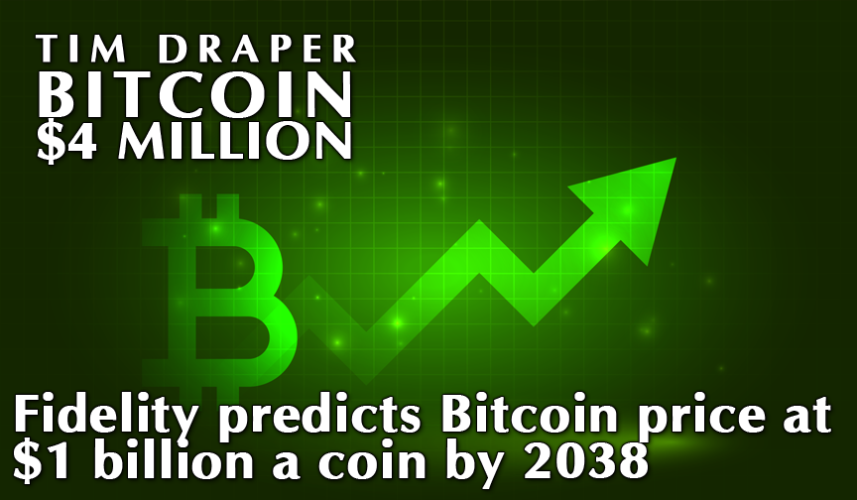
With increasing institutional support and significant technological progress, the future of Bitcoin continues to be a popular topic of debate, especially its price, which remains a primary concern for investors, businesses, and other stakeholders. The crypto market is curious about the Bitcoin price prediction for 2025 and beyond. Some conservative estimates suggest that Bitcoin could reach $200,000 by the end of the year. Longer-term forecasts propose that Bitcoin could hit $10 million and even up to $1 billion by 2038. 

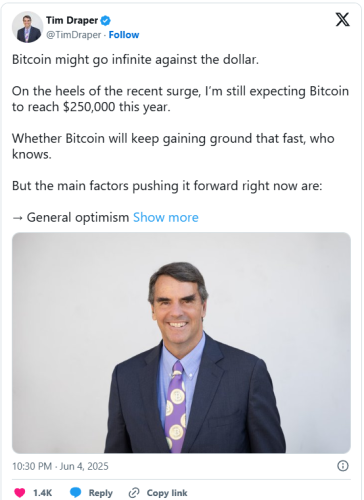
Billionaire venture capitalist and prominent early Bitcoin investor, Tim Draper, has made a bold prediction regarding the future trajectory of Bitcoin's price. He foresees an astonishing potential 30-fold increase, which would propel Bitcoin's value to an unprecedented $3 million. Draper's optimism stems from his perspective on the surge in Bitcoin's value to $100,000 last November, which he characterizes as "totally rational." He firmly believes that this digital asset is not merely a speculative commodity but instead destined to become "the currency of the future." 

This conviction underscores a fundamental shift in how he views financial transactions and the potential for decentralized digital currencies to revolutionize traditional monetary systems. His prediction suggests a future where Bitcoin plays a central role in global commerce and daily transactions, displacing or significantly complementing existing fiat currencies. More recently, he renewed his short-term forecast of $250,000 by year’s end.

Source: Tim Draper X

Other prominent figures and experts in the crypto industry share a similar outlook:

  • Michael Saylor believes that within the next 48 months, BTC will become 'the largest asset in the world.'
  • Peter Brandt estimates the price will range from $120K to $200K by September 2025.
  • Chamath Palihapitiya forecasts $500K by October 2025 and aims for $1M by 2040.
  • Bernstein, along with other forecasts, highlights the potential for reaching $200K by 2025.
  • Max Keiser has made several Bitcoin price predictions for 2025, with the latest and most notable target being $220,000 by the end of the year.
  • Hal Finney, with a long-term vision, believes Bitcoin could hit $10M.
  • Cathie Wood suggests that Bitcoin could hit a value of $1 million by 2030, as explained further in this article.

These projections show a strong belief in Bitcoin's potential for significant future growth; however, Fidelity's forecast goes far beyond that.

Fidelity's Bitcoin Predictions 

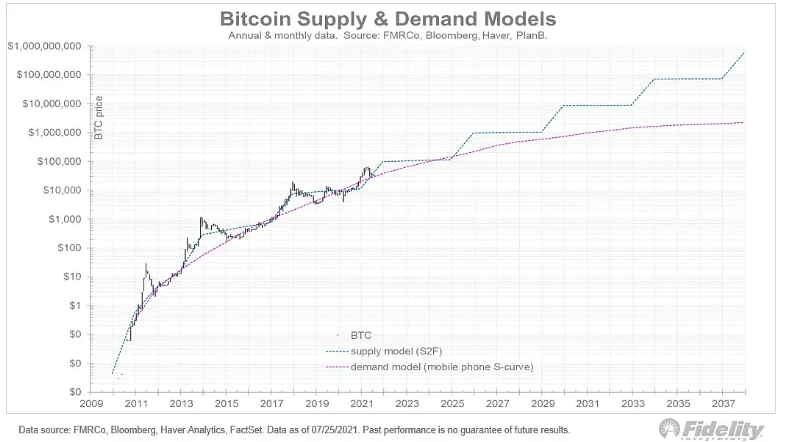
Jurrien Timmer, Director of Global Macro at Fidelity, has provided various Bitcoin price forecasts, both short-term and long-term, based on network adoption models and macroeconomic factors. Timmer's most bold prediction, initially shared in 2021, indicates Bitcoin could reach $1 billion by 2038. 

This projection is based on Metcalfe's Law, which posits that a network's value increases with the square of its users. Timmer suggests that as Bitcoin's user base grows, comprising individuals, businesses, exchanges, and institutions, its network effect will lead to exponential value growth, similar to the patterns seen in the internet and social media platforms.

He supports this forecast with two main models: Timmer’s demand model, which is based on Metcalfe's Law, predicts Bitcoin will reach $1 million by 2030 and shows steady growth. The stock-to-flow (S2F) model, created by analyst PlanB, estimates Bitcoin could be valued between $1 million and $10 million by 2030, possibly rising to $100 million by 2035, and eventually hitting $1 billion by 2038.

Source: Jurrien Timmer X

Timmer notes that his demand model generally indicates Bitcoin's lowest price level, whereas the S2F model more accurately reflects peak prices. The growing gap between these models after 2030 is partly due to an anticipated long-term decline in the dollar's value. Inflation and monetary expansion may reduce fiat currencies' buying power, making large nominal amounts such as $1 billion increasingly plausible.

He draws a historical comparison, pointing out that $1 invested in stocks during the 18th century would be worth about $4 billion today. This highlights how currency devaluation can make vast numbers seem more plausible over long periods. If Bitcoin hits $1 billion, even a small amount like 0.001 BTC (which is roughly $116 now) could grow into a $1 million stake, potentially changing how early investors build wealth.

The increasing number of companies achieving a $1 trillion market capitalization suggests that trillion-dollar valuations will become more common in the next 20 years. This could even extend to individuals being worth a trillion or more, with the scale of numbers potentially reaching the quadrillion range. 

Timmer also forecasted Bitcoin surpassing $96,210 by 2025, assuming favorable macroeconomic conditions persist. Currently, Bitcoin is trading around $116,000, showing that while Timmer’s 2025 predictions are becoming more relevant, the long-term $1 billion goal remains a highly speculative, long-term vision reliant on unprecedented adoption, network effects, and macroeconomic shifts.

Bitcoin Establishes Its Esteemed Role as a Store of Value

In 2023, Fidelity Digital Assets' Chris Kuiper and Jack Neureuter published "Bitcoin First Revisited," a study reaffirming Bitcoin's uniqueness among digital assets. Building on a January 2022 analysis, the study emphasizes Bitcoin's sustained distinct qualities, increased adoption, and expanding market share over the past 18 months, even as other digital assets faced difficulties.
 
The study describes Bitcoin as a unique monetary good, separate from other digital assets, because of its secure, decentralized, and sound digital money features. The authors believe no digital asset can surpass Bitcoin in these aspects without trade-offs. They recommend Bitcoin as the primary entry point for traditional investors into digital assets, highlighting the importance of separate evaluation frameworks for Bitcoin and other digital assets.
 
Fidelity's report highlights Bitcoin's special role as a store of value in the digital world, arguing that its success does not threaten other digital assets. The broader ecosystem serves different needs that Bitcoin does not address. The study thus acts as a foundation for making informed investment choices in the digital asset space, emphasizing the unique value proposition Bitcoin offers.

Screenshot: CoinMarketCap

The Bitcoin Effect: Why Altcoins Tend to Follow BTC’s Lead

Cryptocurrency investors constantly monitor Bitcoin's price movements, as it often influences the entire market. However, many are also curious about how altcoins and Bitcoin prices relate and why they tend to move together.

At the beginning of the cryptocurrency era, Bitcoin was the only digital currency, making its name almost synonymous with "cryptocurrency." Although many new blockchain projects with various uses have appeared since then, Bitcoin remains dominant, influencing market trends throughout the entire cryptocurrency world.

Bitcoin's rise marked a key milestone, transforming cryptocurrencies from a niche idea into a global phenomenon. Its core features, such as decentralization and limited supply, played a significant role in its extraordinary value increase and served as a driving force for the entire digital asset sector. The steady and increasing demand for Bitcoin significantly influences overall market trends, often shaping the direction and valuation of other cryptocurrencies.

This symbiotic relationship is clear in various market behaviors. When Bitcoin moves significantly in price, whether up or down, it often triggers a ripple effect across altcoin markets. This phenomenon, usually called "Bitcoin dominance," highlights its role as the industry's benchmark and a leader for investor sentiment. 

Furthermore, Bitcoin's technological advancements, such as developing the Lightning Network for quicker transactions, continue to influence the evolution of blockchain technology and inspire innovation in other crypto projects. Its established liquidity and perceived stability often make it the top choice for new investors, further solidifying its central role in the expanding digital economy. The ongoing story of Bitcoin, from its halving events to increasing institutional adoption, constantly emphasizes its importance and lasting impact on the future of finance.

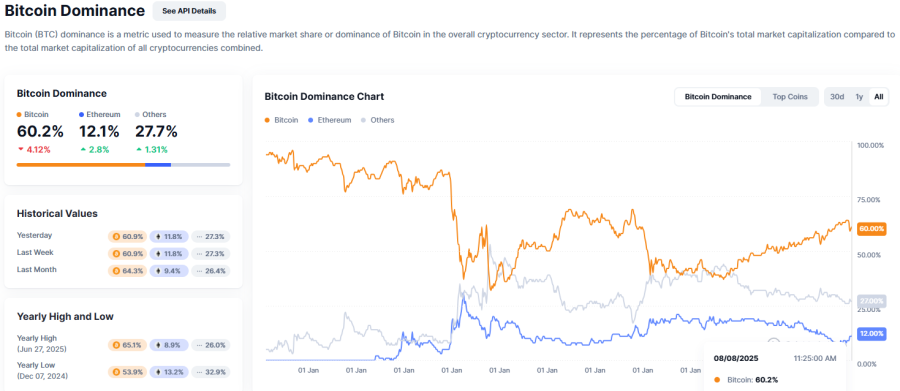
The main reason altcoins follow Bitcoin is that altcoin prices are usually valued in Bitcoin. Although 19.14 million competitors might surround the original crypto asset, it still dominates more than half of the entire cryptocurrency market cap. This market dominance gives Bitcoin significant influence and control.

A key aspect of the current market situation is that many altcoins, especially those with significant market cap, are traded in pairs with Bitcoin. Additionally, most coins can’t be bought directly with fiat currency, so traders often need to acquire BTC first. Consequently, if an altcoin holder decides to exit the crypto market, they usually convert their assets into Bitcoin before exchanging for traditional currency. This process closely links the value of many altcoins to Bitcoin due to the frequent transactions.

Altcoins tend to increase in value when Bitcoin's price rises, due to the strong market correlation driven by Bitcoin's role as the benchmark and dominant asset in the cryptocurrency market. This relationship arises from market sentiment, trading activity, and investor behavior, where gains in Bitcoin indicate bullish confidence and lead investors to pursue higher returns in altcoins.

When Bitcoin consolidates after a big rally, investors tend to move their funds into altcoins, hoping for greater gains. This is called 'altseason.' It is characterized by falling Bitcoin dominance and increased investment in alternative cryptocurrencies. Market sentiment and FOMO (fear of missing out) intensify this trend, as traders expect and react to upcoming price changes, which strengthens the correlation.

However, exceptions do exist. For example, positive news such as an altcoin getting listed on a major exchange or announcing an upgrade can boost its price, even if the broader market is declining. These price increases are often driven by investors exchanging their BTC for the altcoin, expecting its value to rise.

Essentially, Bitcoin acts as the tide that lifts all boats. Its dominance means that its price movements influence the entire market. While altcoins have their unique technological innovations and use cases, their short to medium-term price trends are heavily affected by the prevailing market sentiment, which is often driven by Bitcoin's trajectory. This interdependence underscores the importance of watching Bitcoin's performance as a barometer for the broader cryptocurrency market.

What does BTC’s Significant Price Forecast imply for Utility Altcoins such as Hivecoin?

The unprecedented rise of Bitcoin toward a potential value of just $4 million is set to generate a significant ripple effect across the entire cryptocurrency market, especially benefiting altcoins that provide real-world utility and a distinct, defined purpose. This isn't just about speculative profits; it's about the growth of a developing industry, where Bitcoin's strong foundation serves as a catalyst for other digital assets to demonstrate their true value.

As Bitcoin establishes itself as a store of value and a hedge against traditional financial instability, it will naturally attract more institutional and retail investment into the broader crypto ecosystem. This influx of capital will likely spill over into altcoins, but not randomly. Investors, encouraged by Bitcoin's growth, will focus on projects that are creating real solutions to current problems, rather than those driven only by hype or short-term trends.

Altcoins integrated into supply chain management, providing transparent and immutable tracking of goods, are likely to see increased adoption. Those facilitating decentralized finance (DeFi) solutions, offering alternatives to traditional banking services like lending, borrowing, and asset management, will attract users seeking greater control and efficiency. Additionally, cryptocurrencies powering the growing Web3 infrastructure—enabling decentralized applications (dApps), secure data storage, and peer-to-peer communication, such as social networking, marketing, and e-commerce—will have significant growth opportunities. If BTC reaches $4 million, Hivecoin (HVC) could potentially surpass $100,000.

The key differentiator for these altcoins will be their ability to go beyond theoretical promises and showcase tangible applications that address real-world issues. This era will favor innovation that results in practical benefits, helping to create a stronger and more sustainable digital economy built on Bitcoin's foundational success. Therefore, the future of the crypto market depends not just on Bitcoin's rise but also on its various offshoots proving their lasting value through genuine utility and purpose.

This article is provided for informational purposes only and should not be relied upon as legal, business, investment, or tax advice. Furthermore, however plausible, the contents of this article may include speculative opinions. Of course, there is nothing wrong with speculation as long as its premises are made clear. Speculation is the customary way to begin the exploration of uncharted territory, as it stimulates a search for evidence that will support or refute it.


Editor in Chief Markethive: Deb Williams. (Australia) I thrive on progress and champion freedom of speech.  I embrace "Change" with a passion, and my purpose in life is to enlighten people to accept and move forward with enthusiasm. Find me at my Markethive Profile Page | My Twitter Account | and my LinkedIn Profile.


Tim Moseley

How Online Casino Pending Withdrawal Periods Work

When a player presses the withdraw button, the expectation of an instant transfer is common. In reality, the casino must run a series of checks before any money leaves the platform. These checks are built into a waiting window that can last from a few hours to several days, depending on the casino and the chosen payout method.

The first step is the casino’s internal review. The platform verifies that the requested amount does not exceed the player’s available balance, that no pending bonuses or wagering requirements are outstanding, and that the player’s account is in good standing. Simultaneously, anti‑money‑laundering procedures scan the transaction for patterns that could signal fraud.

Once the internal review clears, the withdrawal is marked as pending. Casinos typically schedule the transfer for the next business day, but weekends, public holidays, or high‑traffic periods can push the start of the actual transfer further out. During this interval, the casino may notify the player of the pending status and the expected completion window.

After the casino authorises the payment, the funds are handed over to the chosen payment provider, whether that is a bank, an online wallet, or a third‑party processor. For additional context, casinositeleri can be considered alongside this overview. The provider then moves the money into the player’s external account. Depending on the provider’s processing speed, this final leg can take anywhere from a few hours to several business days. Some e‑wallets offer instant settlement, but the casino still needs to confirm the transfer before the player can see the balance.

Because the process involves multiple actors, transparency is key. Casinos that openly communicate each stage and provide clear timelines reduce uncertainty for players. If a player notices a delay beyond the advertised window, they can contact customer support and, if needed, file a dispute with the casino’s regulatory authority. For more detailed information on how pending periods are regulated, you can visit .

The pending withdrawal window is not merely a quirk of the industry; it is a safeguard that balances speed with security and regulatory compliance. By giving the casino time to verify identities, confirm balances, and ensure that money moves through legitimate channels, the system protects both the player and the platform from fraud and financial crime. Understanding how each stage contributes to the final outcome helps players set realistic expectations and evaluate whether a particular casino’s payout policy aligns with their needs.

Common Crypto Casino Payment Mistakes

The mechanics of transferring digital assets to a gaming platform rely on distributed ledger technology, which operates on principles fundamentally different from those of conventional financial institutions. Unlike traditional wire transfers or credit card processing, blockchain transactions are irrevocable once they are confirmed by the network. A frequent error involves the selection of incorrect network protocols, such as attempting to send tokens over a chain that is incompatible with the destination address. Because these platforms maintain specific liquidity pools tied to individual networks, choosing the wrong chain often results in the asset being stuck in a smart contract that the receiving wallet cannot access, rendering the funds inaccessible despite the transaction showing as successful on a public explorer.

Another significant oversight relates to the discrepancy between decimal precision and minimum deposit thresholds. Cryptocurrency wallets often display balances with many decimal places, yet gaming interfaces may implement strict minimum requirements for incoming transfers. When a user sends an amount slightly below the platform’s set minimum, the transfer may successfully reach the destination address but fail to trigger an automated update to the user’s account balance. This results in a state where the funds remain in the hot wallet of the platform, requiring manual intervention or reconciliation from support teams. These situations underscore the necessity of verifying specific platform parameters before finalizing any movement of value.

Managing the security of these transactions often requires a deep understanding of address formats and the risks inherent in manual entry. Copying and pasting address strings is prone to errors, particularly with sophisticated malware capable of altering clipboard contents during the transfer process. For additional context, best non gamstop casinos uk can be considered alongside this overview. A more reliable approach involves using QR codes to verify destination details or cross-referencing multiple characters across the address string, which you can to better understand, as it provides a practical method for auditing destination accuracy. Relying on browser caches or autocomplete features when inputting wallet addresses can lead to sending assets to legacy addresses that are no longer supported or to unintended recipients.

The timing of network congestion also introduces risks, specifically regarding gas fees and transaction priority. When users choose low transaction fees during periods of high activity, their transfers may stay in a pending state on the blockchain for an extended duration. During this interval, the casino platform may experience a shift in exchange rates or policy, potentially complicating the credit process. Furthermore, some platforms set aggressive timeouts for incoming deposits. If the blockchain does not confirm the transaction within a predetermined window, the internal credit system may ignore the deposit request, necessitating an inquiry to resolve the resulting discrepancy between the user’s records and the platform’s database.

The absence of institutional mediation is the defining characteristic of this payment model, placing the burden of accuracy entirely on the sender. In traditional finance, chargebacks or reversal requests provide a buffer against error; however, cryptographic protocols inherently lack these recovery mechanisms. The irreversibility of the ledger means that a single mistyped character or an incompatible token type is usually terminal for the assets involved. As decentralized wagering continues to evolve, the most effective strategy for users remains the methodical verification of every technical parameter before initiating a transfer, ensuring that the autonomy provided by the technology is matched by the responsibility of the operator.

The Artist that came out of the Winter