Market Purge Continues As Crypto Industry Strives For Maturity. Perfect Timing For Markethive
Also, Updates On New Integrations And The Markethive Wallet
As the bear market continues wth its crypto-cleanse and traders bemoan the adverse price action, some industry leaders opine these conditions will eradicate bad actors and create more significant opportunities for upcoming projects and future participants. Several leading crypto analysts and engineers embrace the idea that this is the time to engage in moves leading to the loftiest gains when the bull cycle returns.
Markethive stands firm with these sentiments and continues to build its next-generation entrepreneurial platform and be ready for the market-cleansed bull run. Those on the Markethive journey may be aware that new features are being integrated into the newsfeed in preparation for the five-channel dashboard housing various feeds.
The new features and upload capabilities now active on the platform include;
Emojis
Emojis include a range of bees, appropriate for the Hive and a fantastic way to make the workplace and your social interactions fun. A poll conducted by Appboy found that people enjoy emojis in general. More than 64% like or love emojis, compared to only 6% dislike them.
Polling
Another sought-after feature by many entrepreneurs is now live on the Markethive platform. This is a great way to gauge reactions, opinions, and information from the community at large. Perhaps you could do a poll to see how the Markethive community like the new emoji integration.
Images and Gifs
We now have a new way to upload images and gifs either directly from any website or personal computer. Simply copy the image from the origin and paste it to the desired location in Markethive, or paste in the image address. With gifs, paste the image address unless you are copying from your files with your device. This is a requirement for the animation to work.
Videos
Now you can upload videos directly from your device into Markethive as part of the Markethive video system. This is the inception of the Markethive Video Channel that will be integrated into the new dashboard, where you can post your video from Markethive directly to many other media platforms by way of a permalink.
You can also upload videos from YouTube, Vimeo, Rumble, and Bitchute, which will play directly on the newsfeed. This negates being taken away from the Markethive site.
Significant upgrades have also been installed for the internal Markethive Messaging interface, Newsfeed, and comments system.
And It’s Just The Beginning
This is just the beginning of the dynamic transformation and direction Markethive is moving towards. The innovative five-channel dashboard integration will consist of five newsfeeds—the general newsfeed, the blog, the video channel, curation, and surveys.
It will significantly streamline your activities and business facilitation and will include a search engine so you can build your personal algorithms. This will save time and effort by eliminating what you don’t want to see in your newsfeeds, be more intuitive, and enhance the user experience.
The Markethive Wallet
CEO of Markethive, Thomas Prendergast, and the team of engineers have made substantial headway with the wallet. It is all but done, and the release is imminent. It’s not a simple wallet that just transfers coins. It is a complete portfolio and accounts of all your transactions, payments, and affairs, including your ILPs. The wallet comprises fourteen major foundational processes and is your internal wallet on the Markethive database.
An itemized account on all elements of the wallet is as follows;
1 Hivecoin wallet (done) for sending and receiving coin (initially for upgrades only) â
2 The New Vault (done) with Feed the Vault and Auto fund thresholds and deposits tracking control panel including the following:
a. Subscriptions â
b. Payment History â
c. Payment Methods â
3 Markethive Credits (done) Markethive Credits are used to pay for Markethive services.â
A Markethive credit is a credit token valued at $1 USD per token and can be purchased with a credit card, crypto, (and Hivecoin after we are on the exchanges)
4 ILP notes control panel (this is the last function being built)
5 Hivecoin price chart scale (will be integrated when the coin is listed)
6 Subscriptions Control (done) â
7 Payment History (done) â
8 Payment Methods (done) â
9 Crypto Merchant Account (done) (turnkey for upgrade members use also) â
10 Feed The Vault (done) â
11 Vault Deposit History (done) â
12 Vault Threshold (done) â
13 New Staking (done). â
Markethive Credits will receive staking. Hivecoin will no longer be staked.
14 Coin Clip History (done) â
The manyfacets of the Wallet are completed except the ILP platform, which is nearing completion. Once these facets are completed, they all need to be designed into the wallet's interface. The Merchant Account, the Vault Interface, and Markethive Credits components are already completed.
As we approach the wallet release, the Coin Drop incentive for people joining Markethive will be reduced from 500 HVC to 50 HVC, and new Entrepreneur One accounts will no longer be available. Simultaneously, we will release our Premium upgrades at a reduced cost, enabling members to take advantage of the many benefits and services Markethive offers.
As stated by Thomas Prendergast,
“After the release of the wallet, we will launch a new offshore company to begin building our own exchange. We will also have several campaigns engaged in getting listed on as many exchanges as we can as quickly as we can.”
The Current Crypto Landscape
Although we are deeply immersed in a bear market, Markethive continues to progress in its development. As the entrepreneurial culture is knitted into the fabric of Markethive, its community sees the bigger picture and is aligned with the sentiments of the industry experts.
According to experts, crypto winters are actually good for Bitcoin; For example, pivotal projects like the Lightning Network, a major Bitcoin-related project enabling cheaper, faster Bitcoin transactions, were developed during bear markets. The initial concept of the Lightning Network was formulated during the bear market of 2015.
Also, people in the industry continue to reiterate that bear markets are actually healthy for the crypto industry, as they remove speculators and scams while providing space to build genuine and excellent products and services.
In recent weeks, a wave of panic has swept through the crypto community, with BTC miners' selling activity rising to seven-month highs as mining profitability dropped to levels last seen in October 2020.
TheBitcoin Fear & Greed Index posted that it recently fell to 7, indicating 'extreme fear,' the lowest number since the pre-pandemic Q3 2019. The self-updating image below shows a more positive rating at the time of writing, although it is still in the extreme fear category. But according to some industry experts, the recent events in the industry do not look as bad as they first appear and the bear market is not to be feared.
Anthony Pompliano, in arecent interview with Fox News, explained that Bitcoin’s value and price are diverging and that weak hands are selling to strong hands.
“What we’re watching right now is the transfer from weak, short-term oriented people with weak hands into the long-term oriented, strong hands.”
“Bear markets are good for Bitcoin. Builders face fewer distractions, and the fake ‘project founders’ that were only looking for a quick VC funding and naive retail exit liquidity disappear as quickly as they previously appeared. Real builders rejoice when all the bullshit gets washed out.”
Perfect Timing For Markethive
So the timing couldn’t be better for Markethive to distinguish itself and gain prominence in the crypto market as the blockchain-driven multi-media network pioneer. The purpose of Markethive is to deliver a broadcasting platform, marketing systems, and communication interface, all based on Biblical principles where truth, freedom, and liberty are the foundation and intrinsic to the entrepreneur.
Markethive and its community stand by these principles and are inherently guided by Divine Providence, where everything takes shape in God’s timing, not ours. Markethive is in every country in the world and ready to lift millions of people into an environment of freedom of speech and information, financial sovereignty, and well-being. We are responsible for creating a massive army for the Lord and a foundation for the last days; The final harvest.
We live in uncertain times, prophesied as the end times, with catastrophic events impacting society on every level. With the global economy in free fall, the need for a different approach is here, and these events are forcing the crypto industry to grow and mature. Markethive is here to pave the way as one of the new innovative technologies that will rise in the wake of this bear market.
Come to our Sunday meetings at 10 am MST as we approach massive major upgrades and the wallet launch. See and hear explanations, ask questions, and witness the ever-evolving technology and concepts of Markethive. The link to the meeting room is located in the Markethive Calendar.
CRYPTO BEAR MARKET – Why Experts Say It’s A Good Thing
Billions of dollars of value have been wiped off the cryptocurrency market in the last few weeks because of a sell-off in stocks, another rate hike and balance sheet shrinkage by the Fed, and the downfall of algorithmic stablecoin terraUSD. Cryptocurrency and Blockchain industry leaders believe that the recent crash in the crypto market would purge “bad actors.” The executives said the market purge was necessary and characterized it as “healthy.”
There are currently over 19,000 cryptocurrencies and at least 1000 blockchain platforms with four types of Blockchain Networks. Blockchain is the technology underlying these digital currencies and platforms. Still, the question is who will survive this massive bear market that has been happening for at least six months, and the experts are shying away from predicting its short-term future.
Many industry executives see the current market situation as unsustainable. Ripple CEO Brad Garlinghouse believes that the future may see “only a handful” of cryptocurrencies remaining, stating that there are around 180 national currencies worldwide. So many cryptocurrencies aren't really necessary.
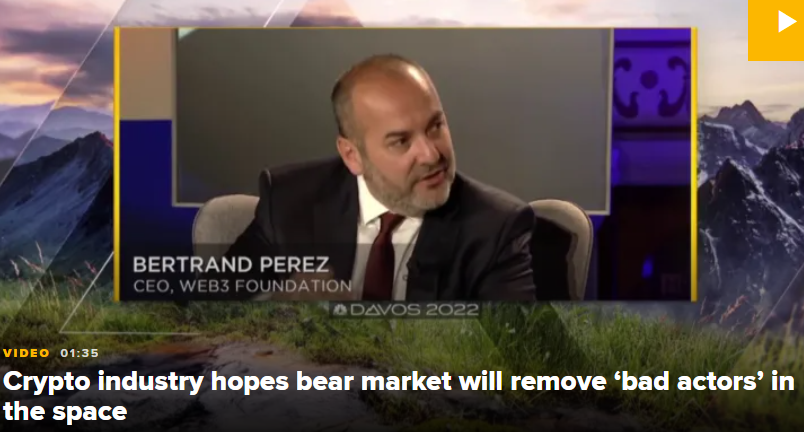
Bertrand Perez, CEO of the Web3 Foundation, told CNBC,
“We’re in a bear market. And I think that’s good. It’s good because it’s going to clear the people who were there for the bad reasons.”
He went on to say,
“It’s good also because all those projects are gone. So the legit ones will be able to focus only on developing on building and forget about the valuation of the token because everyone is down. During the bull markets, when everything is green, no one thinks about building; everyone thinks about making a fortune, which is the wrong mindset.”
Other executives reiterated the same view that the massive price rally caused people to focus on speculation rather than building products. Michael Gronager, co-founder and CEO of the crypto data analysis firm, Chainalysis, says these down periods help distinguish between the signal and the noise.
Mr. Gronager explained,
“It’s during these bear markets where good new tech gets developed. We’ve seen people get excited about new technology, and suddenly everyone wants to access it, but it’s never as good as people hope for. And then there’s a certain level of disappointment, but it’s when a bear market comes along, and companies are under-funded that real innovation emerges.”
So despite the anguish of speculative investors when the price of cryptocurrency collapses across the board, some argue it is a necessary development to sort the genuinely innovative projects from the pump-and-dump schemes.
Why Do So Many Cryptos Fail?
Although the flagship cryptos, Bitcoin and Ethereum, have fallen substantially from their historical prices, other altcoins have fared even worse, with many that have entirely failed, including Luna, Dogecoin, Squid Game, PayCoin, and many more for various reasons. So many crypto coins have been released into the market and have died and disappeared over time. Why do they keep failing?
Numerous ventures are sure to face challenges in a market that is still emerging. Therefore, after releasing their coins and tokens, the creators often realize that their concepts are obsolete. Developers typically do not invest sufficient time or research when planning their foundational structure for their coins and tokens, only to find out after release that their concept is already on the market.
Many cryptocurrencies are copied versions of previously successful currencies, and many of them aspired to match Bitcoin's success. However, Bitcoin is already on the market and is still in demand, especially now with its emerging Lightning Network.
A Few Key Elements Why Cryptos Fail
Lack of a Defined Purpose: Most cryptocurrencies do not have a clear purpose or target market. They are like a machine gun firing in all directions, hoping to find a target and hit it. A well-defined purpose will help your cryptocurrency attract the right people and repel the wrong ones.
Lack of a use case: A cryptocurrency with no actual use case will eventually become obsolete. A cryptocurrency with a clear use case will help people understand why they should own it. Many cryptocurrencies today don’t seem to solve a real problem. They are just trying to find a niche to apply blockchain protocol and take advantage of emerging technology.
Weak Ecosystem: Some cryptocurrency projects are focused on creating a coin and trading it without building a community that aligns with its vision and mission. The importance of a robust ecosystem cannot be overstated. Without one, a project will have a hard time gaining traction, let alone succeeding. A tenuous ecosystem could cause other problems, such as low liquidity and volatility.
Inactive Development: In the crypto ecosystem, things change at a rapid pace. New technologies emerge, new competitors appear on the scene, and user needs and preferences change. If a crypto project is not flexible enough to keep up with these changes, it will not be able to survive in the long term.
Security Issues: Breaches to cryptocurrency projects can also lead to their failures. From hacking to creating fake nodes, bringing down a coin is easy when its security isn't robust.
Rug Pull: A rug pull is a malicious maneuver in the cryptocurrency industry where crypto developers abandon a project and run away with investors’ funds. Rug pulls got away with more than $2.8 billion worth of cryptocurrency from victims in 2021.
Tokenomics: The amount of tokens supplied has a significant impact on the price. If there is a lot of supply, that can depress the price, even more so when demand is low. It's all about the law of supply and demand.
Shiba Inu is one example with a coin supply of 1 quadrillion. Shiba Inu trades for a small fraction of a penny because its supply is so large. There was some speculation it may reach $1; however, there’s currently a supply of 549 trillion SHIB tokens in circulation, giving it a market cap of around $11 billion.
If those tokens were worth $1 each, SHIB's market cap would be $549 trillion, roughly 200 times bigger than Apple, the world's most valuable company, and more than six times the world's annual GDP.
In other words, Shiba Inu reaching $1 would likely require a massive reordering of the world economy, and that's not going to happen. But there is a way to decrease the total coin supply by burning the coin; however, it takes considerable time.
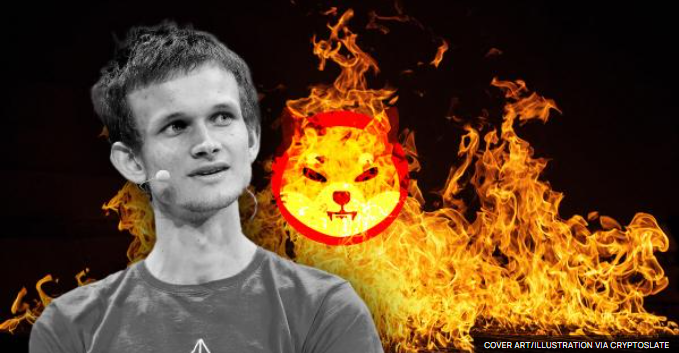
Shibburn, a website dedicated to the project burn of Shiba Inu, said that 410 trillion Shiba Inu coins have already been burned. They were taken out of circulation by Vitalik Buterin, co-founder of Ethereum after the anonymous Shiba Inu founder gave him half of the one quadrillion Shiba Inu coin supply. Buterin said he was uncomfortable controlling so much of the supply.
According to Shibburn, around 63 million Shiba Inu coins have been burned in the last 24 hours, which seems like a lot. However, if that rate continues, it would take just over two weeks to burn 1 billion coins and 40 years to burn 1 trillion. If there were an organized movement among SHIB holders, the burn could accelerate and pick up steam if the value of SHIB continues to drop.
However, there's a clear disincentive to burning the coins. If the value begins to increase, it's in the interest of holders to keep their coins rather than burn them. The decentralized nature of cryptocurrency makes it unlikely that an organized movement will be powerful enough to reduce the number of coins substantially.
And what about the use case? John Wu, president of Ava Labs said, Shiba Inu "wasn't built with a sophisticated use case like borrowing, lending, trading, or gaming. It’s really just the Shib Army rallying behind the coin.”
Why Bitcoin And Other Purposeful Cryptos Will Survive
More and more institutions are paying greater attention to the role of Bitcoin and Ethereum as hedging tools. There is increasing interest in several countries to adopt Bitcoin as their official currency. El Salvador was the first to adopt it in September of last year as their legal tender, the most recent being the Central African Republic.
More individuals, companies, and governments are beginning to accept and adopt Bitcoin, and more investors are noticing its value, so I think it’s safe to say that our digital store of value or digital gold will remain and gain prominence well into the future.
In addition, Bitcoin has faced various attacks and smear campaigns in the past decade in the past decade. Despite everything, Bitcoin has withstood the test of time with great tenacity, providing ample evidence of its ability to overcome challenges and problems.
As mentioned earlier, experts in the industry believe the timing is perfect for getting rid of the weeds. At the same time, emerging projects rise with all the fundamentals and utility to cater to users' needs. So, it’s an excellent time to take stock of more promising cryptocurrency ventures for the remainder of this year. As the crypto world changes rapidly, some of these projects' overall strengths or weaknesses will likely change, while others will be on point.
Although Bitcoin and Ethereum have the first-mover’s advantage, a few Blockchain projects such as Solana, Elrond, and Cardano have the underlying principles and infrastructure to survive the most challenging crypto winters. They all have a strong community and dedicated team of developers with a defined end goal and solutions to some of the most challenging hurdles facing the blockchain and crypto industry.
An Emerging Sector For the Blockchain Crypto Industry
Another sector overcome by centralization and severely lacking in blockchain technology is the social media and marketing niche, until now. Markethive is a blockchain-driven social media, inbound marketing, and broadcasting network rapidly building a dynamic ecosystem for the entrepreneur.
Markethive is a crypto project with extensive and varied use cases that significantly drive demand for its token. (HVC) It has developed the much-needed solutions for marketers, influencers, business owners, and the like. We have all been victims of the current state of the media and tech companies where monopolies have been created.
A decentralized and open media ecosystem, by definition, requires it necessary to have different options to broadcast and consume information free from censorship. Where content remains the creator's property, and the culture embraces self-sovereignty.
Markethive is an entirely different animal and one of the most promising and potentially disruptive projects in the entire social media and marketing industry. It is a project with a large number of real-world applications, and it has the potential to change the media landscape.
With its comprehensive wallet and member merchant accounts nearing completion, the timing couldn’t be better to distinguish itself and gain a foothold in the crypto market. This bear market will see weak projects and unscrupulous players fall, and the meaningful, intense, and focused projects will survive and thrive.
Some argue that the best bear strategy is to hoard cryptos, but a better approach is to earn more cryptos with one's existing holdings, which resembles receiving interest on bank deposits. This strategy is just one of the ways Markethive rewards its users who are part of the community.
The whole ecosystem revolves around earning and accumulating your crypto holdings by being active on the platform and conducting ecommerce via their business facilitation, thereby creating traction and velocity that is very likely to propel the coin.
As Markethive is a first-mover for the blockchain-related social media and marketing sector with its proprietary technology, it is poised to become mainstream in the next phase of cryptocurrency and blockchain technology in the aftermath of the massive cleanup of all useless altcoins. Many experts in the cryptocurrency space have said they expect thousands of cryptocurrencies to collapse.
Some exchanges have already folded or laid off employees, including Coinbase. Much of this is due to the crypto crash and the fact they hold many of these dead coins on its exchange. Perhaps it’s time for them to rethink their strategies when listing cryptos.
We are currently experiencing a collapse in traditional financial markets and many unprecedented events that are being hailed as “the storm”; spiritual, social, political, and economic – a storm affecting every aspect of our lives.
As the volatility of the global socioeconomic conditions continues on a downward trend, Markethive, guided by Divine inspiration, is here to pave the way as one of the new innovative technologies that will rise in the wake of this bear market.
There is a large contingent of people that believe that cryptocurrency can offer a more stable alternative. With more people investing and utilizing crypto, the market has more stable prices and less chance of being manipulated by outside forces.
When looking beyond the shortcomings and issues of nascent technology, there are many positive benefits with new technology constantly emerging and the philosophical approach of many entrepreneurs heading the upcoming sophisticated projects. It makes sense why crypto is becoming an increasingly popular alternative for investing in the face of instability in traditional markets.
BlackRock – Shadow Government?
Is It Too Big To Fail? Or Has It Now Got Too Big To Control?
There is a company out there that has more funds running through its systems than the entire GDP of the USA. A company that can and has used its clout to effect “societal change” whether we like it or not. A company with a direct connection with powerful politicians in the world has recently come front and center as it has started exploring investments in the crypto space and venturing into governance territory that will impact worldwide.
The BlackRock Behemoth
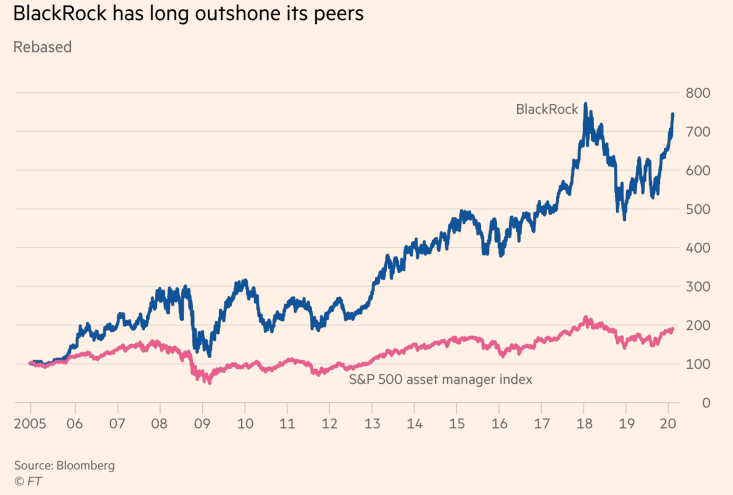
BlackRock is the world’s largest asset manager, and while many may have heard of it, you may be surprised just how much control it has over the financial markets. A control is afforded to it through leveraging our money, so there’s a strong chance that you and your money are connected with it somehow. It is a company that has its fingers in many pies, with over $10 trillion in assets under management.
They are also one of the most secretive companies in the world of finance. Trading and commodities are two areas of BlackRock’s business that have come under scrutiny from government regulators in recent years.
The Commodity Futures Trading Commission (CFTC) has claimed that the process of trading commodities futures is not transparent and is likely being abused by large investment firms like BlackRock. One of the most controversial aspects of BlackRock’s business is the way they have been operating their so-called dark pools.
Blackrock’s political connections are extensive. Over the past couple of years, there has been growing concern about how much control large corporations like Blackrock exert over American politics and economic policymaking.
Although they claim to be a non-political organization whose only interest is maximizing shareholder value, it is clear that many large corporations like Blackrock do wield significant influence over how our government works and what kinds of policies it enacts into law.
BlackRock is a New York City-based company founded in 1988 by Laurence [Larry] Fink and Ralph Schlosstein. Starting as a Bond Asset manager, it quickly grew into a financial services company that provides investment management, risk management, and fiduciary financial services to a wide variety of clients ranging from Central Banks to pension funds and individual investors.
In 1999, BlackRock became a publicly-traded company and continued its rapid expansion in the asset management sector. In 2006, the firm acquired Merrill Lynch's Asset Management business, which rapidly expanded its offerings in the equities sector. This was further compounded by the purchase of Barclay’s iShares in 2009. At $13.5 billion, this was one of the biggest deals in Asset Management history.
As a result, BlackRock quickly morphed from being a bond asset management company to an Index Fund provider. Index Funds, sometimes called Exchange Traded Funds, are collective investment vehicles that track the performance of a particular index or basket of Securities. They're hugely popular, not only because they're easy to invest in but also because they incur lower fees than more active investment management firms.
These benefits have also made index funds extremely attractive for more passive institutional investors, the most common being pension funds. Trillions of dollars are invested on our behalf and find their way into index funds of some sort. So there’s a strong possibility our money has been invested through BlackRock somehow. Either that or it's being invested by another index provider thanks to BlackRock’s technology.
The point is that BlackRock is a behemoth that invests on behalf of hundreds of millions of people, and what that means is it has an interest in nearly every company you can think of. Since BlackRock must invest funds to track indexes or other investing themes, it must invest in the underlying assets. If these funds track an equity index, BlackRock must take a stake in the underlying company, so BlackRock is often one of the largest shareholders of a company's outstanding shares.
These companies include some of the biggest Wall Street banks, like Goldman Sachs, JP Morgan, Bank of America, and Citibank. Essentially, BlackRock is one of the top three shareholders in the banks that keep the financial markets running.
BlackRock is also vested in the media with Comcast, Viacom, et al. Also, social media and tech companies with large stakes in Google, Apple, and Twitter. They even have stakes in the food industry with Mcdonald's, Chipotle, et al. Along with State Street and Vanguard, BlackRock forms a trio of the largest shareholders in the vast majority of publicly-traded companies in America.
For example, according to a recently published paper by Corpnet, these prominent three asset managers are the largest shareholders for over 90% of all companies in the S&P 500. In fact, in the broader collection of all outstanding publicly traded companies, 40% of them have these three as their most significant shareholders. And it’s not just America; it holds considerable positions in companies in Europe as well.
A Slice Of The Real Estate Pie And Now Crypto
BlackRock has its eyes on cryptocurrency with BlackRock CEO, Larry Fink saying the firm is studying the crypto sector broadly, including assets, stablecoins, permissioned blockchains, and “tokenization,” where it perceives a benefit to its customers. We are increasingly seeing interest from our clients, he said.
BlackRock is an investor in a $400 million fundraising round for Circle Internet Financial, the crypto-focused company that manages the stablecoin USD Coin. During a conference call in April 2022, Larry Fink said BlackRock has been working with Circle over the past year as a manager of some of Circle’s cash reserves. He said he expects BlackRock eventually to be the primary manager of those reserves. We look forward to expanding our relationship, he said.
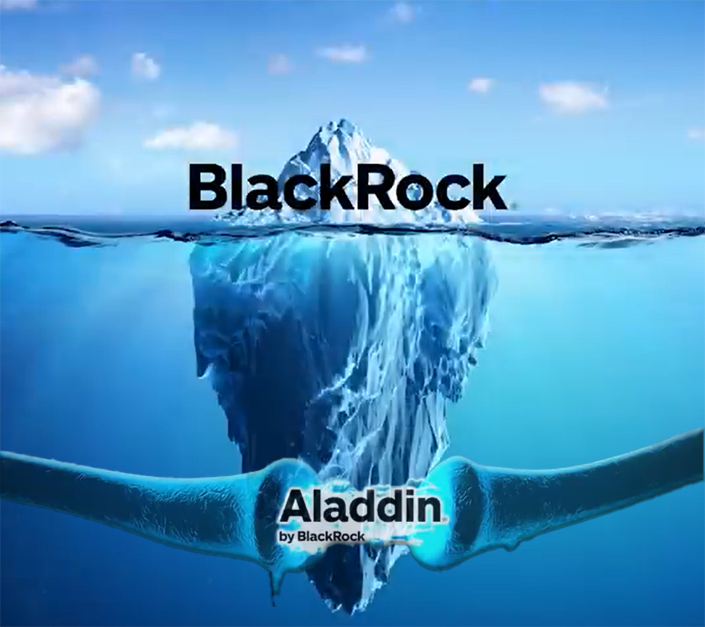
You might also be surprised to learn that asset managers like BlackRock have been competing with you regarding residential real estate. Last year, large institutional investors bought up entire property units to diversify their holdings. Just imagine, large asset managers could potentially be using your pension money to outbid you on a home. Despite how crazy all this sounds, it’s just the tip of the iceberg.
ALADDIN – BlackRock’s Genie Of Growth And Control
BlackRock has not only made a name for itself through its index funds, but it's also developed an institutional investing platform that is the backbone of the asset management system. The “central nervous system” is relied upon by nearly every billion-dollar capital allocator. It’s called Aladdin, an acronym for Asset, Liability, And Debt, Derivative Investment Network.
Since Aladdin’s humble beginnings as a time-saving system that BlackRock could use to report on bond positions automatically, it has grown over the years to become the operating system for the company that inhabits multiple data centers and is maintained by a group of between 1,500 and 2,000 people.
Aladdin is so integral to BlackRock’s internal risk management systems that around 13,000 BlackRock employees use it worldwide. Aladdin also became so sophisticated that BlackRock saw an opportunity to start making money from competing asset managers, institutional investors, and corporates by making the platform available to them. It would also allow these investors to manage their portfolios and model the inherent risk.
The list of companies that use Aladdin is vast, with over 240 external clients currently relying on the platform. Companies like Google, Apple, and Microsoft use it for their corporate treasury management. The $1.5 trillion Japanese government pension fund is also a client, as well as State Street and Vanguard.
So, in reality, BlackRock’s biggest competitors are effectively paying to use BlackRock's systems and, in the process, giving BlackRock access to reams of data about their portfolios. This data further helps BlackRock refine Aladdin and better model risk. Needless to say, because all these portfolios are linked, it certainly gives BlackRock the edge with Aladdin as a critical component in the global management of assets.
In 2020, an estimated $21.6 trillion sat on the platform, which is higher than the entire GDP of the United States at that time. Another comparison is if you were to empty the bank account of every one of the 7.6 billion people in the world, every single bill and coin, and place them all in a pile, it would be worth around $5 trillion.
So, this means that Aladdin has grown into a system that is responsible, directly or indirectly, for over four times the value of all the money in the world. Aladdin doesn’t make investment decisions, but its risk models inform the investment decisions of all who use it.
There have been many who have questioned whether this system poses a systemic risk to the market. For example, given how many managers rely on its analytics and modeling, does this create complacency and reliance that could give a false sense of security? What happens if there are inaccurate or erroneous readings? It's only a computer model, after all.
A UK regulator, the Financial Conduct Authority, reported that the failure of an extensive portfolio and risk system like Aladdin could cause serious consumer harm or even damage market integrity.
Jon Little, former head of BNY Mellon's international asset management business, told the Financial Times,
“The industry is becoming reliant on a small number of players such as Aladdin, yet regulators seem to be reluctant to regulate or intervene to supervise these key service providers directly.”
This video sums up the level of involvement BlackRock has with their technology, Aladdin has and looks somewhat like a terrifying science-fiction scenario, but it is happening today.
BlackRock’s Helping Hand
Did you know that BlackRock was instrumental in the bailouts and deals in 2008’s GFC? It was a key adviser to other big banks and the government itself. So BlackRock is not only a massive asset manager that controls one of the world’s most powerful computers, but it also offers advisory services.
It’s called the Financial Markets Advisory or FMA. It was born from the financial crisis as these big banks, along with the US Treasury and Federal Reserve Bank of New York, turned to Larry Fink of BlackRock for help and counsel on their predicament.
Through an array of government contracts, BlackRock effectively became the leading manager of Washington’s bailout of Wall Street. The firm oversaw the $130 billion of toxic assets that the U.S. government took on as part of the Bear Stearns sale and the rescue of A.I.G.
It also monitored Fannie Mae's and Freddie Mac's balance sheets, which amount to some $5 trillion. It provided daily risk evaluations to the New York Fed on the $1.2 trillion worth of mortgage-backed securities it had purchased to jump-start the country’s housing market.
Eleven years after the financial crisis, we had another emergency, the pandemic, which brought on a level of spending that was many multiples larger. The FED embarked on an unprecedented bond-buying program and monetary stimulus. These were trillions upon trillions of dollars that are used to buy back not only treasury securities but, more risky, corporate bonds and mortgage-backed securities.
And, of course, they needed the advice of someone who knew about these types of securities. Thankfully, they had the industry experts such as Larry Fink on speed dial. It was later disclosed that BlackRock was central to the pandemic response. According to this New York Times article, Larry Fink was in constant contact with Jerome Powell and Stephen Minuchin in the days before and after the FED's stimulus program announcement.
According to a contract posted in March 2020, the FED hired BlackRock to help with the corporate bond purchase program. Although there was much more transparency about the terms of the deal compared to its work back in 2008, it meant that BlackRock was instrumental in that bond-buying program.
It again shows how reliant these officials have become on this behemoth of Wall Street. So it's clear that BlackRock has political influence or, at the very least, is aligned with some really powerful people. But perhaps more concerning about the firm is its power and intention to exert over corporate board rooms.
BlackRock’s Role And Goal Posts Have Shifted
As mentioned above, BlackRock and the top three asset managers generally are the largest shareholders in hundreds of Fortune 500 companies. What this means is that not only do they own the shares, but they also get board representation. These corporate boards are designed to help advise on company strategies, and board members can have much more say in a company’s strategic objectives.
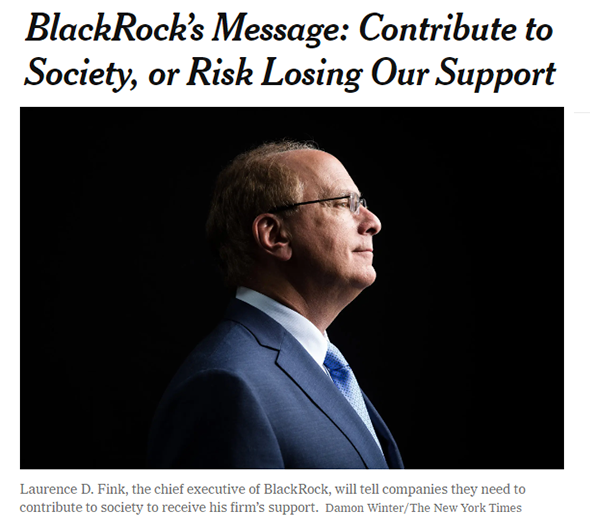
Given that BlackRock invests on behalf of clients, it is considered a passive investor, meaning it's merely tasked with allocating capital and voting in the best interest of shareholders. Up until a few years ago, that's precisely what it did. However, in 2018, it all changed because, at this time, Larry Fink wrote a letter to the CEOs of some of America's largest public companies. This was the first salute in his pitch to better contribute to society,
“Society is demanding the companies, both public and private serve a social purpose. To prosper over time, every company must not only deliver financial performance but also show how it makes a positive contribution to society.”
This was a novel idea at the time but has since shaped the mood around investing based on ESG or Environmental Social and Governance principles. The primary modus operandi behind this investing methodology is that companies should not only be graded on their bottom line but also on how they impact society.
This letter was a big deal. You had one of the most powerful investors on Wall Street saying that it would be using ESG criteria to grade companies, everything from their climate change records to diversity on their boards. Some wondered whether BlackRock really would carry out these plans for a more activist role; any doubts on the matter were laid to rest with some controversial shareholder votes.
For example, last year, BlackRock disclosed that as Exxon Mobil's second-largest shareholder, it was backing board changes proposed by an activist hedge fund. The fund in question was Engine No 1, and it's been trying to get Exxon Mobil to move faster in reducing its carbon footprint. The activist investor only held about $50 million in stock but had proposed some board members who Exxon claimed didn't possess the requisite skills to serve on the board.
As mentioned in this WSJ report, BlackRock also backed similar initiatives by voting against a board director of an Australian oil and natural gas producer called Woodside Petroleum. The reason for the vote was that the company was not outlining targets for emission reductions to its customers. So the world’s largest asset manager is showing it is more willing to use its heft to influence the policies of the companies it invests in.
Rich Field, a partner at the law firm King & Spalding, who focuses on corporate governance issues, said,
“BlackRock has strongly signaled that quiet diplomacy is not the only tool in its toolbox. We expect more votes for shareholder proposals and against directors in this and future years.”
Since 2020, BlackRock has stepped up pressure on more companies by publishing criticism with online bulletins about key votes. Some executives worry they could face lawsuits for publicizing details on labor or climate plans in areas where global disclosure standards don’t yet exist.
There are so many boards that BlackRock sits on that it could be hard to apply proper due diligence to these ESG votes. Some have complained BlackRock’s recent votes have come without warning or an adequate rationale. Ali Saribas, a partner at shareholder advisory firm SquareWell Partners, said,
“BlackRock’s approach will fuel a rising frustration among companies that believe BlackRock’s stewardship team will most likely apply a tick-the-box approach given the sheer volume of companies they passively own.”
Jessica Strine, CEO at advisory firm Sustainable Governance Partners, says,
“It would be very hard for a passive fund manager to support a shareholder proposal that addresses systemic risks but wades too far into dictating strategy.”
Investors propelled ESG funds to new heights in 2020, and federal agencies are watching. WSJ explains why regulators have ethical and sustainable investment funds under review. Photo Illustration: Alex Kuzoian
Has BlackRock Gone Too Far?
Some may think this is good news for a better future. Still, one of the biggest problems with this approach is that it assumes that meeting these ESG criteria could be complementary to the shareholder returns objectives.
However, this is often not the case because meeting these criteria may come at the expense of potential company performance and long-term shareholder returns. For example, in the case of the Exxon proposal, unless these standards are applied to all competing companies in the field, you are hampering some to the advantage of others.
Many oil and gas companies are private or listed elsewhere, companies that don't have BlackRock as a shareholder and hence don't have to worry about meeting the same standards. They can compete as much as the law allows them to, and sometimes to the detriment of Exxon. This could lead to a fall in the value of Exxon shares and the company as a whole.
Now the same principles can, of course, be applied to the S and G angles of the ESG strategy too. Then, of course, you have the administrative burden and the unpredictable way this ESG mandate is managed.
The approach that BlackRock wants to take could hamper the efficient performance of a company's board and corporate strategy, which is unsuitable for that long-term shareholder value. Beyond the additional burdens that this could place on companies, you have the question of whether a company like BlackRock should have such a significant say in how society is shaped.
The Silenced Majority
Have all the stakeholders, the millions of us who have pension funds and invest in ETFs, been asked how we feel about these proposals? Are stakeholders polled on each one of these proposals? And how do we know there's no broader political agenda that could seep in should the winds of public opinion shift. Does this create a precedent for other large companies to follow suit? These are all relevant questions that need to be answered. It is, after all, good governance.
Many of us know BlackRock is a powerful company but to realize how far that power extends is an eye-opener, to say the least. As the world's largest asset manager, it manages an ocean of capital that gives it immense control over the financial system.
Given that it's the owner and operator of one of the largest and most crucial asset management platforms, many would argue that it's too big to fail, but more to the point, it's now too big to control. That's because BlackRock seems to be taking on a new mission beyond mere capital allocation.
The firm is looking to use its ESG mandate to shape the way that corporate America is run. It's also not as if politicians can really do much about it. Given BlackRock's connections with all of these higher-ups, it is more likely to call the shots than the other way around.
Of course, the mandate and goals of BlackRock may be benevolent and sincere, but you have to question how this power could be used in the future should it fall into the hands of someone who would use it for more than just ESG benchmarks? Money is power, after all, and given that BlackRock controls so much money, it has absolute power. And as the saying goes, absolute power corrupts, absolutely.
ENTREPRENEURS vs. POLITICIANS – SOVEREIGN KINGDOMS vs. ONE WORLD GOVERNMENT
Could it be that the tide is turning for entrepreneurs to be accepted by an overwhelming majority to the political platform? With all that is revealed recently, and many corrupt politicians and bureaucrats facing indictment, perhaps it's time to let the entrepreneurs take the helm. Think Hunter Biden & Co, Burisma and Ukrainian connection.
We all saw what an entrepreneur could do for a country for a short time that has gone down in history as triumphant by many, all to be destroyed in one year when a political puppet with his cronies seized power in what many considered as a coup d'état.
Many entrepreneurs are stepping up to thwart the dictator-driven hierarchy that is not even an elected official. Such as the World Economic Forum headed by Klaus Schwab pushing for a one-world government, one kingdom of a new world order where "you will own nothing and be happy." And where all governments across the world are answerable to it.
One entrepreneur and investor, Peter Thiel, is stepping down from the board of Meta (Facebook) with a focus on helping elect Republican candidates that support former President Trump's strategies. Candidates such as J.D. Vance and Blake Masters, also entrepreneurs, will be directly backed by Mr. Thiel for the 2022 midterm elections.
These non-politicians have all the hallmarks of entrepreneurship; they are critical thinkers and innovative individuals who focus on real people's lives and do not follow the dogmas that have manifested over the last few decades. They can empathize with their constituents on a simpler level; delivering their message the people can understand and follow through with positive action is just one example of what they would bring to the table.
On the other hand, politicians deliver lip service with an agenda that suits them rather than society. We've seen it play out, especially in the last two years, in such a blatant fashion that it’s incredulous. Some politicians are also ignorant of emerging technologies to the point where they are apathetic and show disdain for fear of losing their grip on power.
Some Get It – Some Don’t
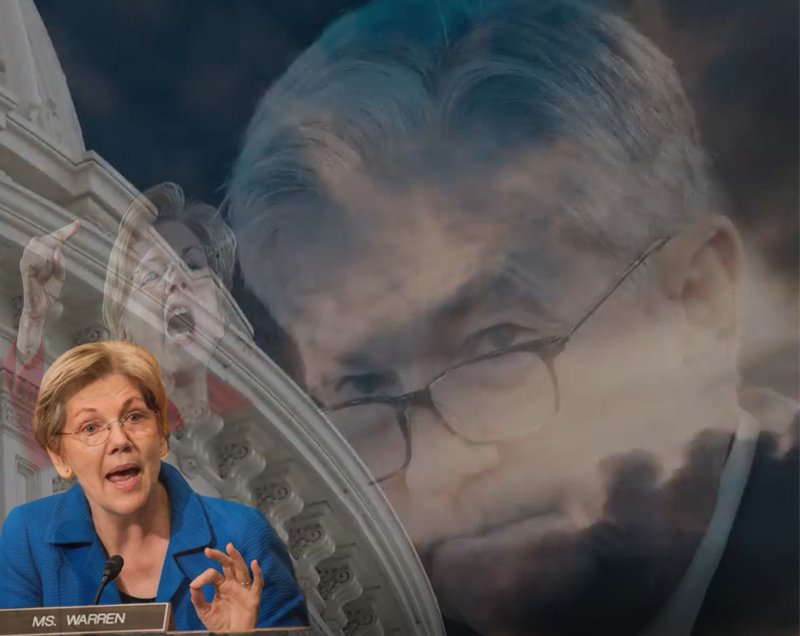
Their skewed perception of world affairs results in poor, even detrimental decisions for us ordinary folk worldwide. In a recent congressional testimony based around interest rates, Jerome Powell, Chairman of the Federal Reserve Bank, was in the hot seat where questions were asked about crypto.
Senator Elizabeth Warren rants about how corporations are causing inflation and how Russia is evading sanctions by using cryptocurrency in the second hearing. She even slammed cryptocurrency exchanges for refusing to sanction regular Russians; Powell stated that it was outside of his area of expertise.
Senators Jack Reed and Kyrsten Sinema voiced their concerns regarding the global trend away from the US dollar, explicitly noting that some superpowers have accelerated their abandonment of the dollar in the wake of the Russia/Ukraine war. It’s most likely the superpowers saw that Central Bank assets are fair game for sanctions.
Kyrsten also confirmed that US politicians are becoming concerned that their sanctions against Russia are doing more harm than good to the dollar. And Jerome essentially said that the damage to the dollar depends on how long this situation lasts.
It seems the FED may have found itself backed into a corner that it can't get out of easily. As much as it's tried to stay neutral and avoid becoming politicized, politicians have been unscrupulous in using the dollar as a political weapon against International opponents.
Notably, the international community has known this for some time, and many have been trying to move off the dollar for years. Many wars were started to preserve the American dollar as the reserve currency. When Moammar Gaddafi created an evaluated currency for Africa, western military power went to Libya and assassinated Gaddafi.
When Saddam Hussein announced in Iraq that he would no longer accept the US dollar for oil, two months later, the war broke out in Iraq, and Saddam Hussein was murdered. The current conflict has accelerated this process, giving the edge to crypto and its benefits because it can be used to cut through the corrupt and fragile fiat financial system that is failing in every capacity.
Some countries such as El Salvador have realized that fiat currencies are futile and have turned to adopt currencies that aren't controlled by any other nation. Currencies that maintain their value and can't be turned off for any reason.
Jerome Powell’s testimony indicates that fiat currency’s days are numbered. We are heading towards a trend of decentralizing national currencies, and for many, favorably in the form of cryptocurrencies and not a Central bank-run digital currency. (CBDC)
Below is a snippet of the essential points of the second hearing relating to crypto from Guy at Coinbureau.
To watch the full video of Guy breaking down Powell's testimony of both hearings into its most critical parts, giving you his take on what this could mean for the markets, click here. – 30mins.
The SWIFT System Weaponized
Since the sanctions on Russia by certain western countries and corporations, including the globally used SWIFT system. Founded in 1973, Belgium-based SWIFT is used by banks for cross-border financial transactions. It facilitates trillions of dollars of payments between 11,000 financial institutions in more than 200 countries making it the backbone of the international financial transfer system.
The Central Bank of Russia has since permitted its largest bank, Sberbank, to act as a cryptocurrency vendor to circumvent sanctions imposed by the U.S and E.U and a way to avoid the massive downward pressure exerted on Russia’s ruble.
The above decision, along with other contingencies such as India purchasing oil from Russia using rupees instead of dollars. And Saudi Arabia is working on selling oil to China in yuan instead of dollars.
It’s worth noting that most of the world has not joined the sanctions against Russia, including Argentina, Brazil, China, Mexico, India, Indonesia, Israel, South Africa, Saudi Arabia, United Arab Emirates, Qatar, and Pakistan.
In 2014, Russia launched the System for Transfer of Financial Messages (SPFS), a Russian alternative to SWIFT. In 2015, China launched the Cross-Border Interbank Payment System (CIPS), a Chinese alternative to SWIFT. CIPS processed around $12.68 trillion in 2021. CIPS has 1,280 financial institutions in 103 countries and regions.
Combine the Russian System for Transfer of Financial Messages (SPFS) with the Chinese Cross-Border Interbank Payment System (CIPS), and you see the foundation of a new Russian-Chinese cross-border payment system bypassing SWIFT speeding up global de-dollarization.
Interestingly, Russia has the ruble, which is fully backed by gold, unlike fiat with no intrinsic value except faith, trust, and acceptance of the people in their governments. India, China, and Russia have long had a different monetary system apart from SWIFT.
As recently as November 16, 2019, Vladimir Putin said,
“The Dollar enjoyed great trust around the world. But, for some reason, it is now being used as a political weapon to impose restrictions. They’ll collapse soon. Many countries are now turning away from the Dollar as a Reserve Currency.”
What is happening here is that some misinformed or even corrupt self-serving decisions are giving rise to a multi-polar world, which is quite the opposite of a one-world government. In effect, the countries that have sold out to the United Nations supporting their Agenda 21/30 are creating their own demise.
Are You Ready For Some Truth Bombs?
An award-winning journalist, and former newscaster, Lara Logan, drops a few truth bombs in this interview that rocks the world. The alternative media exposes the NWO, EU, US, NATO, the UN, CERN, the WHO, the CIA, the MOSSAD as all one big snake pit connected up the dark evil pyramid of the elite.
You are not hearing this on mainstream media as they are facilitating the agenda and narrative of corrupt politicians whose thoughts and strategies are a polar opposite to entrepreneurs with life experience and a humanitarian approach.
"If a nation expects to be ignorant and free, it expects what never was and never will be . . . The People cannot be safe without information. When the press is free, and every man is able to read, all is safe."
Thomas Jefferson
The Crypto Industry Takes A Firm Stand. More Entrepreneurs Stepping Up
The dollar as the Reserve currency all countries align is diminishing rapidly. The cry for regulation of cryptocurrencies by corrupt governments shows the corruption and mutiny within organized financial system bodies like the SEC, revealing how protected Bitcoin and Ethereum are.
Some governments asked entrepreneur and SpaceX CEO Elon Musk to block Russian media outlets from its Starlink satellite broadband service. In a tweet he sent out on March 5th, Musk declared the company would not comply with the request "unless at gunpoint." According to Musk, the demand hadn't come from Ukrain, and he added, "Sorry to be a free speech absolutist."
The sanctions to squeeze Russia's economy and sever the country from the global financial system have forced companies and financial firms to halt business. But many of the world's largest crypto exchanges – including Binance and US-based Kraken and Coinbase refused to ban Russian clients, despite a plea from the Ukrainian government.
They said they would screen users and block anyone targeted by sanctions. The standoff illustrates the ideological difference between the traditional financial sector and the world of cryptocurrencies, whose origin lies in the ideal of liberty and distrust of governments. The crypto exchanges argued that cutting off a whole nation would counter Bitcoin's ethos of offering access to payments free of government oversight.
A Turning Point In History And The Rise Of Kingdoms
The world’s state of affairs may look bad to some, but it's a turning point in history, with Russia now seeming to lead the way out of the Matrix, leaving behind the corrupt financial system and mainstream media. This is perhaps the start to implementing a free world outside of the matrix of the cabal that we have been trapped in for centuries.
We now have what can be considered separate kingdoms of sovereignty emerging that are all fundamentally on the same page and supporting each other. It includes social media marketing cryptocurrency ecosystems that can help an expanding community in times like these where the world has reached a level of volatility unprecedented.
Unlike the tech giants, Markethive will not be or will ever be involved in sanctions that hurt people at the very core. Every individual from every country is welcome to the sovereign kingdom of Markethive and escape the tyranny that surrounds it but will not penetrate it.
Aptly recognized as the Ecosystem for Entrepreneurs, Markethive stands for freedom of speech, critical thinking, self-expression, and liberty, cultivating the entrepreneurial spirit to keep it alive. Perhaps it’s time to get the entrepreneurs back into government—empaths with substance and have no agenda except to help humanity thrive.
An Individual Thinker – An Entrepreneur Of Medieval Times
I will finish off with a quote from Roger Bacon, who was born in 1220 and died in 1294. A scholar with a background in experimental science, philosopher, educational reformer, he later became a friar and was subsequently condemned to prison for daring to speak his mind and his penchant for millenarianism.
He also predicted the hot air balloon, the flying machine, and the magnifying glass. He was the first person in the West to give exact directions for making gunpowder.
Bacon displayed prodigious energy and zeal in the pursuit of experimental science. His studies were talked about everywhere and eventually won him a place in popular literature as a kind of wonder-worker. Bacon, therefore, represents a historically precocious expression of the empirical spirit of experimental science. He is what I would call an entrepreneur of medieval times.
“True knowledge stems not from the authority of others, nor from a blind allegiance to antiquated dogmas, but instead is a highly personal experience. A light that is communicated only to the innermost privacy of the individual, through the impartial channels of all knowledge and of all thought.”
Note from Editor; This article is an alternative view to the mainstream narrative. After much research, I felt the need to put it out there. After all, there are two sides to every story.
As of writing, the pioneer cryptocurrency is trading at $39,943 despite tapping $42,967 on Thursday, accounting for a 5.97% decline in the past 24 hours according to CoinMarketCap. Ethereum also took a hit, albeit losing 5.32%, and is currently trading at $2,976. Other cryptocurrencies also continued to reel under a wider market drawdown with Solana (SOL) Cardano (ADA) and Avalanche (AVAX) bearing the largest brunt among the top ten altcoins, down 8.12%, 4.87%, and 6.09% in the past 24 hours respectively.
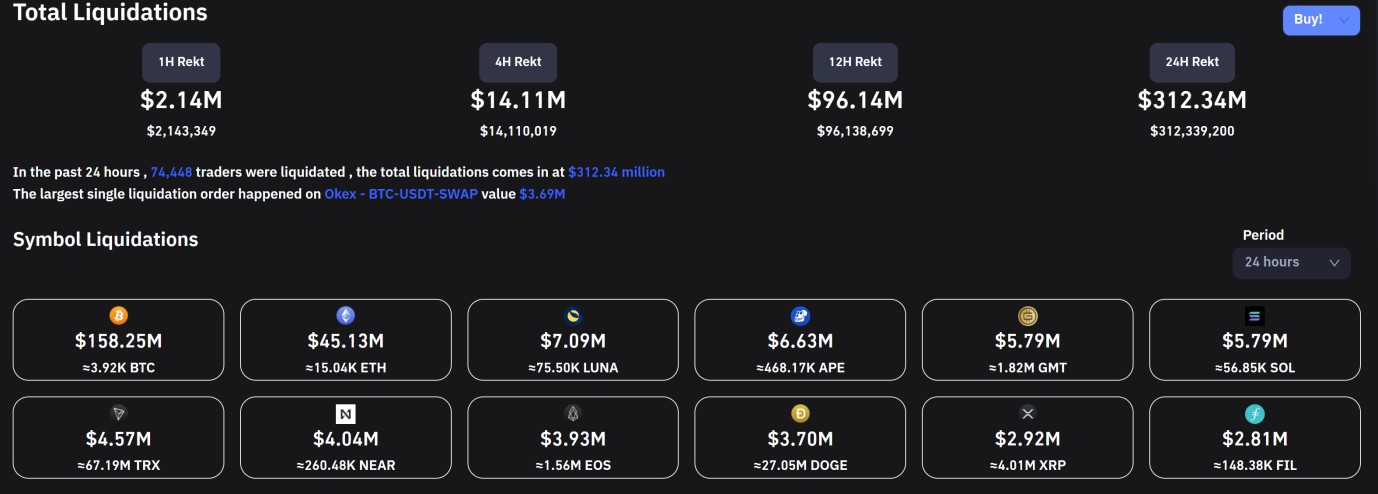
In the past 24 hours, 70,968 traders were liquidated, the total liquidations come in at $280.12 million, according to Coinglass data.
(Click image for larger view)
The drop was also mirrored in major tech stocks, with the Nasdaq 100 (NDX) slumping 4% in the last 24 hours.
The havoc has been attributed to hawkish comments by Fed Chair Jerome Powell on Thursday stating that the plan to raise the benchmark U.S. interest rates by 50 basis points (0.5%) “will be on the table” during the next Federal Open Market Committee(FOMC) sitting.
“I would say 50 basis points will be on the table for the May meeting,” Powell said during a panel meeting presented by the International monetary fund (IMF), raising expectations for the move in May. The comments come on the heels of the Fed rolling out an aggressive policy to tame inflation which has climbed to a rate of 8.5%, the fastest in four decades. His assertions have however mostly led to BTC dumping, as investors shield from the effects of an increasingly erratic FED.
“From the investor point of view and especially from an equity point of view, the words are great but there has to be some meaning and there actually has to be some action,” Andrew Maynard, Managing Director and Head of Equities at China Rennaisanse told CNBC on Friday.
That said, traders continue to view Powell’s comments as posing risk to cryptos in the short term and now closely watching macroeconomic indicators. The crypto market seems to still be strongly correlated with the equity market with the 90-day tie-in between the top cryptocurrency and the S&P500 hitting the highest level in BTC’s history. Sadly, the S&P500 does not look so good.
From a technical perspective, traders are closely watching the $40,000 support as we move into the weekend, with $37,800 being the strongest support level in sight. On the upside, Thursday’s swing high of $42,967 continues to pose a stake especially if the weekly candle closes in the red. To kickstart a strong upward move in the short term, BTC must settle above $40,250 and the 100 moving average. If bulls are successful, the price could push to the $44,000 resistance level.
Markethive Advertisement
DISCLAIMER: None Of The Information You Read On ZyCrypto Should Be Regarded As Investment Advice. Cryptocurrencies Are Highly Volatile, Conduct Your Own Research Before Making Any Investment Decisions.
** Get secure funding for business projects in the USA and around the world. Learn more about USA & International Financing at Commercial Funding International. **
The Central Hub Of The Markethive Economy – The Wallet
What Does The Wallet Do?
What Does It Mean For You?
The launch of the Markethive wallet is approaching, so it’s time to start beating the proverbial drum. It is the start of an exciting time with the advent of many integrations to follow the release of the wallet that will bring Markethive into prominence as an unprecedented platform. The combination of inbound marketing, social media, digital broadcasting, video, conference rooms, e-commerce, gamification, etc.
Markethive is a blockchain-driven crypto economy, all-inclusive, with a distributed database system required for this decentralized, monolithic global project. We’re almost there with the release of the wallet that will initiate entrepreneurial sovereignty and open the floodgates of this divine enterprise with its plethora of systems and services, including the new interface and dashboard.
We now have a complete working wallet with the Solana Network, and we also have a fully functional crypto merchant account. The Markethive wallet is being polished with the finishing touches, keeping mindful that it’s not just a simple wallet but a comprehensive, dynamic engine centralized for you that powers your platform and business.
Markethive is fundamentally a sophisticated inbound marketing and storefront platform, integrated with a social network, and not just another social media platform you see popping up to counter the media tech giants we’ve come to know as oppressive, censoring you and using your personal data for their own gain.
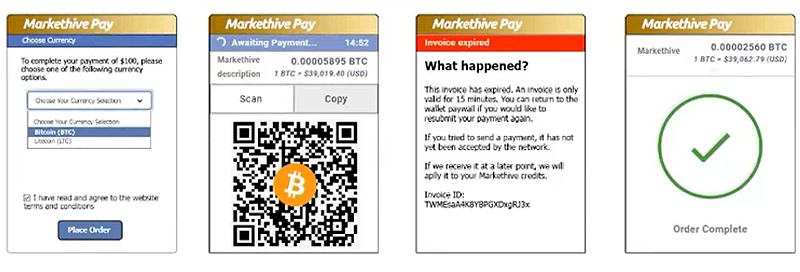
Markethive Pay Transaction Example
Your Very Own Merchant Account
The Markethive platform is massive,and it lends itself to the cottage industry concept allowing members to monetize the various initiatives within Markethive. It also allows you as an entrepreneur and business owner to facilitate and promote every aspect of your business, including eCommerce payments, right from your business Storefront in Markethive.
In other words, you will have a personal Merchant Account that you can plug in to your WordPress or Storefront group through Markethive. You will be able to utilize your chosen wallet address for payments relating to your business, and it will keep track of everything for you. You will not have to rely on APIs and third parties that can shut you down at a whim because you don’t go along with their agenda.
The Functionality Of The Wallet
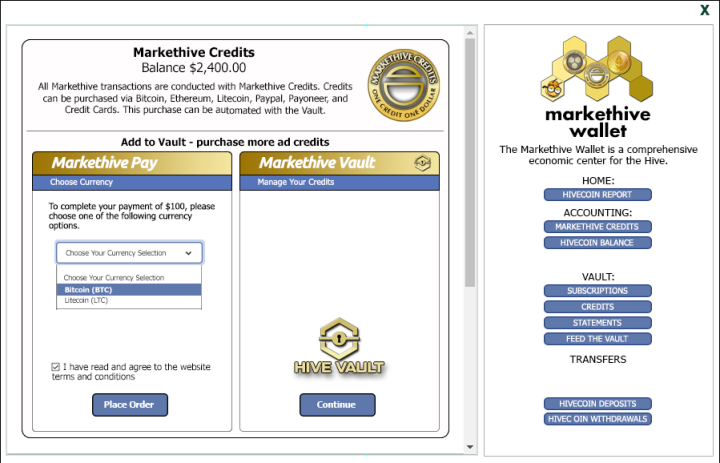
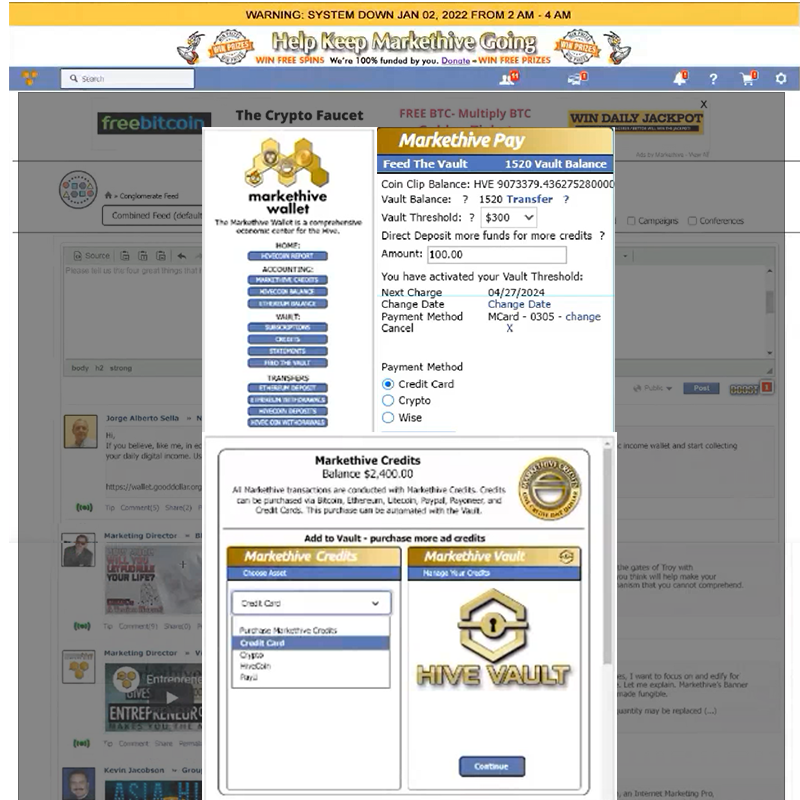
The wallet is not just a wallet to send coins out from Markethive to an exchange. It will house the functioning and tracking of the ILPs, your transactions, subscriptions, statements, payments, and the Vault. The Vault is home for your Markethive Credits, likened to a stable coin.
You can fund your vault with Markethive Credits via various cryptocurrencies, Bitcoin, Ethereum, Litecoin, Hivecoin, Credit/debit cards, and a payment processor new to Markethive, wise.com. Due to the adversarial nature of PayPal, the processor will not be available. More updates will come as we finalize all the moving parts of this comprehensive mechanism.
With the tightening of crypto regulations by the unforgiving, anti-business sentiment of the US government, it is in everyone’s best interest to stake Markethive Credits instead of Hivecoin. If we were to stake HVC, the regulations require Markethive to report monthly all individuals' staked earnings. This would be a tedious, expensive exercise and not one any of us as a community or individual would want.
As Markethive Credits are not classed as crypto, it sidesteps these regulations and allows us to accumulate Hivecoin passively. Utilizing the Vault by having an ongoing threshold balance of Markethive Credits is a form of staking. In other words, keeping any amount in the Vault above your monthly commitments (e.g., subscriptions) that are automatically debited from your vault generates interest.
The higher the threshold balance, the more interest you receive, and it also increases your Hive Ranking, which also increases your interest. You cannot trade or sell your Markethive Credits; they are for purchasing services within Markethive, so the vault can be considered a debit card.
Equally, it can be used as a bank account, except the interest received from banking your funds in the Vault would be considerably more than a regular bank account. With interest being paid to you in Hivecoin, it also has increased worth as the price of the coin rises.
Markethive Wallet Example
Markethive’s Coin-Only Exchange
Markethive is also in the process of setting up an offshore corporation to be able to facilitate a coin-only exchange wholly owned by Markethive, similar to Yobit.
Why is it important to have our own exchange system?
Markethive has a tremendous amount of activity with its coin through its members, so the way to document that for other exchanges to view the millions of transactions is to have our own exchange. This makes it conducive for other coin-to-fiat exchanges to have Markethive on board and allow trading (buy/sell), invoking pre-eminence and increased market value.
Markethive is not just building a non-purposeful meme coin like Doge or Shiba, nor are we creating a simple exchange. It’s a comprehensive, dynamic platform that will serve humanity on every level imaginable, helping us through these difficult times and into the light where our personal sovereignty will rise in harmony and abundance in the collective.
Benefits Of A Reduced Total Coin Supply
Along with the integration to the Solano Blockchain, Markethive will drastically reduce the total supply of Hivecoin into the low millions (actual amount to be advised). This means the price potential for HVC, through supply and demand, will increase a hundredfold+ and benefit you as a Hivecoin holder.
Think of Bitcoin's total Market supply of only 21 million coins as opposed to the other altcoins with a supply into the trillions. (less supply, more demand, market price increases.)
It will also make Hivecoin kinetic and benefit you when building your business within Markethive with all the tools and services you and others need all transacted with Hivecoin. The implementation of a gamified system will draw people in, which in turn broadens your sphere of influence as you use the system.
As this activity takes place, it expands the usage, awareness, and adoption of Markethive services, which then drives up the demand for the coin. It creates an alternative economy, a complete ecosystem for entrepreneurs of every caliber making a living online. It makes Hivecoin legitimate as it has purpose and utility, unlike so many other tokens out there that have very little to no purpose and a total supply into the billions and trillions.
Entrepreneur One Upgrades First Access. Automatic KYC
The Entrepreneur One members will be the first to receive access to the wallet. KYC (Know Your Customer) will also be implemented for all members. Notably, if you register a credit card within Markethive, you will automatically be KYC level two. Uploading your passport or driver's license and utility bill will be classed as KYC level one.
What this means for you when building your business is that the people you are dealing with in Markethive are verified and legitimate. They are who they say they are, and your level of engagement will be much better and more genuine than on any other social network.
It’s important to understand that the Entrepreneur One Upgrade will no longer be available upon release of the wallet. Existing, current E1 members will continue to enjoy the benefits of the upgrade, including receiving a 1/10th ILP for every year their subscription is active for up to ten years. The benefits are explained further in this article.
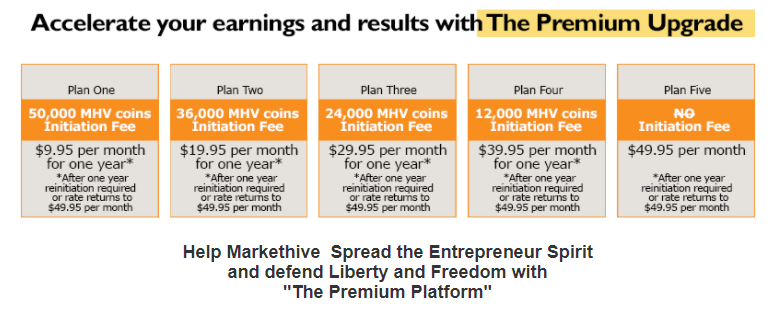
The Premium Upgrade will also launch once the wallet is released, with many benefits for Markethive members. It increases your earning potential and allows you to monetize the initiatives Markethive has implemented. Click here to preview the features of the Premium Upgrade.
There's still time to upgrade to Entrepreneur One and be privy to the complete Markethive system that can be described as a cottage industry with money machines that champions everything else out there. You will be one of Markethive's early adopters and have a rare opportunity to cement your future of self-sovereignty.
How can you forge your future as an Entrepreneur and get your share of ILPs with the Entrepreneur One Loyalty Program?
By clicking on the Membership Upgrade tab on the main menu of the home page and following the prompts.
The precarious state the world is in provides us with the opportunity to take advantage of emerging technology to “unhook” from the global majority and its nefarious, corrupt systems.
Markethive truly wants everyone to succeed and have a sustainable business that’s making you a sustained income from anywhere in the world. That’s the Markethive promise, the vision, and what we’re building.
Be with us at the Sunday meetings at 10 am Mountain time to learn more and stay updated with the latest Markethive news. You’ll find the link to the meeting room in the Markethive calendar.
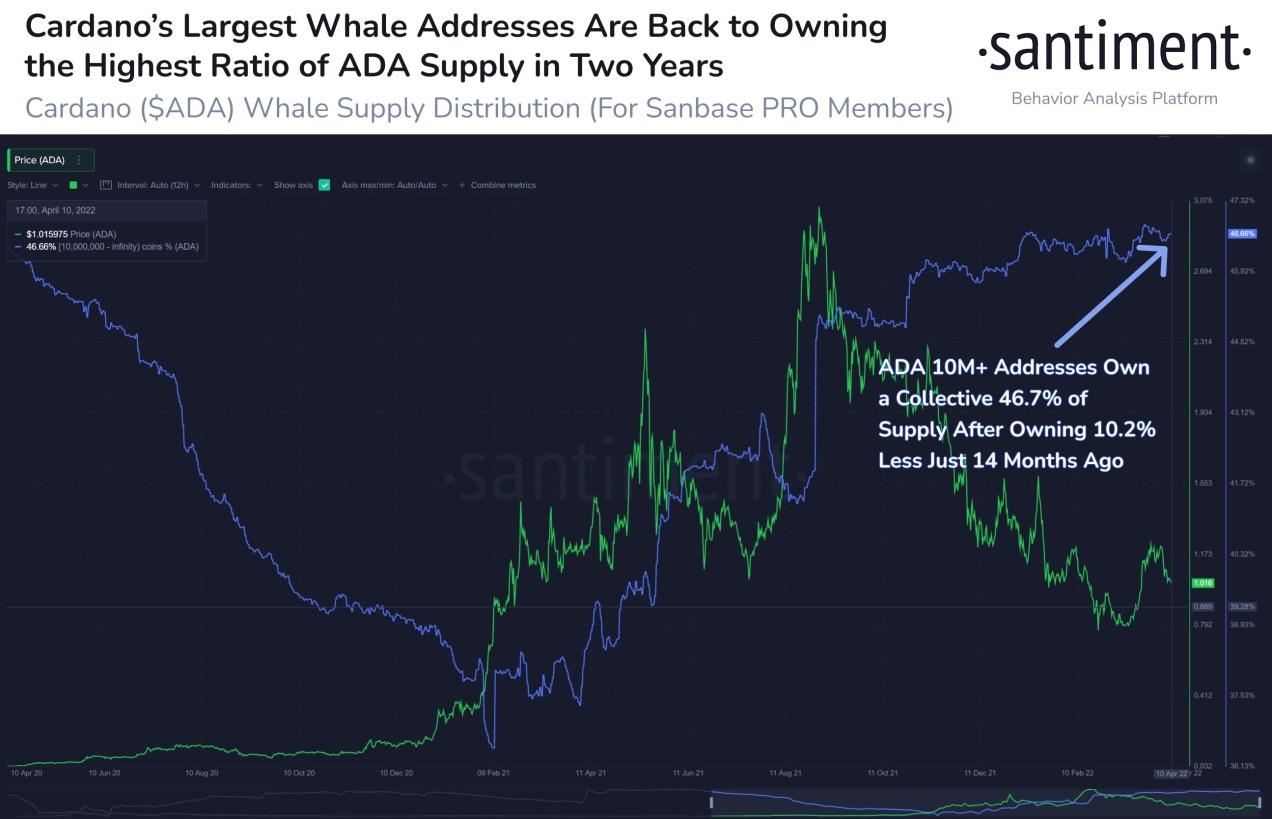
Cardano’s biggest whales seem to have bounced back after an eight-month-long drawdown that saw investors offset some of their ADA holdings for profit to scoop up more coins.
According to blockchain analytics firm Santiment, despite ADA being down close to 60% from September highs, ADA whales are back to owning the largest supply of coins. ADA whales are entities that hold 10 million coins or more in their wallets.
âCardano is down -59% since its $3.10 all-time high. However, the asset’s top whales (holding 10M+ ADA) have returned to their largest percentage of supply held in two years, at 46.6%. Note that a large portion of these addresses is owned by exchanges.â Santiment wrote on Tuesday.
(Click image for larger view)
A recent report by the firm has also shown that the group of addresses holding between 10,000 to 100,000 ADA has been accumulating rapidly, as they continuously bought dips since the price started dropping in late September and now hold 16.8% of the available supply./p>
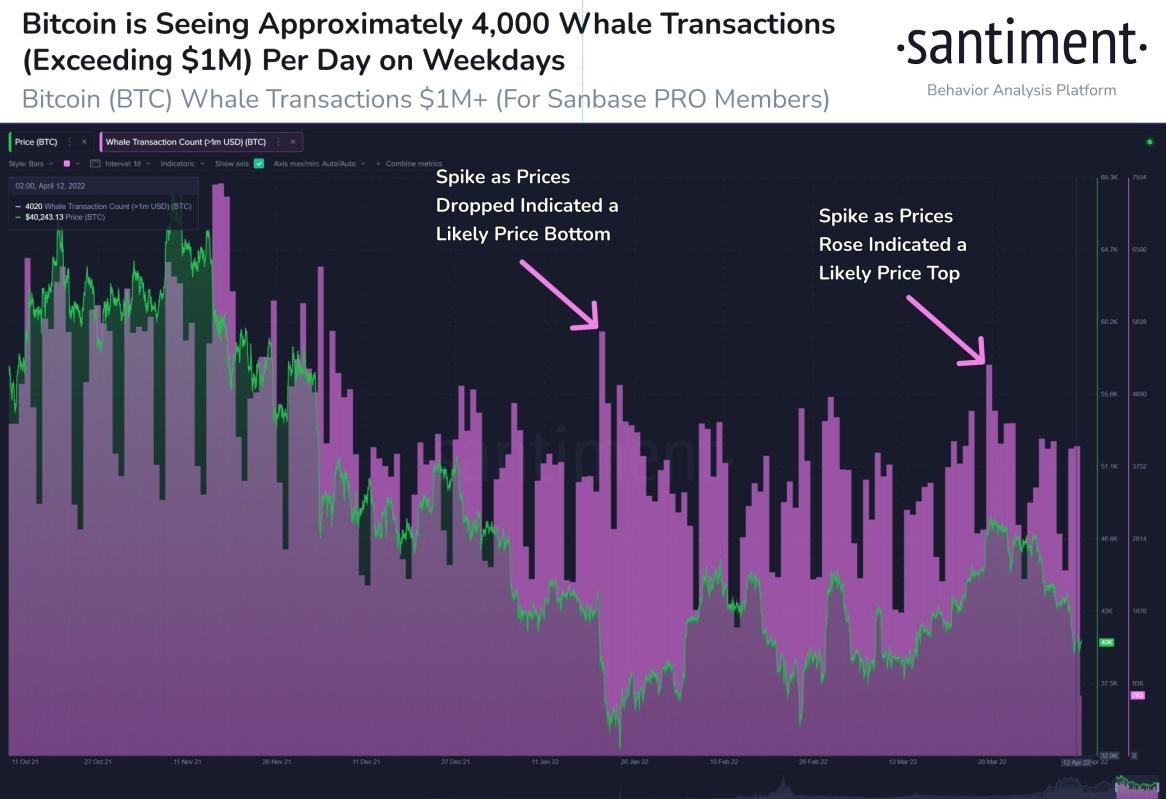
Santiment also sheds light on Bitcoin’s whale behavior, noting that the cryptocurrency saw a steady supply of 4,000 whale transactions exceeding $1M+ Monday through Friday, with mild slowdowns on weekends. It however notes that large increases are needed if the price is to foreshadow March highs./p>
(Click image for larger view)
Looking at Ethereum and other altcoins, Santiment noted that the ongoing FUD could create âbuy the dipâ opportunities. The firm also mapped out elevated growth in exchange outflows for ETH, noting that âthis climb continues pointing to a greater proportion being kept away from exchange sell-off risk.â/p>
That said, ADA continues its struggle to reclaim the $1 price level after slumping along with other major cryptocurrencies as a result of negative macroeconomic events. Two weeks ago, ADA managed to rise above $1 after bouncing off the $0.78 support and breaking a crucial resistance downtrend line before tapping $1.25. That strength, however, seems to have been sapped in the past ten days, with the price falling below the dollar threshold./p>
Santiment has stated that apart from positive fundamentals, for ADA’s price to rise, an uptick in the number of transactions equal to $100,000+ would be crucial. This may perhaps inject the much-needed liquidity to push ADA back to fresh highs. At press time, ADA ($32B Capitalization) is trading at $0.96, up 5,460.20% from its all-time low./p>
DISCLAIMER: None Of The Information You Read On ZyCrypto Should Be Regarded As Investment Advice. Cryptocurrencies Are Highly Volatile, Conduct Your Own Research Before Making Any Investment Decisions.
** Loans, secure funding for business projects in the USA and around the world. Learn more about USA & International Financing at Commercial Funding International. **
Law enforcement agencies in Shanghai have infiltrated a crypto pyramid scheme.
The scheme involved over 60,000 victims and 100 million yuan.
Chinese authorities have been increasing their oversight of the illegal industry.
Despite ousting the crypto industry from its borders, China has continued to uncover criminal operations related to crypto. A joint law enforcement operation in Shanghai has led to the crackdown of the city’s first crypto pyramid-scheme case.
10 arrested in connection with 100 million yuan crypto scam
The local news outlet, The Paper, reports that the bust was the result of more than six months of investigations carried out by the Economic Investigation Team of the Shanghai Public Security Bureau, together with the Yungpu Public Security Branch.
So far, about 10 persons have been arrested in connection with the dubious scheme which was set up in June 2020. Authorities also claim more than 100 million yuan is involved.
The scammers marketed the scheme to be a “unicorn in the global application field” and “the world’s fastest public chain”, the authorities stated. However, investigations revealed that the elaborately set up company was only running multi-level marketing (MLM) scam, promising participants massive returns for signing up, buying tokens, and referring new participants.
No blockchain or token existed as the scheme was only run through a server, rewarding old signups with funds and new sign-ups.
This has not been the only crypto-related pyramid scheme that Chinese authorities have exposed of late. Last month, Ripple Pay Union, another MLM scam was clamped down. The criminal network claimed to have ties with the American fintech company, Ripple, and its XRP token.
Asides from pyramid schemes, China has also recorded an alarming amount of crypto being used for money laundering and gambling. The crypto that was most commonly involved was found to be USDT according to an analysis by a blockchain forensics firm.
China’s crypto scammers have also involved victims from neighboring countries. Business Standard recounts that victims in Singapore lost over $139 million to Chinese fraudsters last year.
China broadening its crypto crackdown net
China officially declared holding, trading, mining cryptocurrencies illegal last year. Since then it has been going after lawbreakers and putting new regulations in place to ensure there are no loopholes for the crypto industry.
Last week, China’s Supreme People’s Procuratorate disclosed that it prosecuted 1,262 people for laundering crimes involving crypto. The offenders included crypto exchange executives and online lending platforms.
DISCLAIMER: None Of The Information You Read On ZyCrypto Should Be Regarded As Investment Advice. Cryptocurrencies Are Highly Volatile, Conduct Your Own Research Before Making Any Investment Decisions.
** Loans, secure funding for business projects in the USA and around the world. Learn more about USA & International Financing at Commercial Funding International. **