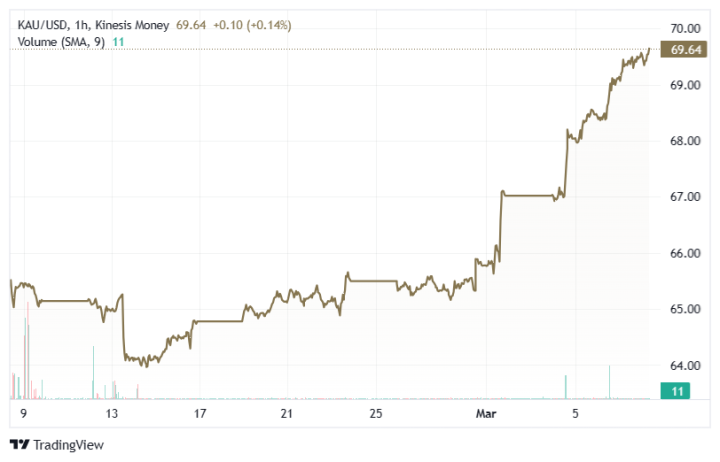
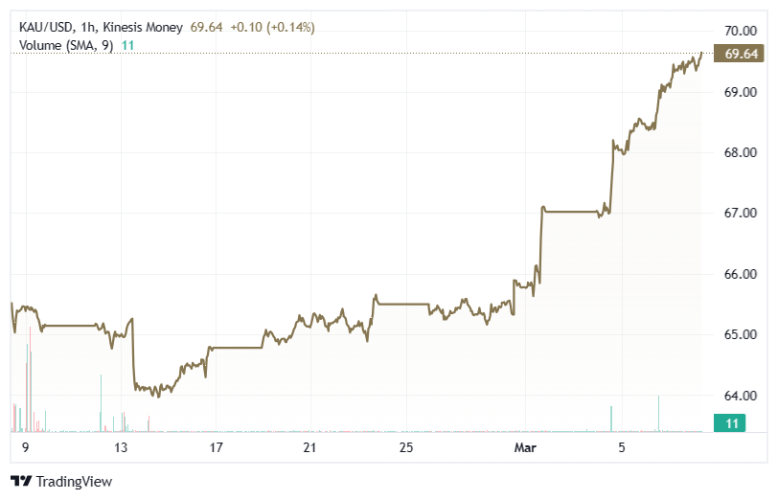
Gold prices extended their recent gains on Thursday to hit fresh all-time highs of over $2,160 an ounce.
Prices notched up a high of $2,164 an ounce on Thursday, compared with around $2,148 an ounce in late deals Wednesday.
Several bullish factors have combined to propel gold prices to record highs in recent days. In particular, weaker economic data from the US has prompted traders to up their bets on an interest rate cut in June. Data from interest rate traders now indicate a probability of just over 70% for the US Fed to start cutting rates at its June 12th meeting, of which most expect a 25 basis-point cut and a minority gunning for a 50 basis-point cut.
Any lowering of interest rates reduces the appeal of holding cash or government bonds, and boosts interest in non-yielding assets like precious metals.
Fed Chair Jerome Powell was quoted on Wednesday saying the central bank needs more evidence that inflation is easing before going ahead with interest rate cuts, although he also signalled that rates have likely reached their peak at the current 5.25-5.5%, in comments to a congressional hearing.
The market’s expectations on monetary policy have also coincided with a period of strong central bank buying of gold in recent months, which has been further augmented by a risk premium due to geopolitical instability and the risks this poses to commerce and financial markets.
Looking ahead, the markets will be watching out for monthly US non-farm payrolls figures on Friday as well as the unemployment rate for February for a further health check on the state of the US economy.
Frank’s experience covering the commodities markets spans 22 years, with a particular specialism in metals, carbon and energy markets. He has worked as a senior editor for S&P Global Commodity Insights (formerly Platts) and before this, at ICIS-LOR, a part of Reed Business Information (Reed Elsevier), where he covered the petrochemicals markets from 2003 to 2005.
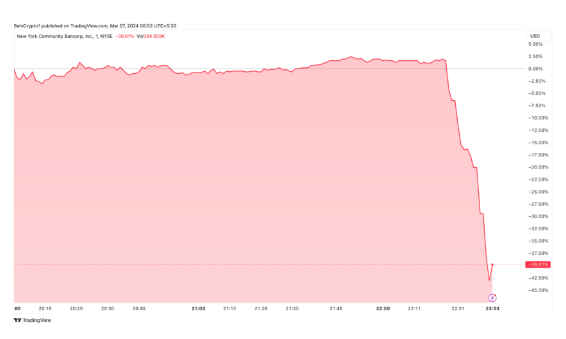
NYCB's stock value plummeted over 40% amidst financial health concerns, while Bitcoin soared to a new high of $69,000.
The bank's struggles, including a $2.4 billion loss and leadership changes, contrast starkly with Bitcoin's robust growth.
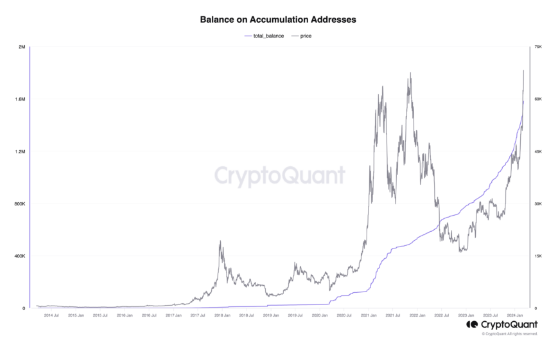
Bitcoin's demand surges as shown by record-high accumulation addresses and ETF holdings, despite potential corrections.
In a dramatic turn of events that echoes the prescient warnings of Satoshi Nakamoto, the creator of Bitcoin, the financial system witnessed another stark contrast between the faltering traditional banking sector and the growing cryptocurrency market.
The spotlight shone brightly on New York Community Bank (NYCB), which experienced a precipitous decline in its stock value. It plunged over 40% in the wake of alarming revelations about its financial health and management disruption. This turbulence occurred against Bitcoin’s 58% year-to-date ascent to a fresh all-time high of $69,000.
NYCB Goes Bust While Bitcoin Hits Record Highs
The plight of NYCB, a regional lender based in Hicksville, New York, became public knowledge when it disclosed a “material weakness” in its internal controls. This led to a staggering $2.4 billion loss for shareholders last quarter.
A leadership reshuffle compounded the bank’s woes. Alessandro DiNello assumed the roles of president and CEO while a series of credit rating downgrades pushed NYCB’s debt into junk territory.
This series of misfortunes mirrored the earlier collapse of First Republic Bank. Therefore, it hinted at a potential systemic issue within the regional banking sector. Still, NYCB grappled with its internal turmoil and secured a major cash infusion amid the possible erosion of depositor confidence.
“In evaluating this investment, we were mindful of the Bank’s credit risk profile. With the over $1 billion of capital invested in the Bank, we believe we now have sufficient capital should reserves need to be increased in the future to be consistent with or above the coverage ratio of NYCB’s large bank peers,” Former United States Secretary of the Treasury Steven Mnuchin said.
NYCB Price Performance. Source: TradingView
This financial distress starkly contrasted with the flourishing crypto market. Unprecedented investment and accumulation of Bitcoin have signaled a robust vote of confidence from both new and veteran investors.
Significant inflows into accumulation addresses underpin Bitcoin’s resilience and growth. Likewise, growing exchange-traded fund (ETF) holdings reflect an increasing Bitcoin demand that contrasts with the instability plaguing the traditional banking industry.
This divergence reflects a broader shift in investor sentiment, seeking refuge in what many perceive as a more decentralized and secure financial future.
“The total Bitcoin holdings of accumulation addresses also reached record-high levels. The total holdings at these addresses are now 1.5 million Bitcoin. These addresses denote investors that only accumulate Bitcoin and have never sell, so the accelerating growth in their Bitcoin holdings is a sign of strong demand,” analysts at CryptoQuant told BeInCrypto.
However, it is not all smooth sailing for Bitcoin. Despite the growing demand and reaching new price heights, other indicators suggest Bitcoin might be entering an overheated phase. These metrics reveal a complex time where rapid gains could precipitate equally swift retractions.
“A short-term pause/correction may be brewing as prices have increased too fast in relation to key on-chain metrics… Moreover, traders’ unrealized profit margins are now above extreme levels, which can anticipate selling pressure from these market participants,” analysts at CryptoQuant added.
As Bitcoin continues to chart its course, the fate of traditional banks may serve as cautionary tales for an industry at a crossroads, navigating the challenging waters of modern finance in the shadow of Satoshi Nakamoto’s remarks.
“Banks must be trusted to hold our money and transfer it electronically, but they lend it out in waves of credit bubbles with barely a fraction in reserve. We have to trust them with our privacy, trust them not to let identity thieves drain our accounts,” Satoshi Nakamoto wrote.
Disclaimer
All the information contained on our website is published in good faith and for general information purposes only. Any action the reader takes upon the information found on our website is strictly at their own risk.
** Get secure funding for business projects in the USA and around the world. Learn more about USA & International Financing at Commercial Funding International. **
Predictions and analysis come from many people in the dynamic crypto world. But recently, Michaël van de Poppe, a well-known crypto analyst, has made waves with his bold proclamation that this Bitcoin bull run is not just significant – it’s about to be a “giant” and possibly even a “supercycle.” In this article, we delve into van de Poppe’s insights and explore the implications of his prediction on the broader crypto landscape.
The Unusual Bitcoin Cycle
One of the standout features of van de Poppe’s analysis is his observation that Bitcoin has never reached an all-time high before its halving.
This altered occurrence has led the analyst to believe that the ongoing Bitcoin bull cycle holds extraordinary potential. Despite a recent correction that saw Bitcoin drop 8% from its $69,000 peak, van de Poppe remains optimistic, attributing the pullback to the natural flow of the crypto market.
Altcoins Positioned to Outperform Bitcoin
Contrary to the Bitcoin-centric focus that often dominates discussions, van de Poppe predicts that altcoins will be the real stars of the upcoming months.
Emphasizing their potential to outperform Bitcoin, he points to notable performers like Dogecoin (DOGE), Shiba Inu (SHIB), and Pepe (PEPE), which have made impressive moves in recent weeks.
Navigating the Crypto Landscape
While Robert Kiyosaki’s bullish prediction for Bitcoin reaching $100,000 by June 2024 sounds exciting, van de Poppe’s nuanced perspective offers a more detailed view of the crypto landscape. With his belief that altcoins like Ether, Solana, XRP, Cardano, Shiba Inu, and PEPE are about to dominate the current bull run, it’ll be interesting to see how both theories play out.
Expert analysis and predictions provide invaluable insights into the ever-evolving world of crypto. Michaël van de Poppe’s bold proclamation about the potential “giant” Bitcoin bull cycle and the anticipated outperformance of altcoins fuel the excitement surrounding crypto assets. The coming months promise to be dynamic, with altcoins potentially taking centre stage in the crypto arena.
DISCLAIMER
The views expressed in the article are wholly those of the author and do not represent those of, nor should they be attributed to, ZyCrypto. This article is not meant to give financial advice. Please carry out your own research before investing in any of the various cryptocurrencies available.
** Loans, secure funding for business projects in the USA and around the world. Learn more about USA & International Financing at Commercial Funding International. **
Pantera is Raising $250M to Buy SOL from FTX Estate: Report
Lucky Ebosele | Last updated March 7, 2024 | @ 14:43
Crypto-focused asset manager Pantera Capital is reportedly raising money from large investors to buy discounted Solana tokens from the bankrupt FTX estate.
Pantera Seeks to Raise $250M
According to a Bloomberg report that cited marketing materials sent to prospective investors, Pantera is seeking funds for the âPantera Solana Fund,’ which would have the option to buy up to $250 million worth of SOL tokens from FTX at $59.95 or 39% below the average price over the past 30 days.
The report stated that investors would have to agree to a vesting period of up to four years in exchange for this discount.
Pantera was aiming to close the fund by the end of February, but it is unclear how much money they were able to raise. Investors participating in the fund must invest at least $25 million and have their SOL tokens initially locked and gradually vested over four years.
The asset manager plans to charge a management fee of 0.75% and a performance fee of 10%.
Pantera’s investment is an opportunity to capitalize on the discounted price of SOL and potentially profit as the Solana ecosystem grows. On the other hand, the deal will allow FTX to offload its SOL holdings and return value to creditors without putting immediate pressure on the token’s price.
SOL Performance Post-FTX Implosion
As of Wednesday, March 6, FTX held 41.1 million SOL tokens, worth approximately $5.4 billion in current prices and equivalent to 10% of the token’s total supply.
Since the FTX implosion in November 2022, SOL’s price has surged by nearly 4x after facing a tumultuous period. Over the past year, the token has jumped by approximately 650%, thereby increasing the value of FTX’s holdings and giving the firm the opportunity to fully repay creditors.
SOL was trading at $142.10 at press time, representing an 11.37% increase in the past 24 hours.
Disgraced FTX co-founder Sam Bankman-Fried (SBF) was a major backer of the Solana network. Moreover, FTX and its sister company, Alameda Research, were heavily invested in the Solana ecosystem.
DISCLAIMER
Information found on this website is those of the writers quoted. It does not represent the opinions of Coinfomania on whether to buy, sell, or hold any investments. Readers must conduct their own research before making any investment decisions. Use the provided information at your own risk.
** Loans, secure funding for business projects in the USA and around the world. Learn more about USA & International Financing at Commercial Funding International. **
Gold price vs. Bitcoin price record rally: Mixed market signals, here's what it all means — Gareth Soloway
(Kitco News) – Are the gold and Bitcoin rallies sending mixed messages to the market, and which narrative should investors pay attention to more? Gareth Soloway, Chief Market Strategist at VerifiedInvesting.com, breaks down the two signals.
Even though gold and Bitcoin rallied in tandem — the two assets sent different kinds of messages to the market about the global risk appetite, Soloway told Michelle Makori, Lead Anchor and Editor-in-Chief at Kitco News.
As Bitcoin topped $69,300 and set a new record high on Coinbase — the largest crypto exchange in the U.S. — on Tuesday, gold rallied to new all-time highs above $2,100 and even extended that rally the following day, trading above $2,150 an ounce.
A simultaneous record high for gold, a traditional safe-haven, is in contrast to Bitcoin, which still trades as a risk asset despite being viewed by some as a store of value, Soloway said.
"The risk-on environment is driving Bitcoin. We've seen the stock market making new all-time highs. The NASDAQ has been really running, but we've seen other sectors in the S&P lagging technology," he explained. "That's been driving the stock market in Bitcoin with money flow. There's also excitement about the spot ETF inflows. The talk has been contributing to this GameStop, AMC-type run in this asset."
In gold's case, Soloway points to smart money getting involved in the trade. "I'm convinced that smart money is at a point here where they're starting to say, this is a bubble in these risk assets, and therefore, they're rotating [into gold.] You got the momentum kicking in now," he said.
Soloway pointed out that viewing gold as unimportant is a mistake. "The central banks, the ones that print all the money, are buying the most gold," he said. "That's the smart money. Institutions and hedge funds are not so smart. They're included with everyone else, and they're running after Bitcoin. They're running after stocks."
What's next for Bitcoin
Soloway describes the recent Bitcoin rally as a "culmination of greed," with people chasing the market, which creates a highly volatile environment.
"Just looking at the last week, we're up from $50,000. The momentum of that carried up to this all-time high, but it's also known as a technical double top," he described. "There's notoriously going to be players that are selling into that level or shorting it. And when you get to this point of euphoria, it gets every last buyer in so that when those sellers and shorters start pounding it down, there's no one left to buy."
For Soloway's breakdown of Bitcoin's immediate support and resistance levels, watch the video above.
Soloway warns that if the stock market tops out and sells off, Bitcoin is at risk of following in its footsteps. "This has been my thesis for a long time — if the stock market sells off dramatically, Bitcoin comes in dramatic as well," he said.
In risk-off trading conditions, Bitcoin retraces back. For Soloway's price forecast in this scenario, watch the video above.
For insights on how steep the market selloff could be and the immediate triggers for the price reversal, watch the video above.
Soloway also reveals where he sees Bitcoin in May and at the year-end. For his longer-term price calls, watch the video above.
What's next for gold
This gold breakout, which has been long coming, is just the start for gold and gold miners, Soloway noted.
"This is huge for gold. We've been hovering right up against this level since the 2020 COVID run," he said. "You can calculate the next target via an inverse head and shoulders, and it gives us a $2,500 an ounce."
On when gold can hit this price target, watch the video above.
Soloway also breaks down the contradiction between gold reaching new all-time highs and gold ETFs continuing to see outflows.
"Gold has stayed so close to its all-time highs because there is demand. There's massive demand from governments stockpiling. It has to do with the debasement of currencies. These central banks know that they will have to, at some point, turn the printing presses on. How do you backstop your own? You have to buy that gold," he said.
For other assets, Soloway is bullish on going into the spring and summer, watch the video above.
Whilst no measures can completely guarantee the prevention of an attack, these measures can help mitigate the damage of possible attacks. It is possible to reduce an attacker’s chances by keeping systems up to date with security patches and updates and by hiring people with expertise in security. While formal verification of the correctness of computer systems is possible, it is not yet common. In order for these tools to be effective, they must be kept up to date with every new update the vendor releases. Some organizations are turning to big data platforms, such as Apache Hadoop, to extend data accessibility and machine learning to detect advanced persistent threats.
Vulnerabilities can be discovered with a vulnerability scanner, which analyzes a computer system in search of known vulnerabilities, such as open ports, insecure software configuration, and susceptibility to malware. In computer security, a countermeasure is an action, device, procedure or technique that reduces a threat, a vulnerability, or an attack by eliminating or preventing it, by minimizing the harm it can cause, or by discovering and reporting it so that corrective action can be taken. When a target user opens the HTML, the malicious code is activated; the web browser then decodes the script, which then unleashes the malware onto the target’s device. In early 2016, the FBI reported that such business email compromise (BEC) scams had cost US businesses more than $2 billion in about two years. However, they are also multi-staged, meaning that “they can infiltrate networks and move laterally inside the network.” The attacks can be polymorphic, meaning that the cyberattacks used such as viruses, worms or trojans “constantly change (“morph”) making it nearly impossible to detect them using signature-based https://cognifyo.com/articles/bypassing-phone-lock-codes-exploration/ defences.”
The challenges in IT security shift constantly, presenting organizations with persistent obstacles. Network security protects the infrastructure from unauthorized access, misuse, or damage by using firewalls, encryption and other tools. IT security is broader than cybersecurity, covering all aspects of protecting an organization’s data, software, hardware and infrastructure — not just protection against cyberattacks. Finally, mission-critical assets like operating systems, health records, software tools, financial records and cloud infrastructure make up the mission-critical layer.
Check Point IT Security Solutions
These should cover password management, incident reporting, and other security processes. Begin with a comprehensive security policy that clearly articulates protection measures for hardware, software, networks, and data. These range from cyberattacks to equipment theft or power failures. How to safeguard data, prevent breaches, and stay ahead of evolving https://clomidxx.com/why-careful-planning-is-key-in-building-a-mobile-strategy/ risks. IT security policies are designed to keep assets confidential from unauthorized entities, maintain integrity over the modification of assets, and ensure assets will remain continuously available to authorized users.
Although many aspects of computer security involve digital security, such as electronic passwords and encryption, physical security measures, such as metal locks, are still used to prevent unauthorized tampering. In order to craft a comprehensive and effective cybersecurity strategy, the organization must consider its policies, processes and technologies across every http://carbonequity.info/interesting-research-on-what-you-didnt-know/ business function. In a DoS attack, users are unable to perform routine and necessary tasks, such as accessing email, websites, online accounts or other resources that are operated by a compromised computer or network. While maintaining full system operation is an important part of IT security, the more pressing aspect relates to cyberattacks, most of which are designed to access or steal data and other sensitive information. Some countries legally require businesses to invest in the development and implementation of IT security concepts, while other regions provide strict standards as it relates to data privacy and security.
Whilst no measures can completely guarantee the prevention of an attack, these measures can help mitigate the damage of possible attacks. It is possible to reduce an attacker’s chances by keeping systems up to date with security patches and updates and by hiring people with expertise in security. While formal verification of the correctness of computer systems is possible, it is not yet common. In order for these tools to be effective, they must be kept up to date with every new update the vendor releases. Some organizations are turning to big data platforms, such as Apache Hadoop, to extend data accessibility and machine learning to detect advanced persistent threats.
Vulnerabilities can be discovered with a vulnerability scanner, which analyzes a computer system in search of known vulnerabilities, such as open ports, insecure software configuration, and susceptibility to malware. In computer security, a countermeasure is an action, device, procedure or technique that reduces a threat, a vulnerability, or an attack by eliminating or preventing it, by minimizing the harm it can cause, or by discovering and reporting it so that corrective action can be taken. When a target user opens the HTML, the malicious code is activated; the web browser then decodes the script, which then unleashes the malware onto the target’s device. In early 2016, the FBI reported that such business email compromise (BEC) scams had cost US businesses more than $2 billion in about two years. However, they are also multi-staged, meaning that “they can infiltrate networks and move laterally inside the network.” The attacks can be polymorphic, meaning that the cyberattacks used such as viruses, worms or trojans “constantly change (“morph”) making it nearly impossible to detect them using signature-based https://cognifyo.com/articles/bypassing-phone-lock-codes-exploration/ defences.”
The challenges in IT security shift constantly, presenting organizations with persistent obstacles. Network security protects the infrastructure from unauthorized access, misuse, or damage by using firewalls, encryption and other tools. IT security is broader than cybersecurity, covering all aspects of protecting an organization’s data, software, hardware and infrastructure — not just protection against cyberattacks. Finally, mission-critical assets like operating systems, health records, software tools, financial records and cloud infrastructure make up the mission-critical layer.
Check Point IT Security Solutions
These should cover password management, incident reporting, and other security processes. Begin with a comprehensive security policy that clearly articulates protection measures for hardware, software, networks, and data. These range from cyberattacks to equipment theft or power failures. How to safeguard data, prevent breaches, and stay ahead of evolving https://clomidxx.com/why-careful-planning-is-key-in-building-a-mobile-strategy/ risks. IT security policies are designed to keep assets confidential from unauthorized entities, maintain integrity over the modification of assets, and ensure assets will remain continuously available to authorized users.
Although many aspects of computer security involve digital security, such as electronic passwords and encryption, physical security measures, such as metal locks, are still used to prevent unauthorized tampering. In order to craft a comprehensive and effective cybersecurity strategy, the organization must consider its policies, processes and technologies across every http://carbonequity.info/interesting-research-on-what-you-didnt-know/ business function. In a DoS attack, users are unable to perform routine and necessary tasks, such as accessing email, websites, online accounts or other resources that are operated by a compromised computer or network. While maintaining full system operation is an important part of IT security, the more pressing aspect relates to cyberattacks, most of which are designed to access or steal data and other sensitive information. Some countries legally require businesses to invest in the development and implementation of IT security concepts, while other regions provide strict standards as it relates to data privacy and security.
Whilst no measures can completely guarantee the prevention of an attack, these measures can help mitigate the damage of possible attacks. It is possible to reduce an attacker’s chances by keeping systems up to date with security patches and updates and by hiring people with expertise in security. While formal verification of the correctness of computer systems is possible, it is not yet common. In order for these tools to be effective, they must be kept up to date with every new update the vendor releases. Some organizations are turning to big data platforms, such as Apache Hadoop, to extend data accessibility and machine learning to detect advanced persistent threats.
Vulnerabilities can be discovered with a vulnerability scanner, which analyzes a computer system in search of known vulnerabilities, such as open ports, insecure software configuration, and susceptibility to malware. In computer security, a countermeasure is an action, device, procedure or technique that reduces a threat, a vulnerability, or an attack by eliminating or preventing it, by minimizing the harm it can cause, or by discovering and reporting it so that corrective action can be taken. When a target user opens the HTML, the malicious code is activated; the web browser then decodes the script, which then unleashes the malware onto the target’s device. In early 2016, the FBI reported that such business email compromise (BEC) scams had cost US businesses more than $2 billion in about two years. However, they are also multi-staged, meaning that “they can infiltrate networks and move laterally inside the network.” The attacks can be polymorphic, meaning that the cyberattacks used such as viruses, worms or trojans “constantly change (“morph”) making it nearly impossible to detect them using signature-based https://cognifyo.com/articles/bypassing-phone-lock-codes-exploration/ defences.”
The challenges in IT security shift constantly, presenting organizations with persistent obstacles. Network security protects the infrastructure from unauthorized access, misuse, or damage by using firewalls, encryption and other tools. IT security is broader than cybersecurity, covering all aspects of protecting an organization’s data, software, hardware and infrastructure — not just protection against cyberattacks. Finally, mission-critical assets like operating systems, health records, software tools, financial records and cloud infrastructure make up the mission-critical layer.
Check Point IT Security Solutions
These should cover password management, incident reporting, and other security processes. Begin with a comprehensive security policy that clearly articulates protection measures for hardware, software, networks, and data. These range from cyberattacks to equipment theft or power failures. How to safeguard data, prevent breaches, and stay ahead of evolving https://clomidxx.com/why-careful-planning-is-key-in-building-a-mobile-strategy/ risks. IT security policies are designed to keep assets confidential from unauthorized entities, maintain integrity over the modification of assets, and ensure assets will remain continuously available to authorized users.
Although many aspects of computer security involve digital security, such as electronic passwords and encryption, physical security measures, such as metal locks, are still used to prevent unauthorized tampering. In order to craft a comprehensive and effective cybersecurity strategy, the organization must consider its policies, processes and technologies across every http://carbonequity.info/interesting-research-on-what-you-didnt-know/ business function. In a DoS attack, users are unable to perform routine and necessary tasks, such as accessing email, websites, online accounts or other resources that are operated by a compromised computer or network. While maintaining full system operation is an important part of IT security, the more pressing aspect relates to cyberattacks, most of which are designed to access or steal data and other sensitive information. Some countries legally require businesses to invest in the development and implementation of IT security concepts, while other regions provide strict standards as it relates to data privacy and security.
Whilst no measures can completely guarantee the prevention of an attack, these measures can help mitigate the damage of possible attacks. It is possible to reduce an attacker’s chances by keeping systems up to date with security patches and updates and by hiring people with expertise in security. While formal verification of the correctness of computer systems is possible, it is not yet common. In order for these tools to be effective, they must be kept up to date with every new update the vendor releases. Some organizations are turning to big data platforms, such as Apache Hadoop, to extend data accessibility and machine learning to detect advanced persistent threats.
Vulnerabilities can be discovered with a vulnerability scanner, which analyzes a computer system in search of known vulnerabilities, such as open ports, insecure software configuration, and susceptibility to malware. In computer security, a countermeasure is an action, device, procedure or technique that reduces a threat, a vulnerability, or an attack by eliminating or preventing it, by minimizing the harm it can cause, or by discovering and reporting it so that corrective action can be taken. When a target user opens the HTML, the malicious code is activated; the web browser then decodes the script, which then unleashes the malware onto the target’s device. In early 2016, the FBI reported that such business email compromise (BEC) scams had cost US businesses more than $2 billion in about two years. However, they are also multi-staged, meaning that “they can infiltrate networks and move laterally inside the network.” The attacks can be polymorphic, meaning that the cyberattacks used such as viruses, worms or trojans “constantly change (“morph”) making it nearly impossible to detect them using signature-based https://cognifyo.com/articles/bypassing-phone-lock-codes-exploration/ defences.”
The challenges in IT security shift constantly, presenting organizations with persistent obstacles. Network security protects the infrastructure from unauthorized access, misuse, or damage by using firewalls, encryption and other tools. IT security is broader than cybersecurity, covering all aspects of protecting an organization’s data, software, hardware and infrastructure — not just protection against cyberattacks. Finally, mission-critical assets like operating systems, health records, software tools, financial records and cloud infrastructure make up the mission-critical layer.
Check Point IT Security Solutions
These should cover password management, incident reporting, and other security processes. Begin with a comprehensive security policy that clearly articulates protection measures for hardware, software, networks, and data. These range from cyberattacks to equipment theft or power failures. How to safeguard data, prevent breaches, and stay ahead of evolving https://clomidxx.com/why-careful-planning-is-key-in-building-a-mobile-strategy/ risks. IT security policies are designed to keep assets confidential from unauthorized entities, maintain integrity over the modification of assets, and ensure assets will remain continuously available to authorized users.
Although many aspects of computer security involve digital security, such as electronic passwords and encryption, physical security measures, such as metal locks, are still used to prevent unauthorized tampering. In order to craft a comprehensive and effective cybersecurity strategy, the organization must consider its policies, processes and technologies across every http://carbonequity.info/interesting-research-on-what-you-didnt-know/ business function. In a DoS attack, users are unable to perform routine and necessary tasks, such as accessing email, websites, online accounts or other resources that are operated by a compromised computer or network. While maintaining full system operation is an important part of IT security, the more pressing aspect relates to cyberattacks, most of which are designed to access or steal data and other sensitive information. Some countries legally require businesses to invest in the development and implementation of IT security concepts, while other regions provide strict standards as it relates to data privacy and security.
Whilst no measures can completely guarantee the prevention of an attack, these measures can help mitigate the damage of possible attacks. It is possible to reduce an attacker’s chances by keeping systems up to date with security patches and updates and by hiring people with expertise in security. While formal verification of the correctness of computer systems is possible, it is not yet common. In order for these tools to be effective, they must be kept up to date with every new update the vendor releases. Some organizations are turning to big data platforms, such as Apache Hadoop, to extend data accessibility and machine learning to detect advanced persistent threats.
Vulnerabilities can be discovered with a vulnerability scanner, which analyzes a computer system in search of known vulnerabilities, such as open ports, insecure software configuration, and susceptibility to malware. In computer security, a countermeasure is an action, device, procedure or technique that reduces a threat, a vulnerability, or an attack by eliminating or preventing it, by minimizing the harm it can cause, or by discovering and reporting it so that corrective action can be taken. When a target user opens the HTML, the malicious code is activated; the web browser then decodes the script, which then unleashes the malware onto the target’s device. In early 2016, the FBI reported that such business email compromise (BEC) scams had cost US businesses more than $2 billion in about two years. However, they are also multi-staged, meaning that “they can infiltrate networks and move laterally inside the network.” The attacks can be polymorphic, meaning that the cyberattacks used such as viruses, worms or trojans “constantly change (“morph”) making it nearly impossible to detect them using signature-based https://cognifyo.com/articles/bypassing-phone-lock-codes-exploration/ defences.”
The challenges in IT security shift constantly, presenting organizations with persistent obstacles. Network security protects the infrastructure from unauthorized access, misuse, or damage by using firewalls, encryption and other tools. IT security is broader than cybersecurity, covering all aspects of protecting an organization’s data, software, hardware and infrastructure — not just protection against cyberattacks. Finally, mission-critical assets like operating systems, health records, software tools, financial records and cloud infrastructure make up the mission-critical layer.
Check Point IT Security Solutions
These should cover password management, incident reporting, and other security processes. Begin with a comprehensive security policy that clearly articulates protection measures for hardware, software, networks, and data. These range from cyberattacks to equipment theft or power failures. How to safeguard data, prevent breaches, and stay ahead of evolving https://clomidxx.com/why-careful-planning-is-key-in-building-a-mobile-strategy/ risks. IT security policies are designed to keep assets confidential from unauthorized entities, maintain integrity over the modification of assets, and ensure assets will remain continuously available to authorized users.
Although many aspects of computer security involve digital security, such as electronic passwords and encryption, physical security measures, such as metal locks, are still used to prevent unauthorized tampering. In order to craft a comprehensive and effective cybersecurity strategy, the organization must consider its policies, processes and technologies across every http://carbonequity.info/interesting-research-on-what-you-didnt-know/ business function. In a DoS attack, users are unable to perform routine and necessary tasks, such as accessing email, websites, online accounts or other resources that are operated by a compromised computer or network. While maintaining full system operation is an important part of IT security, the more pressing aspect relates to cyberattacks, most of which are designed to access or steal data and other sensitive information. Some countries legally require businesses to invest in the development and implementation of IT security concepts, while other regions provide strict standards as it relates to data privacy and security.