
Business Development, Make Money, Technologies
Blockchain Lingo Made Simple: A Beginner’s Guide to Crypto Terms
Blockchain Lingo Made Simple: A Beginner’s Guide to Crypto Terms Why This Guide Matters If you’re just getting into cryptocurrency, you’ve probably seen terms like blockchain, wallet, token, and private key and wondered what they really mean. This beginner-friendly guide breaks down the most common blockchain concepts in clear, simple language so you can follow…
6–9 minutes
blockchain, blockchain for beginners, crypto for beginners, decentralized technology, simple blockchain explained
Blockchain Lingo Made Simple: A Beginner’s Guide to Crypto Terms
Why This Guide Matters
If you’re just getting into cryptocurrency, you’ve probably seen terms like blockchain, wallet, token, and private key and wondered what they really mean.
This beginner-friendly guide breaks down the most common blockchain concepts in clear, simple language so you can follow the crypto world with confidence.

What Is Blockchain?
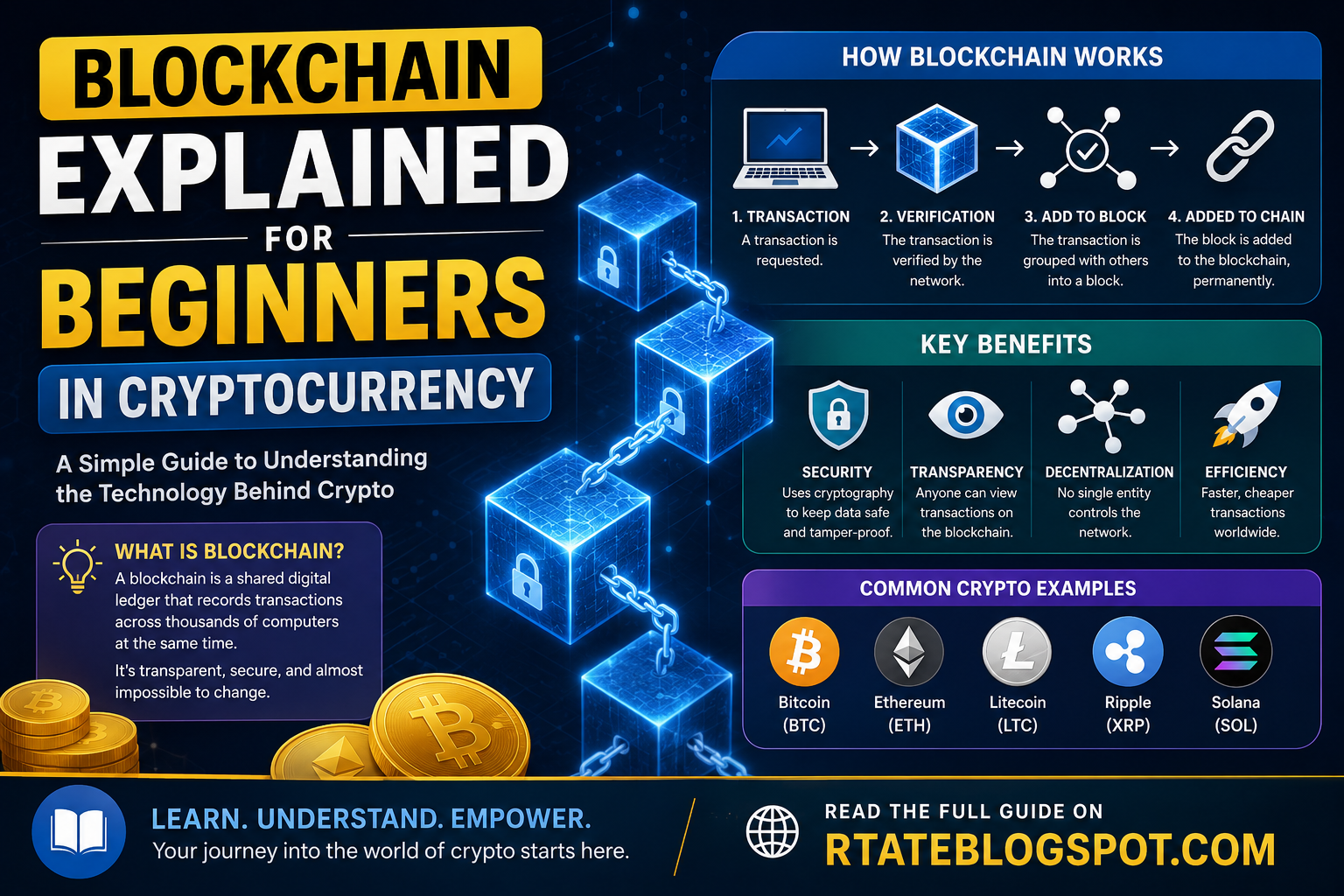
A blockchain is a shared digital ledger that records transactions across thousands of computers at the same time.
Instead of one company owning the database, everyone on the network keeps a synchronized copy, making it very hard to change past records.
Think of it like a public notebook: every new “page” of transactions is added permanently, and once written, it’s extremely difficult to erase or rewrite.
Blocks: The Building Units: Blockchain
A block is simply a bundled group of verified transactions.
Each block typically contains:
-
Transaction details
-
A timestamp
-
A reference (hash) to the previous block
Linking blocks together in order creates the secure chain of data we call the Blockchain
Cryptocurrency: Digital Money on the Blockchain
A cryptocurrency is a form of digital money that uses blockchain technology for security and transparency.
Popular examples include:
-
Bitcoin (BTC)
-
Ethereum (ETH)
-
Litecoin (LTC)
-
Solana (SOL)
Unlike traditional money, most cryptocurrencies operate without a central bank, relying instead on decentralized networks of computers.
Wallets: Your Interface to Crypto
A crypto wallet doesn’t store coins like a physical wallet; it stores the digital keys that let you access your crypto on the blockchain.
Your funds always live on the blockchain, and the wallet is the tool you use to view, send, and receive them.
Common wallet types include:
-
Software (desktop/web) wallets
-
Mobile wallets
-
Hardware wallets (physical devices)
-
Paper wallets (printed keys)
Public Key: Your Receiving Address
A public key functions like your bank account number.
You can share it safely so others can send cryptocurrency to your wallet, and it’s often displayed as a long string of characters or a QR code.
Private Key: The Ultimate Secret
Your private key is the secret code that proves you own and control the crypto in your wallet.
Anyone with access to your private key can move your funds, so it must never be shared or stored carelessly.
Treat your private key like the master password to your entire crypto portfolio.
Seed Phrase: Your Backup Plan: Blockchain
A seed phrase (also called a recovery phrase) is a list of typically 12–24 words generated when you create a wallet.
If you lose your device or wallet app, your seed phrase lets you restore access to your funds.
Write it down, keep it offline, and store it somewhere secure—never share it or save it in plain text online.
Mining: Securing the Network with Computation
Mining is the process used by certain blockchains to validate transactions and add new blocks.
Miners run powerful computers to solve complex mathematical puzzles, and the first to solve them earns the right to add the next block.
In return for this work, miners may receive newly created cryptocurrency and transaction fees as rewards.
Validators: Securing Proof-of-Stake Chains
Not all blockchains use mining.
Some use validators, who help secure the network by locking up cryptocurrency and verifying transactions through a system called staking.
Validators are chosen based on factors like how much they stake, and they earn rewards for honest participation.
Staking: Earning by Locking Your Crypto
Staking means committing (locking) your cryptocurrency to help secure a proof-of-stake blockchain.
In exchange for supporting the network, you can earn periodic rewards, similar to earning interest.
Many users stake through exchanges or staking pools rather than running their own validator nodes.
Smart Contracts: Code That Executes Itself
A smart contract is a small computer program stored on the blockchain that runs automatically when certain conditions are met.
Once deployed, it can execute agreements—like payments, trades, or access rights—without needing a bank, lawyer, or other middleman.
Smart contracts power many decentralized apps (dApps), DeFi protocols, and NFT marketplaces.
Decentralization: No Single Point of Control
Decentralization means control is shared across many computers instead of being concentrated in one company or authority.
This design makes blockchain networks more resistant to censorship, outages, and single points of failure.
The more decentralized a network is, the harder it is for any one party to change or manipulate its data.
Nodes: The Backbone of the Network
A node is any computer that connects to a blockchain network and participates in it.
Nodes can:
-
Verify transactions
-
Store and share copies of the blockchain
-
Help keep the network synchronized and secure
Thousands of nodes working together create the resilience that blockchains are known for.
Tokens: Digital Assets on Existing Chains
A token is a digital asset built on top of an existing blockchain, such as Ethereum.
Tokens can represent:
-
Utility inside an application
-
Voting rights in a project
-
Rewards and loyalty points
-
Digital collectibles
-
Ownership of real-world or digital assets
They are created using smart contracts, not by launching an entirely new blockchain.
Coins: Native Assets of a Blockchain
A coin is the native cryptocurrency of its own blockchain.
Examples include:
-
Bitcoin (BTC) – native to the Bitcoin blockchain
-
Ether (ETH) – native to the Ethereum blockchain
-
Litecoin (LTC) – native to the Litecoin blockchain
Coins are often used as digital money, to pay transaction fees, and to incentivize network participants.
Gas Fees: The Cost of Using the Network: Blockchain
A gas fee is the payment you make to process a transaction on certain networks like Ethereum.
These fees compensate validators or miners for the computation and security they provide.
Higher network activity can drive gas fees up, while quieter periods can make transactions cheaper.
NFTs: One-of-a-Kind Digital Items
An NFT (Non-Fungible Token) is a unique digital asset recorded on the blockchain.
Unlike cryptocurrencies, which are interchangeable, each NFT has its own identity and cannot be swapped 1:1 with another NFT.
NFTs can represent:
-
Digital art
-
Music and videos
-
Collectibles
-
In-game items
-
Access passes or membership tokens
DeFi: Financial Services Without Banks
DeFi (Decentralized Finance) refers to financial applications built on blockchains instead of traditional banking systems.
With DeFi, users can lend, borrow, trade, and earn interest directly through smart contracts and dApps.
This opens global access to financial tools, often without needing a bank account or credit check.
Exchanges: Where You Trade Crypto
A crypto exchange is a platform where people buy, sell, and trade cryptocurrencies.
There are two main types:
-
Centralized exchanges (CEXs), run by companies
-
Decentralized exchanges (DEXs), powered by smart contracts
Both aim to make it easier for users to enter and exit positions in different digital assets.
Market Cap: Measuring Project Size
Market capitalization (market cap) is a way to estimate the overall value of a cryptocurrency project.
It’s calculated as:
Current coin price × number of coins in circulation
Higher market caps usually indicate larger, more established projects, while lower caps often represent newer or riskier ones.
HODL: Holding Through the Volatility
HODL started as a typo for “hold” in an online forum, but it has become a popular crypto slogan.
It means holding onto your cryptocurrency long term instead of selling when prices swing wildly.
Many long-term investors embrace “HODLing” as a mindset for surviving market ups and downs.
Bull vs. Bear Markets: Blockchain
A bull market is a period when prices are broadly rising and investor sentiment is optimistic.
A bear market is the opposite: prices are generally falling, and investors become more cautious or pessimistic.
Crypto markets can move quickly from bullish to bearish cycles, so understanding these terms helps you read the overall mood.
Closing Thoughts: Building Your Crypto Vocabulary
Blockchain technology is reshaping finance, digital ownership, and online services across the globe.
While the terminology can feel overwhelming at first, learning these core concepts gives you a solid foundation for exploring cryptocurrencies and decentralized applications.
Move at your own pace, keep educating yourself, and always protect your private key and seed phrase—they are the keys to your digital assets.
The more you understand blockchain language today, the better prepared you’ll be to participate in tomorrow’s digital economy.

Getting Started with Markethive: Blockchain
If you’re exploring blockchain as part of your marketing or content strategy, Markethive is a practical place to begin. It combines blockchain concepts, inbound marketing, and community-driven tools in one ecosystem, making it easier to learn while you build.
A simple way to start is to create an account, explore the platform, and get familiar with the available resources at your own pace. Once you’re comfortable, you can see how it connects with publishing, networking, and digital growth.
You can visit Markethive here. Markethive
—————————————————–
Exploring Cryptocurrency: Your Guide to the Digital Financial Revolution
Tim Moseley