
The Foundation of Startup Success: A Clear, Documented Vision, Team, and Product.
.png)
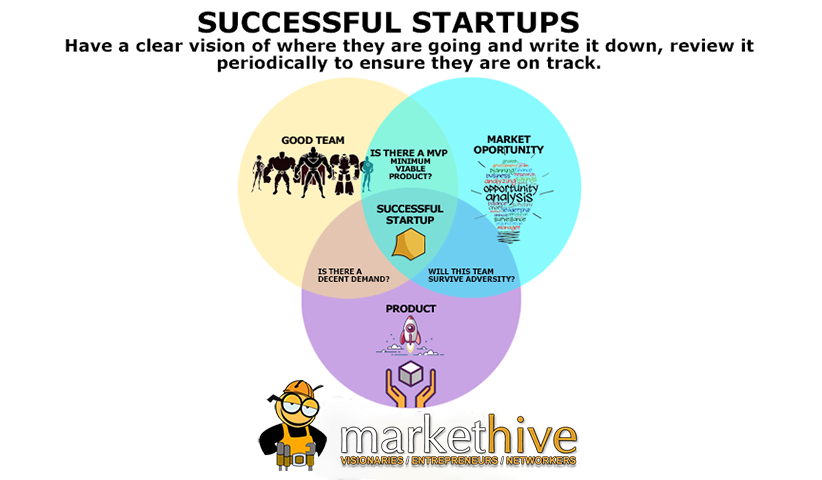
Successful startups stand out by having a clearly defined, crystal-clear vision of their ultimate goal and purpose. This vision isn't just a vague idea; it is a carefully written and formally documented strategic asset. The act of putting the vision on paper compels the leadership team to clearly state their goals, target market, proposed value proposition, and long-term impact with accuracy and thoroughness.
Most importantly, this documented vision should not be seen as a static record stored away. Instead, it serves as the company's guiding compass and requires regular, structured reviews and updates. Leadership teams should meet often to assess operational performance, market shifts, and the competitive landscape in relation to the vision, ensuring the startup stays effectively "on track." This continuous review process is crucial for:
- Ensuring Alignment: It allows the leadership team to critically assess whether the current trajectory, operational metrics, and immediate goals (such as product development or marketing strategies) continue to accurately steer the company toward its ultimate vision.
- Maintaining Relevance: As markets change, technology advances, and customer needs evolve, the review process helps ensure the vision remains relevant and inspiring, potentially requiring minor strategic tweaks without altering the core goal.
- Reinforcing Commitment: Frequent revisiting of the written vision re-energizes the team and strengthens shared dedication to the long-term journey, especially during tough growth periods or unexpected setbacks.
- Inspiring Stakeholders: A well-defined, written vision gives investors, partners, and early adopters confidence in the leadership's foresight and dedication to reaching a clearly articulated future goal.
In essence, a written, frequently reviewed vision transforms aspiration into a measurable, manageable journey toward success.
Adopt the Minimum Viable Product (MVP) strategy.
The foundation described above, combined with the steps and pillars discussed in this article, such as defining the problem clearly, identifying the target audience, and creating a compelling value proposition, serves as the essential groundwork for developing your Minimum Viable Product (MVP).
Launching an initial, functional version of your product swiftly is vital for early startup success, even if it's not perfect. This approach, called the Minimum Viable Product (MVP), is more than just a fast delivery method; it acts as a crucial way to conduct real-world testing with genuine users. This early exposure is invaluable, allowing quick identification of critical bugs, subtle flaws, and essential areas for significant improvement that internal testing might miss.
It is critically important to resist the urge to aim for an unattainable initial "perfection." This perfectionist impulse is a common trap that often leads to significant development delays, substantial resource overruns, and, most importantly, missed opportunities to receive timely, genuine feedback from your target market. Instead, the focus should be on practicality: launching a stable, working version with the least time and money necessary.
An MVP is fundamentally a structured experiment, not a final, complete product. Its core philosophy is to develop the most basic, functional version of a product that contains only the essential features required to address the primary, high-value problem experienced by your initial target users, often referred to as early adopters.
For example, instead of building a fully-featured, complex platform, you launch a basic version with the most critical features and simple feedback tools, such as surveys, basic contact forms, or support mechanisms that allow users to report bugs or suggest improvements, forums, or dedicated groups, such as those actively used by the Markethive platform, where the company can engage directly with its user base. This is vital for actively valuing, incorporating, and prioritizing community input, transforming users into co-creators of the evolving product.
The MVP isn't just an unfinished product; it's a version of a new product designed to help a team gather the most validated customer learning with minimal effort. This idea primarily focuses on improving learning efficiency and iteration. The aim is to go beyond assumptions by collecting empirical data that confirms or refutes the core hypothesis of the product's value proposition.
The development roadmap is guided entirely by data and qualitative insights from early user engagement, enabling you to release targeted updates, new features, and improvements aligned with actual user needs and behaviors. This iterative, user-centered process minimizes risks and ensures each subsequent investment in the product aligns with market demand.
Build, Measure, and Learn: The Continuous Improvement Cycle
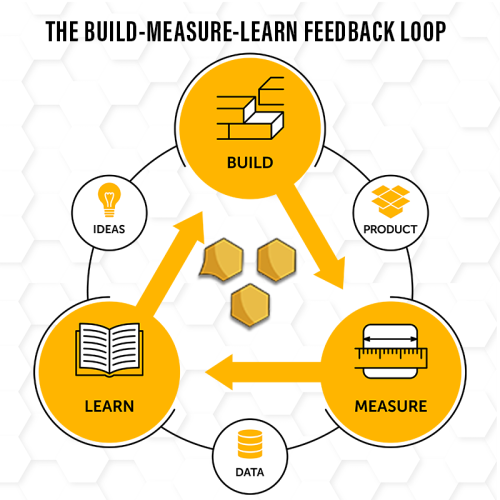
Launching an MVP is just the beginning, not the end, of the process. It marks the start of the most essential phase: ongoing testing and improvement. This phase follows the "build-measure-learn" loop, a continuous cycle vital for handling the uncertainties typical in a startup environment.
The Measure Phase: Defining Success with Data
After delivering the MVP to early adopters, the next step is to focus on detailed data collection and analysis. This includes monitoring key performance indicators (KPIs) directly linked to the initial hypotheses and the core value proposition. These metrics provide concrete evidence for evaluating performance relative to expectations.
Important metrics often tracked include:
- Activation Rate: The proportion of users completing key setup steps.
- Retention Rate: The percentage of users who keep using the product over time.
- Customer Lifetime Value (CLV): The expected total revenue from a single customer.
- Churn Rate: The percentage of customers who stop using the product.
- Conversion Rates: The percentage of users completing specific actions like signing up, upgrading, or purchasing.
In addition to quantitative data, collecting direct user feedback through interviews, surveys, and usability tests is equally important. This qualitative data explains the reasons behind the numbers, revealing insights into user experience, challenges, and unmet needs.
The Learn Phase: Interpreting Data and Making Decisions
The data collected during the measure phase must be carefully analyzed to derive actionable insights. This learning stage involves critically evaluating the product's performance by validating assumptions, such as whether the market responded as expected and if the core features are influencing user behavior. It also involves identifying gaps, like where users exit or which features are confusing or underused.
Based on these insights, a strategic decision is made: either to persevere or pivot. Persevering involves continuing to optimize, improve incrementally, and scale successful features if the data shows positive traction. Conversely, if the data reveals fundamental issues, such as a misaligned target market, an ineffective solution, or a less urgent problem, a pivot is necessary. A pivot is a structured change aimed at testing a new hypothesis about the product, strategy, or growth approach.
The Build Phase: Iterative Improvement
The transition from the learning phase to the build phase marks a key turning point in the agile startup journey. Unlike traditional development methods that focus on a large, risky product launch, the goal here is quite different: to pursue fast, iterative development based solely on validated insights. This principle emphasizes that the product should not be expanded recklessly but instead refined through a series of small, focused changes, or iterations.
This intentional strategy of incremental growth is the foundation of capital-efficient and low-risk expansion. By committing to minor, evidence-based adjustments, the startup avoids investing large amounts of capital into features that the market may ultimately reject. Each iteration serves as a small, controlled experiment, reducing the risk involved in new product development.
This ongoing cycle ensures that empirical data exclusively guides every development effort. It prevents teams from relying on speculation or personal bias, greatly enhancing the chances of delivering a product or service with genuine market fit. This continuous feedback loop is more than just a process; it is the driving force behind a lean startup's long-term, sustainable success, ensuring that resources are always directed toward solving problems the market genuinely needs and values.
Achieve the Perfect Product-Market Fit
Product-Market Fit (PMF) is a key milestone for startups, signifying when a company's product successfully meets a substantial market need. It is more than a theoretical idea; it's a measurable state achieved when the right product aligns with the right market, creating a self-sustaining growth engine that can't be ignored.
The accurate indicator of PMF is in the metrics: fast, viral, and long-lasting organic growth, combined with exceptionally high customer retention and lifetime value, often with little dependence on paid acquisition channels. Customers aren't merely using the product; they are passionately promoting it, and the market is actively driving the product out of the company.
Once PMF is conclusively demonstrated, the focus must immediately and strategically shift from simply validating the market to aggressive, systematic scaling. This is a sensitive and complex phase where initial success needs to be leveraged carefully without disrupting the operational framework that supported the growth.
Strategic Scaling: The Essential Next Step After Product-Market Fit
Once PMF is conclusively demonstrated, the focus must immediately and strategically shift from simply validating the market to aggressive, systematic scaling. This is a sensitive and complex phase where initial success needs to be leveraged carefully without disrupting the operational framework that supported the growth. The key areas of strategic scaling include:
- Optimizing Operations and Infrastructure: The systems, processes, and technology stack that worked for a small user base will inevitably struggle during rapid growth. Scaling demands improving every part of the operation, from customer support and fulfillment logistics to engineering workflows and data infrastructure. This involves investing in automation, building a strong, scalable architecture, and adopting standardized, efficient procedures to keep service quality and margins steady as volume increases.
- Expanding Market Reach and Penetration: Scaling involves deliberately broadening the company's reach through geographic expansion, targeting nearby customer groups, or launching new product lines that complement existing offerings. Success depends on a thorough understanding of the Total Addressable Market (TAM), Serviceable Available Market (SAM), and Serviceable Obtainable Market (SOM). Implementing a targeted, data-backed go-to-market plan is essential for effective market penetration, often requiring localized sales efforts, marketing campaigns, and strategic partnerships.
- Solidifying a Defensible Competitive Edge: PMF attracts competitors. Therefore, scaling must be paired with the intentional building of a "moat," a sustainable competitive advantage, to ensure long-term success and protect market share. This advantage can take several forms:
- Network Effects: Creating a platform where the product's value grows exponentially as more users join (e.g., social networks, marketplaces).
- Proprietary Technology: Developing unique IP, algorithms, or specialized technology that is hard or costly for competitors to imitate.
- Cost Advantage: Achieving economies of scale that enable the lowest cost structure in the industry.
- Brand and Community: Building a strong brand presence and fostering a loyal, active community that serves as a substantial barrier to entry.
- High Switching Costs: Integrating the product so thoroughly into a customer's operations or daily routine that switching to a competitor becomes difficult.
Successfully navigating the scaling phase is what distinguishes a successful startup from a long-term category leader. It demands discipline, ongoing improvement, and a dedication to operational excellence, all while fiercely safeguarding the core product value proposition that initially achieved Product-Market Fit.
.png)
Markethive: The Product – A Unified Platform Dedicated to Perpetual Growth
Markethive represents a paradigm shift in the digital marketing landscape, establishing itself as a pioneering, all-in-one ecosystem designed for modern entrepreneurs and companies. Its core innovation is the seamless internal integration of a robust suite of inbound marketing tools and diverse Software-as-a-Service (SaaS) utilities directly within a dynamic, built-in social media interface. This creates a unified environment that powers every facet of a user's online business life.
The platform's unique architectural design delivers a distinct and immediate competitive advantage. It completely eliminates the fragmentation and inefficiency traditionally associated with managing a digital presence. Users, including solo entrepreneurs, business owners, content creators, and professional digital marketers, no longer need to toggle between disparate applications for daily operations. Instead, they operate entirely within a single, highly efficient, and synergistic environment.
Within this unified hub, users can effortlessly manage their professional social presence, execute sophisticated multi-channel marketing campaigns (including email, blogging, and landing pages), and access essential business resources such as Customer Relationship Management (CRM) and analytics. This seamless integration significantly reduces friction, saves valuable time, and enables users to focus on strategic growth and creativity rather than administrative overhead.
Markethive: Ushering in the Decentralized Market Network Era
With the revolutionary rise of blockchain technology, Markethive saw a key opportunity to redefine its role in the digital ecosystem. This led to the vision of becoming a major player in the growing crypto space, resulting in the creation of the industry's first fully decentralized Market Network. This step goes beyond traditional social media, marketing, and e-commerce platforms by offering a sovereign, user-centered environment designed for the future of digital entrepreneurship.
Markethive is also strategically committed to financially empowering its members. The platform offers essential tools and an ecosystem that enable users to create, manage, and grow their income streams. Additionally, the company provides opportunities for wealth creation, including the Entrepreneur One (E1) subscription, which integrates the Initial Loan Procurement (ILP), the Banner Impressions Exchange (BIX), and the E1 Exchange (E1X), as well as the Bounty program, Franchives, and Hivepress. This approach keeps the platform innovative and relevant while directly helping its members achieve financial independence.
Commitment to Perpetual Technological Advancement
Markethive's core philosophy centers on a fundamental commitment to continuous improvement, realized through a highly effective development cycle. This process involves constant iteration, testing, and deployment to ensure its marketing technology ecosystem remains cutting-edge.
By taking this proactive and dedicated approach, Markethive not only meets current market needs but also consistently anticipates and stays significantly ahead of emerging digital trends. This investment in technology ensures users are equipped with the most advanced tools to support ongoing business growth in a rapidly evolving landscape.
The result of this relentless iteration is a platform that remains:
- Powerful: Providing entrepreneurs with state-of-the-art capabilities in marketing, communication, and commerce.
- Competitive: Offering features and tools that demonstrably outperform traditional, centralized platforms.
- Highly Relevant: Directly addressing both the immediate and future demands of digital business owners and content creators.
.png)
Tim Moseley