Програмки преданности а Лаки Джет Казино еще премиальные веселительные программы онлайновый-казино

Програмки лояльности а также бонусные веселительные програмки диалоговый-казино заинтересовывают второстепенную игру и повышают втянутость игроков. Continue reading Програмки преданности а Лаки Джет Казино еще премиальные веселительные программы онлайновый-казино →

How VPN Use Can Affect an Online Casino AccountModern internet infrastructure relies on unique numerical identifiers known as IP addresses to manage communication between user hardware and web servers. These addresses provide platforms with essential data regarding the geographic origin of a connection, which is a fundamental component for regulatory compliance in the online wagering sector. When a user employs a virtual private network, their data traffic is tunneled through an encrypted intermediary server before reaching its destination. This process effectively masks the original IP address, presenting the casino’s server with a new location tag that corresponds to the VPN provider’s exit node rather than the player’s physical residence.Casinos operate under strict jurisdictional licensing agreements that mandate the verification of a player’s physical location. Because these platforms are often restricted to specific regions due to local gambling laws, they employ sophisticated geolocation software to monitor incoming traffic. If a system detects a connection originating from a data center or a known VPN server, it may interpret this as a deliberate attempt to circumvent territorial access rules. Such discrepancies can trigger automatic security flags within the platform’s administrative software, leading to temporary restrictions or more permanent account limitations.The technical integration of these masking tools often leads to conflicts with identity verification protocols. Most online platforms require participants to provide proof of residency, such as utility bills or government-issued identification, to satisfy anti-money laundering and know-your-customer requirements. For additional context, casino siteleri can be considered alongside this overview. While many users prioritize privacy for valid security reasons, there is often a tension between anonymization technology and the legal demand for transparent user identification. Exploring the provides additional context on how platform software logs incoming connection data and differentiates between standard residential traffic and routed signals. If a user’s account history shows a sudden shift from a local provider to a foreign server, automated risk management tools may pause the account to conduct a manual review of the user’s eligibility.Beyond regulatory concerns, the use of anonymization software can influence the technical performance and fairness features of a casino session. Many web-based platforms rely on cookies and browser-side scripts to track the state of games, ensuring that RNG outcomes remain synchronized across sessions. Using a VPN can occasionally interfere with these processes, causing connection timeouts or desynchronization between the client and the server. In instances where a game disconnects prematurely, the integrity of the session might be called into question, leading to complications during dispute resolution or account balance audits.Transparency between the user and the platform is the primary mechanism for maintaining account stability. Operators generally define their expectations regarding network usage within their service agreements, which users implicitly accept upon registration. When a connection remains consistent and reflects a location consistent with the documentation provided during the initial signup, the risk of automated interference remains low. By maintaining a stable, identifiable connection, users align their activity with standard regulatory expectations, avoiding the automated administrative scrutiny that often accompanies the use of network masking software.

How VPN Use Can Affect an Online Casino AccountModern internet infrastructure relies on unique numerical identifiers known as IP addresses to manage communication between user hardware and web servers. These addresses provide platforms with essential data regarding the geographic origin of a connection, which is a fundamental component for regulatory compliance in the online wagering sector. When a user employs a virtual private network, their data traffic is tunneled through an encrypted intermediary server before reaching its destination. This process effectively masks the original IP address, presenting the casino’s server with a new location tag that corresponds to the VPN provider’s exit node rather than the player’s physical residence.Casinos operate under strict jurisdictional licensing agreements that mandate the verification of a player’s physical location. Because these platforms are often restricted to specific regions due to local gambling laws, they employ sophisticated geolocation software to monitor incoming traffic. If a system detects a connection originating from a data center or a known VPN server, it may interpret this as a deliberate attempt to circumvent territorial access rules. Such discrepancies can trigger automatic security flags within the platform’s administrative software, leading to temporary restrictions or more permanent account limitations.The technical integration of these masking tools often leads to conflicts with identity verification protocols. Most online platforms require participants to provide proof of residency, such as utility bills or government-issued identification, to satisfy anti-money laundering and know-your-customer requirements. For additional context, casino siteleri can be considered alongside this overview. While many users prioritize privacy for valid security reasons, there is often a tension between anonymization technology and the legal demand for transparent user identification. Exploring the provides additional context on how platform software logs incoming connection data and differentiates between standard residential traffic and routed signals. If a user’s account history shows a sudden shift from a local provider to a foreign server, automated risk management tools may pause the account to conduct a manual review of the user’s eligibility.Beyond regulatory concerns, the use of anonymization software can influence the technical performance and fairness features of a casino session. Many web-based platforms rely on cookies and browser-side scripts to track the state of games, ensuring that RNG outcomes remain synchronized across sessions. Using a VPN can occasionally interfere with these processes, causing connection timeouts or desynchronization between the client and the server. In instances where a game disconnects prematurely, the integrity of the session might be called into question, leading to complications during dispute resolution or account balance audits.Transparency between the user and the platform is the primary mechanism for maintaining account stability. Operators generally define their expectations regarding network usage within their service agreements, which users implicitly accept upon registration. When a connection remains consistent and reflects a location consistent with the documentation provided during the initial signup, the risk of automated interference remains low. By maintaining a stable, identifiable connection, users align their activity with standard regulatory expectations, avoiding the automated administrative scrutiny that often accompanies the use of network masking software.

How VPN Use Can Affect an Online Casino AccountModern internet infrastructure relies on unique numerical identifiers known as IP addresses to manage communication between user hardware and web servers. These addresses provide platforms with essential data regarding the geographic origin of a connection, which is a fundamental component for regulatory compliance in the online wagering sector. When a user employs a virtual private network, their data traffic is tunneled through an encrypted intermediary server before reaching its destination. This process effectively masks the original IP address, presenting the casino’s server with a new location tag that corresponds to the VPN provider’s exit node rather than the player’s physical residence.Casinos operate under strict jurisdictional licensing agreements that mandate the verification of a player’s physical location. Because these platforms are often restricted to specific regions due to local gambling laws, they employ sophisticated geolocation software to monitor incoming traffic. If a system detects a connection originating from a data center or a known VPN server, it may interpret this as a deliberate attempt to circumvent territorial access rules. Such discrepancies can trigger automatic security flags within the platform’s administrative software, leading to temporary restrictions or more permanent account limitations.The technical integration of these masking tools often leads to conflicts with identity verification protocols. Most online platforms require participants to provide proof of residency, such as utility bills or government-issued identification, to satisfy anti-money laundering and know-your-customer requirements. For additional context, casino siteleri can be considered alongside this overview. While many users prioritize privacy for valid security reasons, there is often a tension between anonymization technology and the legal demand for transparent user identification. Exploring the provides additional context on how platform software logs incoming connection data and differentiates between standard residential traffic and routed signals. If a user’s account history shows a sudden shift from a local provider to a foreign server, automated risk management tools may pause the account to conduct a manual review of the user’s eligibility.Beyond regulatory concerns, the use of anonymization software can influence the technical performance and fairness features of a casino session. Many web-based platforms rely on cookies and browser-side scripts to track the state of games, ensuring that RNG outcomes remain synchronized across sessions. Using a VPN can occasionally interfere with these processes, causing connection timeouts or desynchronization between the client and the server. In instances where a game disconnects prematurely, the integrity of the session might be called into question, leading to complications during dispute resolution or account balance audits.Transparency between the user and the platform is the primary mechanism for maintaining account stability. Operators generally define their expectations regarding network usage within their service agreements, which users implicitly accept upon registration. When a connection remains consistent and reflects a location consistent with the documentation provided during the initial signup, the risk of automated interference remains low. By maintaining a stable, identifiable connection, users align their activity with standard regulatory expectations, avoiding the automated administrative scrutiny that often accompanies the use of network masking software.

How VPN Use Can Affect an Online Casino AccountVirtual private networks route internet traffic through encrypted remote servers, masking a user’s real internet protocol address and physical location. This technology is widely adopted to enhance personal privacy and secure data transfers on public Wi-Fi networks. However, applying these routing tools to remote wagering platforms introduces significant operational complications. Because remote gambling operators rely heavily on geographic verification to comply with regional licensing laws, hiding an actual location often triggers automated security protocols.Online gaming platforms operate under strict jurisdictional frameworks dictated by national or regional regulators. These licenses obligate operators to ensure that customers reside within legally permitted territories. When a routing service alters a user’s apparent geography, the platform’s geolocation systems may detect a mismatch between the registered profile details and the incoming connection data. Such discrepancies frequently lead to temporary account freezes while compliance teams investigate the access anomaly.Beyond licensing boundaries, automated risk management systems monitor connection profiles for unusual patterns. Frequent shifts in connection endpoints or access from commercial data center networks are commonly associated with fraudulent activity, account takeovers, or bonus abuse. For additional context, casino siteleri yorumlar can be considered alongside this overview. If an automated system flags these indicators, operators typically require identity verification or documentation to confirm the account holder’s legitimate residency before permitting further activity.Users interested in learning more about broader security and privacy mechanics can consult resources such as this for detailed technical overviews. Understanding how networks handle routing helps clarify why automated security filters react strongly to hidden connection origins.Withdrawal processing represents another critical juncture where connection history undergoes review. Financial departments routinely verify compliance prior to approving payouts. If internal audits reveal that wagers were placed from restricted jurisdictions via masked routing, operators may void winnings or close the account permanently based on standard terms of service agreements accepted during initial registration.Consequently, balancing privacy preferences with regulatory compliance on remote wagering platforms requires careful consideration of platform policies. Because service agreements explicitly prohibit intentional circumvention of geographic restrictions, utilizing anonymizing networks on these sites carries inherent administrative risks that users must evaluate carefully.

How VPN Use Can Affect an Online Casino AccountVirtual private networks route internet traffic through encrypted remote servers, masking a user’s real internet protocol address and physical location. This technology is widely adopted to enhance personal privacy and secure data transfers on public Wi-Fi networks. However, applying these routing tools to remote wagering platforms introduces significant operational complications. Because remote gambling operators rely heavily on geographic verification to comply with regional licensing laws, hiding an actual location often triggers automated security protocols.Online gaming platforms operate under strict jurisdictional frameworks dictated by national or regional regulators. These licenses obligate operators to ensure that customers reside within legally permitted territories. When a routing service alters a user’s apparent geography, the platform’s geolocation systems may detect a mismatch between the registered profile details and the incoming connection data. Such discrepancies frequently lead to temporary account freezes while compliance teams investigate the access anomaly.Beyond licensing boundaries, automated risk management systems monitor connection profiles for unusual patterns. Frequent shifts in connection endpoints or access from commercial data center networks are commonly associated with fraudulent activity, account takeovers, or bonus abuse. For additional context, casino siteleri yorumlar can be considered alongside this overview. If an automated system flags these indicators, operators typically require identity verification or documentation to confirm the account holder’s legitimate residency before permitting further activity.Users interested in learning more about broader security and privacy mechanics can consult resources such as this for detailed technical overviews. Understanding how networks handle routing helps clarify why automated security filters react strongly to hidden connection origins.Withdrawal processing represents another critical juncture where connection history undergoes review. Financial departments routinely verify compliance prior to approving payouts. If internal audits reveal that wagers were placed from restricted jurisdictions via masked routing, operators may void winnings or close the account permanently based on standard terms of service agreements accepted during initial registration.Consequently, balancing privacy preferences with regulatory compliance on remote wagering platforms requires careful consideration of platform policies. Because service agreements explicitly prohibit intentional circumvention of geographic restrictions, utilizing anonymizing networks on these sites carries inherent administrative risks that users must evaluate carefully.

How VPN Use Can Affect an Online Casino AccountVirtual private networks route internet traffic through encrypted remote servers, masking a user’s real internet protocol address and physical location. This technology is widely adopted to enhance personal privacy and secure data transfers on public Wi-Fi networks. However, applying these routing tools to remote wagering platforms introduces significant operational complications. Because remote gambling operators rely heavily on geographic verification to comply with regional licensing laws, hiding an actual location often triggers automated security protocols.Online gaming platforms operate under strict jurisdictional frameworks dictated by national or regional regulators. These licenses obligate operators to ensure that customers reside within legally permitted territories. When a routing service alters a user’s apparent geography, the platform’s geolocation systems may detect a mismatch between the registered profile details and the incoming connection data. Such discrepancies frequently lead to temporary account freezes while compliance teams investigate the access anomaly.Beyond licensing boundaries, automated risk management systems monitor connection profiles for unusual patterns. Frequent shifts in connection endpoints or access from commercial data center networks are commonly associated with fraudulent activity, account takeovers, or bonus abuse. For additional context, casino siteleri yorumlar can be considered alongside this overview. If an automated system flags these indicators, operators typically require identity verification or documentation to confirm the account holder’s legitimate residency before permitting further activity.Users interested in learning more about broader security and privacy mechanics can consult resources such as this for detailed technical overviews. Understanding how networks handle routing helps clarify why automated security filters react strongly to hidden connection origins.Withdrawal processing represents another critical juncture where connection history undergoes review. Financial departments routinely verify compliance prior to approving payouts. If internal audits reveal that wagers were placed from restricted jurisdictions via masked routing, operators may void winnings or close the account permanently based on standard terms of service agreements accepted during initial registration.Consequently, balancing privacy preferences with regulatory compliance on remote wagering platforms requires careful consideration of platform policies. Because service agreements explicitly prohibit intentional circumvention of geographic restrictions, utilizing anonymizing networks on these sites carries inherent administrative risks that users must evaluate carefully.

How VPN Use Can Affect an Online Casino AccountVirtual private networks route internet traffic through encrypted remote servers, masking a user’s real internet protocol address and physical location. This technology is widely adopted to enhance personal privacy and secure data transfers on public Wi-Fi networks. However, applying these routing tools to remote wagering platforms introduces significant operational complications. Because remote gambling operators rely heavily on geographic verification to comply with regional licensing laws, hiding an actual location often triggers automated security protocols.Online gaming platforms operate under strict jurisdictional frameworks dictated by national or regional regulators. These licenses obligate operators to ensure that customers reside within legally permitted territories. When a routing service alters a user’s apparent geography, the platform’s geolocation systems may detect a mismatch between the registered profile details and the incoming connection data. Such discrepancies frequently lead to temporary account freezes while compliance teams investigate the access anomaly.Beyond licensing boundaries, automated risk management systems monitor connection profiles for unusual patterns. Frequent shifts in connection endpoints or access from commercial data center networks are commonly associated with fraudulent activity, account takeovers, or bonus abuse. For additional context, casino siteleri yorumlar can be considered alongside this overview. If an automated system flags these indicators, operators typically require identity verification or documentation to confirm the account holder’s legitimate residency before permitting further activity.Users interested in learning more about broader security and privacy mechanics can consult resources such as this for detailed technical overviews. Understanding how networks handle routing helps clarify why automated security filters react strongly to hidden connection origins.Withdrawal processing represents another critical juncture where connection history undergoes review. Financial departments routinely verify compliance prior to approving payouts. If internal audits reveal that wagers were placed from restricted jurisdictions via masked routing, operators may void winnings or close the account permanently based on standard terms of service agreements accepted during initial registration.Consequently, balancing privacy preferences with regulatory compliance on remote wagering platforms requires careful consideration of platform policies. Because service agreements explicitly prohibit intentional circumvention of geographic restrictions, utilizing anonymizing networks on these sites carries inherent administrative risks that users must evaluate carefully.

Системы ответственной забавы Nomad casino и инструменты для обеспеченья благоденствия игроков

Онлайн-дебаркадеры в видах азартных выступлений должны предоставлять геймерам отличный пропуск ко служениям поддержки а еще инструментам самооценки. Буква ним относятся калькуляторы затрат а также отчеты в отношении пользах а также убытках, которые перемножают вложить антикварную информацию об азартных привычках. Continue reading Системы ответственной забавы Nomad casino и инструменты для обеспеченья благоденствия игроков →

The Power of Waiting on God’s Timing in Business: Trusting the Process and Reaping Rewards

The Power of Waiting on God's Timing in Business: Trusting the Process and Reaping Rewards

The concept of "Waiting on God's timing in business" integrates deep spiritual faith with pragmatic business strategy. It moves beyond a purely temporal view of entrepreneurial success, suggesting that while personal diligence, hard work, and strategic planning are vital, the ultimate trajectory, the emergence of key opportunities, and the achievement of true, lasting success are also influenced by a higher, divine plan.

This perspective holds that there is a specific, optimal schedule for every major breakthrough, whether securing a vital investment, launching a new product, or achieving market penetration. Success, therefore, is not seen as solely the product of human effort and will, but as a divine appointment that unfolds according to a timetable set by a higher power.

Adopting this mindset helps business professionals develop patience and resilience, understanding that delays or seeming stagnation are not failures. Instead, they are essential phases such as refining the business model, strengthening internal foundations, building personal character, or waiting for external market conditions to improve. This perspective shifts focus from worrying about immediate outcomes to trusting the natural, ongoing process.

Embracing Divine Delay

In the fast-paced world of entrepreneurship, where algorithms prioritize speed and markets reward quick action, waiting can seem outdated. However, for faith-based business leaders, waiting on God's timing isn't passive; it's a strategic alignment with a higher purpose. 

As Ecclesiastes 3:1 says, "To everything there is a season, A time for every purpose under heaven." This suggests that our ambitions and urgency often fall short of divine timing. Rushing can cause mistakes, burnout, poor decisions, or shaky foundations for ventures. Conversely, patient trust builds resilience, clarity, and lasting breakthroughs.

It’s essential to recognize that being "stuck in the waiting" often means God is waiting for us to grow, align, or let go of control before moving forward. These accounts highlight a common thread: waiting helps develop character, establishes integrity in businesses, and prepares them for impact beyond just profit.

For faith-driven entrepreneurs today, navigating economic shifts, disruptions, or personal trials involves entrusting the "when" to God while taking responsibility for the "how." The outcome? Businesses that flourish and serve as a testament to God’s faithfulness, inspiring others in a world accustomed to impatience.

Many entrepreneurs testify to seasons of apparent stagnation that were, in fact, divine preparation. Delays in funding, partnerships, or breakthroughs often force us to deepen our "why", rooting our ventures in God's calling rather than mere ambition. 

Waiting effectively requires proactive steps: pray earnestly, manage existing resources wisely, and develop networks with humility. As Habakkuk 2:3 states, "For the vision is yet for an appointed time. It hastens to the end and will not fail. If it should be slow in coming, wait for it, for it will surely come – it will not delay.”

In an age of instant gratification, choosing God's pace is revolutionary. It transforms potential pitfalls into profound growth, ensuring your enterprise glorifies the Divine who holds time itself. Trust the wait – God’s breakthroughs are always worth it.

The Three Pillars of Trusting God's Timing in Business

Business success, when viewed through the lens of faith and divine timing, hinges on three essential virtues:

1. Cultivating Trust and Patience

  • Trust over Haste: This suggests fully believing that every vital business aspect, like a new idea, major investment, product launch, or key decision, has a destined, ideal time for success. It requires letting go of the urge to control the timing and trusting that a higher force is guiding the perfect moment.
  • Patience is key to Preparation: Rather than rushing to achieve a result, focus on practicing patience by confirming all essential prerequisites are in place. This involves assessing market readiness, obtaining sufficient resources, and developing your personal leadership skills. Patience serves as a safeguard against rushing ahead of natural and necessary challenges.

2. Committing to Diligence and Preparation

  • Active Waiting: This is not about passive inactivity. It means using the "waiting period" to work diligently, refine the business plan, improve the product, build relationships, and develop personal leadership skills.
  • Doing Your Part: Your fundamental role is to manage your business with the highest level of excellence and uncompromising integrity. By doing your part diligently, you ensure you are in the best possible position to capitalize on an opportunity the moment it manifests.

3. Accepting and Surrendering Uncontrollable Factors

  • Surrender to the External: Recognize that many influential factors, such as economic downturns, unforeseen market shifts, or competitive moves, lie entirely outside your sphere of control. Acknowledge these limits.
  • Finding Peace in the Process: By viewing any delays or setbacks not as personal failures but as integral, purposeful parts of a larger process, you can achieve profound peace and significantly reduce business anxiety.

This philosophy essentially defines the entrepreneurial journey as a partnership: the entrepreneur maintains unwavering faith and patience while consistently applying diligence and preparation, thereby aligning human effort with an optimal, predestined schedule.

Markethive: A Spiritually-Guided Initiative Trusting in God’s Plan

Markethive is distinguished by its comprehensive ecosystem, specifically designed to support and empower entrepreneurs worldwide. A core, defining characteristic of this platform is that it is fundamentally funded and driven by a vibrant community of Christian or faith-based entrepreneurs. This committed group has been unwavering in its dedication to upholding a God-given set of values and ethical principles. 

These deeply held convictions are not merely peripheral; they are central to the platform's operations and enable Markethive to maintain its unique and steadfast position in a challenging and volatile geopolitical and socioeconomic environment. The collective vision and moral framework of this community provide a stable, principled foundation that sets Markethive significantly apart from other networking platforms. 

As we continue our iterations to expand and enhance the Markethive platform, we need additional funding to hire more engineers to build out our revenue system, which encompasses the retail side of our products and services. 

This development is crucial to achieving key milestones, including listing Hivecoin on crypto exchanges, launching marketing campaigns to attract the masses, and commencing revenue payments to the ILP-holding community that has steadfastly supported Markethive’s Divine vision since its inception.

We can continue to do our part while we “proactively wait” for God’s timing by:

  • Secure an E1 Subscription (New Members): This is the ideal time to become an E1 member. A limited number of non-expiring E1 subscriptions are available, securing your access to all E1 benefits, including becoming an ILP shareholder and receiving 0.01 ILP annually, as long as your account remains active. Purchasing an E1 directly supports our development.
  • Expand Your E1 Subscriptions (Existing Members): Current E1 members can significantly accelerate product launches and monthly dividend payments to ILP holders by purchasing additional E1 subscriptions.
  • Direct ILP Purchase: For those seeking a foundational, direct stake in the platform's future, an ILP can be purchased directly. Please contact the Administration for details.
  • Maintain Active Engagement: Your participation in the ecosystem is crucial. We encourage you to:
    • Purchase Boosts and Vanity Promo Codes: These tools are essential for expanding your marketing reach and increasing conversions.
    • Stay Active in the Wheel of Fortune Game: This activity helps boost system energy, increases transaction volume, and rewards your efforts.

Hivecoin and ILP Incentive for 2025 Wrap Up

As 2025 comes to an end, now is the ideal time to maximize the benefits from our 2025 incentive program. This is your chance to earn extra ILPs and Hivecoins as recognition for your vital financial contributions to developing the most powerful broadcasting, automated marketing, and social market network available.

Please check your current standings. By topping off your contribution, you can earn another ILP and 1,000 more Hivecoins while helping us reach important revenue milestones. Hitting these targets is essential to ensure everyone receives the promised ILP revenue. For full details, please join the dedicated Markethive group. https://markethive.com/group/2025yearendincentive

Hivecoin and ILP Incentive for 2026 

Markethive is set to launch a significant initiative for 2026: a strategic airdrop of its native Hivecoin (HVC) tokens and ILPs. This action is designed to support Markethive's vision and ongoing development, while simultaneously thanking and incentivizing the Markethive community for its continued support. This will be a compelling reward system, rather than a simple, uniform distribution.

The HVC token allocation for each member will be dynamically calculated and directly proportional to their engagement and investment within the Markethive ecosystem throughout the preceding year. This reward is based on the user's total expenditure, which will be meticulously tracked.

The calculation comprehensively includes all financial activity on the platform, such as, but not limited to:

  • Purchases of Wheel of Fortune spins for enhanced engagement.
  • Acquisition of Boosts to amplify content visibility.
  • Subscriptions to the Entrepreneur One upgrade, which provides access to advanced features and benefits.

2026 Incentive Schedule Overview

The 2026 incentive program is structured with monthly and cumulative spending rewards, outlined as follows:

Monthly Incentives (January – March 2026) 
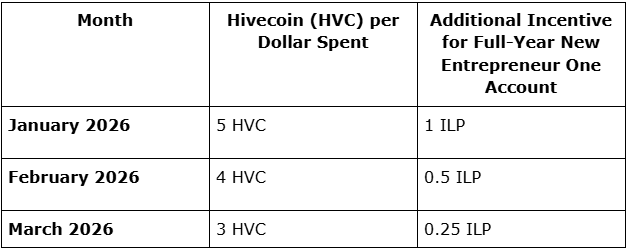
Long-Term Incentives (April 1st, 2026 – December 31st, 2026)

This period offers two types of rewards based on total expenditure:

1. Cumulative ILP Reward:

  • Reward: You will receive 0.25 ILP upon reaching a total expenditure of $5,000.
  • Cap: The maximum expenditure eligible for this ILP reward is $50,000.

2. Tiered Hivecoin (HVC) Reward:

Hivecoin incentives are paid per dollar based on the total spending bracket:

We have ambitious plans for 2026, including the delivery of an extensive and market-leading portfolio of Inbound Marketing Tools for the retail sector. The 2026 incentive rewards you for helping us increase our revenue, enabling us to build out this great list of retail services. To get more details, please register for the Markethive group. As a bonus for registering, you will receive 50 MHV tokens. https://markethive.com/group/2026promoincentive

Thank you for your ongoing support. God bless you.


Tim Moseley

The Artist that came out of the Winter