
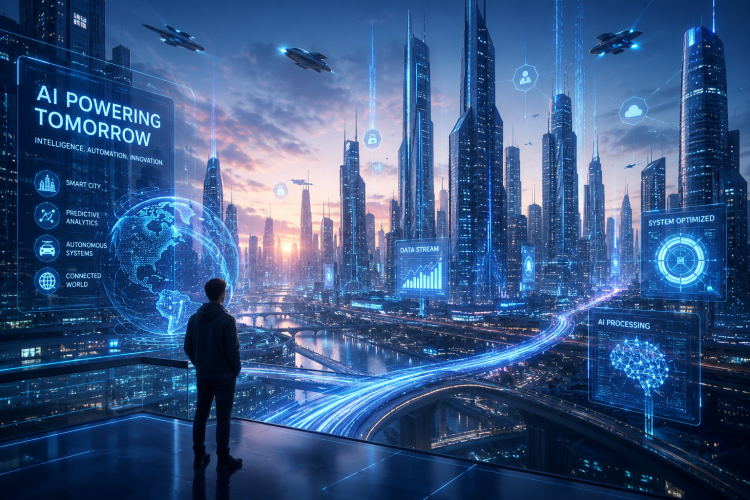
The future of artificial intelligence will be defined by more capable everyday AI assistants, widespread automation across industries, and a major shift toward smaller, efficient models running on local devices, all while reshaping jobs and raising new ethical and regulatory questions. Forbes+2
AI is everywhere in daily life
By 2030, many experts expect people to interact with multiple AI systems throughout the day, not just one assistant. These systems will handle nuanced conversations, remember long-term context, and feel more like partners than tools. reddityoutubeforbes
-
AI assistants will manage schedules, negotiate simple contracts, and adapt marketing or business strategies on the fly. youtube
-
Consumer services like shopping, entertainment, and education will be hyper-personalized through continuous learning about user preferences.fingent+1
-
Robotics combined with AI will bring more autonomous devices into homes, workplaces, and cities, from cleaning robots to delivery drones.engineering.nyu+1
Economic impact and productivity
Analysts project that AI will add trillions of dollars to global economic output over the next decade by boosting productivity and enabling new products and services. Consulting and policy reports see AI as a general-purpose technology, similar to electricity, that cuts across almost every sector.nexford+2
-
PwC has estimated AI could contribute around 15 trillion dollars to global GDP by 2030, while McKinsey simulations suggest roughly a 16 percent uplift in cumulative GDP.fingent+1
-
AI-driven automation will streamline processes in manufacturing, logistics, finance, customer service, and healthcare, freeing humans for higher-value tasks.iedconline+1
-
Regions and companies that invest early in AI skills, infrastructure, and governance frameworks are expected to capture outsized benefits.wevolver+1
Jobs, work, and skills
AI’s impact on jobs will be profound but uneven, with some roles shrinking, others transforming, and new categories emerging. Reports highlight both risks of displacement and opportunities for net job creation in AI-related fields and complementary occupations.nexford+1
-
Forecasts suggest AI could automate a significant share of tasks and potentially affect hundreds of millions of equivalent full-time roles worldwide, especially in routine cognitive and clerical work.iedconline+1
-
At the same time, new jobs are expected in data analysis, AI development, human–AI coordination, and fields that blend technical and domain expertise (for example, AI-augmented healthcare and education roles).nexford+1
-
Many workers may need to reskill or change careers by 2030, with estimates that more than 10 percent of employees globally will transition to new kinds of work.iedconline+1
Edge AI and small models
A key technical shift is the move from massive cloud-only AI systems to smaller, efficient models running at the “edge” on phones, cars, sensors, and industrial devices. This trend supports low-latency, privacy-preserving applications that don’t rely on constant internet connectivity.sdggroup+1
-
Edge foundation models and small language models are being designed to fit within the power and memory limits of consumer electronics, while still providing advanced reasoning and generation. wevolver
-
Combining generative AI with edge computing enables real-time physical intelligence—systems that interpret sensor data and act immediately in factories, vehicles, or smart buildings. sdggroup
-
This decentralization reduces bandwidth costs, improves reliability, and allows organizations to keep sensitive data local, which is especially important in healthcare, defense, and industrial control.sdggroup+1
Intelligent robots and physical automation
Robotics will increasingly benefit from advances in AI perception, planning, and learning, leading to more autonomous and capable machines in real-world environments. Experts anticipate that by around 2030, robots will be able to make higher-level decisions and operate with less human micro-management.engineering.nyu+1
-
Self-driving vehicles, including cars, trucks, and delivery robots, are expected to become more common as AI improves safety and reliability.fingent+1
-
Special-purpose robots will assist with logistics, cleaning, security, and industrial tasks, often coordinated by central AI systems that optimize entire fleets.fingent+1
-
Embodied AI—systems that learn by interacting with the physical world—will allow robots to adapt to new tasks rather than being rigidly pre-programmed.youtubeengineering.nyu
Healthcare, education, and society
AI is poised to reshape key social systems such as healthcare and education, with both promise and challenges. The direction these changes take will depend on regulation, incentives, and how inclusive AI deployment becomes.ai2030+3
-
In healthcare, AI can assist in diagnosis, personalize treatment plans, and monitor patients using wearable devices and edge intelligence, potentially improving outcomes and efficiency.sdggroup+1
-
In education, AI tutors and adaptive learning systems can personalize instruction at scale, offering tailored content and pacing for each learner.nexford+1
-
Governments and organizations are launching initiatives focused on “AI for good” and responsible AI, aiming to ensure benefits are broadly shared and risks are controlled.ai2030+1
Ethics, regulation, and governance
As AI systems become more powerful and pervasive, questions of fairness, accountability, transparency, and control grow more pressing. Policy discussions increasingly focus on balancing innovation with safeguards against misuse and systemic harms.ai2030+1
-
Regulatory efforts worldwide aim to manage issues such as bias in decision systems, privacy violations, misinformation, and safety in high-stakes applications.ai2030+1
-
Organizations are developing governance frameworks, audits, and standards for responsible AI, including rules for data use, human oversight, and red-teaming advanced models.wevolver+1
-
Ethical AI movements emphasize inclusivity, global equity, and preventing AI from exacerbating existing inequalities, aligning with initiatives that promote “AI for all.”ai2030+1
What this means for creators and entrepreneurs
For digital creators, marketers, and entrepreneurs, the future of AI offers both new tools and new competition. Those who learn to orchestrate multiple AI systems, rather than relying on a single tool, will be well-positioned.forbes+2
-
Content creation, design, and marketing workflows will be heavily augmented by AI, making ideation, drafting, and testing faster, while differentiators shift toward strategy, authenticity, and audience relationships.forbes+1
-
Small, on-device models will support personalized customer experiences and autonomous campaigns that adapt in real time, giving even small teams capabilities once reserved for large enterprises.wevolver+1
-
Lifelong learning and continuous upskilling in AI literacy, prompt design, and ethical use will become essential for staying relevant and resilient in the evolving digital economy.iedconline+1
Tim Moseley